
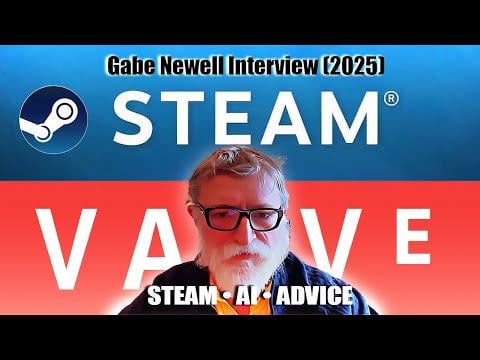
Summary of video:
Why did you choose to be an engineer and what was your journey like?
Gabe Newell started programming in high school as a hobby and initially planned on becoming a doctor. His career in programming began after visiting his brother at Microsoft. He ended up dropping out of Harvard and working at Microsoft for 13 years, finding that he learned more and at a faster pace there than at university. After his time at Microsoft, he founded Valve, along with other research companies.
After joining Microsoft, at what moment did you realize the gaming industry was developing fast, and how did you decide to create games and start Steam?
While working on Windows at Microsoft, Newell noticed that PC game developers were creating their own hardware interfaces, which often led to underperformance. He saw the potential for high-performance games on Windows and ported "Doom" to the platform for free to prove it. This experience, combined with the rise of networking, led him to believe that a new business model focused on product development over sales and distribution was possible. This inspired him to start Valve and create "Half-Life" as an expression of these new ideas.
What advice do you have for young people (in their 20s, international students) who want to achieve success in 2025?
Newell advises young people to learn how to use AI, as it will be a "cheat code" for success in any field. He also recommends that they build something and iterate on it based on user feedback to learn how to create value for customers. Finally, he stresses the importance of surrounding yourself with trustworthy and capable people.
What advice can you give that separates people who achieve success from those who don't?
He suggests that success is not a one-size-fits-all formula but offers some tactical advice. This includes surrounding yourself with trustworthy people, focusing on creating value for customers, and being open to feedback and surprises from them. He also acknowledges that luck plays a significant role in success.
What would you say to the Russian audience, particularly regarding the CIS community and players from games like Counter-Strike and Dota 2?
Newell stated that his advice for the Russian audience is the same as for anyone else: create value for others, surround yourself with great people, and work hard. He also mentioned that Valve has many Russian partners and that he enjoys interacting with CIS players.
For people who don't have access to Bay Area or big tech corporations/universities, what advice do you have for learning and studying? Should they come to the US or can they succeed in their own countries?
He believes that geographical location is becoming less of a barrier to success. He advises people to focus on finding a team globally, delivering value wherever they are, and embracing remote work. He emphasizes that what you work on is more important than where you are located.
Regarding AI, do people need to learn the technical side or just how to use AI tools to their maximum level?
Newell believes that both are important and complementary. While using AI tools will provide significant benefits, understanding the underlying technology will allow for even more effective use of those tools.
For people studying business degrees who want to open businesses or create something useful, what advice do you have before starting businesses or entering the business field?
His primary advice is to focus on creating value for customers. He recommends understanding your unique value proposition, prioritizing customer needs, and avoiding distractions like focusing too early on raising capital. He believes that if you create value, the capital will follow.
What is the difference between billionaires and regular people?
Newell attributes his own billionaire status to luck and the great people he has worked with. He is skeptical of analyses of billionaires, warning against "survivor bias" where correlation is mistaken for causation.
What is your daily routine?
His daily routine consists mainly of working and scuba diving. He lives on a boat and works seven days a week on various projects, including AI, Steam, and brain-computer interfaces. He states that he enjoys his work and it doesn't feel like a chore.
What advice do you have for people in 2025 who spend a lot of time on social media, getting distracted, being lazy, and avoiding work? How can they avoid getting distracted?
He suggests finding more engaging activities and engineering solutions to distraction. Instead of just consuming content, he recommends trying to create it. He also dismisses the idea that younger generations are inherently lazy, noting that this is a common complaint from older generations throughout history.
9 Comments
Everyone knows Gabe, so he doesn’t need exposure but he might help growing a smaller channel!
I think of all the popular tech leaders, only Gabe will entertain small youtuber.
>seemingly small YouTuber
I wonder why, with such an electrifying personality. Always love hearing from Gabe though.
Genuinely curious, was this summary AI generated?
This channel is funny in that it purports to have interviews with influential and powerful men. Which means you need connections of some kind. Just weird the channel has only one interview and 1.5k followers.
Gabe has the same view as I do regarding businesses. If you make a quality product, the profits will follow. So trying to squeeze profits is needless and counterproductive.
This guy needs to work on his S sounds
AI has gotten crazy these days
Valve News Network man will be SEETHING with jealousy.