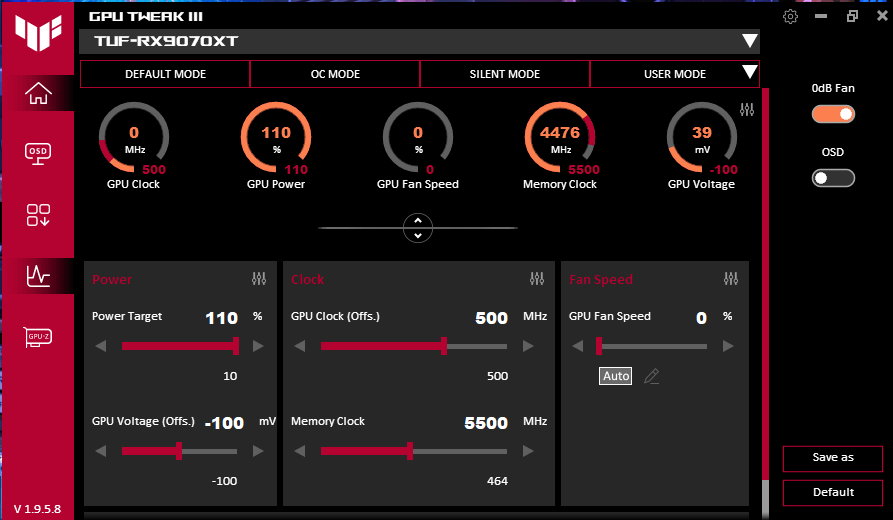
+500 on core is a pretty strong overclock. Most cards are lucky to reach +250Mhz and on average only +100-150 should really be expected, but not guaranteed as the silicon lottery is a thing. I would scale that way down to +200. If it still crashes, go to 175, then 150 and so on by 25hz steps until it is stable.
Also that undervolt may be too strong. Realistically, if you are overclocking, you may not want to undervolt, or at the very least, get whatever overclock you can get stable then try to undervolt in -10 steps. I would zero that, then do your OC, then once you are 100% sure it is stable, then undervolt if you really want to. Or just don’t OC at all and start to tune in that undervolt.
ckae84
Do it in incremental of -25mV, 100 MHz, maybe +5% power limit and change 1 setting at a time. Else it’s hard to determine what is causing the crash.
Another thing, does it crash at stock settings? If yes then there might be other underlying issues. Fix that before thinking about OC.

2 Comments
+500 on core is a pretty strong overclock. Most cards are lucky to reach +250Mhz and on average only +100-150 should really be expected, but not guaranteed as the silicon lottery is a thing. I would scale that way down to +200. If it still crashes, go to 175, then 150 and so on by 25hz steps until it is stable.
Also that undervolt may be too strong. Realistically, if you are overclocking, you may not want to undervolt, or at the very least, get whatever overclock you can get stable then try to undervolt in -10 steps. I would zero that, then do your OC, then once you are 100% sure it is stable, then undervolt if you really want to. Or just don’t OC at all and start to tune in that undervolt.
Do it in incremental of -25mV, 100 MHz, maybe +5% power limit and change 1 setting at a time. Else it’s hard to determine what is causing the crash.
Another thing, does it crash at stock settings? If yes then there might be other underlying issues. Fix that before thinking about OC.