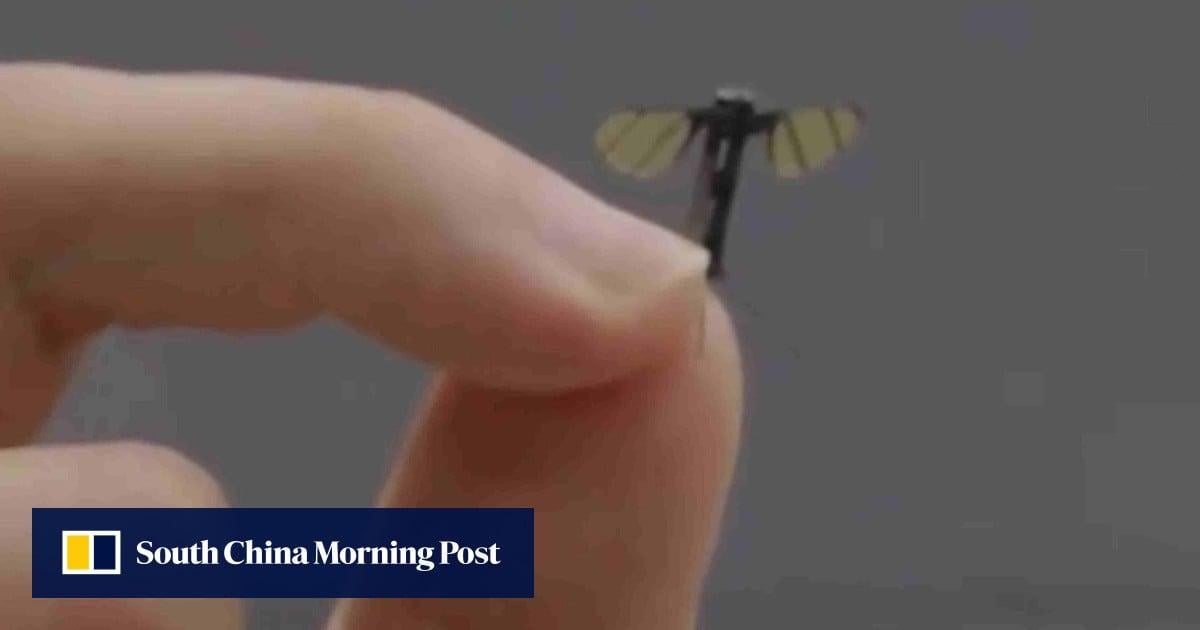
>That little bug hovering over the flowers… might not be an ordinary bug. In the 1970s, CIA’s Office of Research and Development created “Insectothopter,” the first insect-sized unmanned aerial vehicle (UAV) of its kind! It was disguised as an everyday dragon fly.
>When modeling spy tech after real animals, you must consider how the animal behaves in real life. The dragonfly was selected after the initial choice, a bumblebee, didn’t work as well as originally planned. A bumblebee flies in very erratic patterns, so it would have been noticed if it stopped to hover, and, if it flew too close to a person, they may have batted it away fearful of a bee sting.
>Insectothopter was intended to be a listening device. It had a small engine that would make its wings flap up and down, and it was directed and guided by a laser beam. Amazingly, it could fly 200 meters in 60 seconds!
>Unfortunately, our little dragonfly proved not to be operational, because in crosswinds over five miles an hour it, it would get blown off its flight course.
Though the visual images of the concave compound eye is really buggy. It’s like looking through a kaleidoscope on acid. Trippy but hardly state of art surveillance. I mean it’s great for a rave, but not resolute enough to hit with a missile.

3 Comments
Behold! Our super secret spy drone that can only be countered by… a fly swatter.
Well the CIA has had[ robotic Pigeons since the 70s](https://www.cia.gov/legacy/museum/artifact/pigeon-camera/), I’d bet our tech is far more advanced than that.
Actually we’ve even had [Dragon Fly bots since the 70s](https://www.cia.gov/stories/story/natural-spies-animals-in-espionage/) as well:
>**Spy Bugs: Insectothopter**
>That little bug hovering over the flowers… might not be an ordinary bug. In the 1970s, CIA’s Office of Research and Development created “Insectothopter,” the first insect-sized unmanned aerial vehicle (UAV) of its kind! It was disguised as an everyday dragon fly.
>When modeling spy tech after real animals, you must consider how the animal behaves in real life. The dragonfly was selected after the initial choice, a bumblebee, didn’t work as well as originally planned. A bumblebee flies in very erratic patterns, so it would have been noticed if it stopped to hover, and, if it flew too close to a person, they may have batted it away fearful of a bee sting.
>Insectothopter was intended to be a listening device. It had a small engine that would make its wings flap up and down, and it was directed and guided by a laser beam. Amazingly, it could fly 200 meters in 60 seconds!
>Unfortunately, our little dragonfly proved not to be operational, because in crosswinds over five miles an hour it, it would get blown off its flight course.
Who knows what the fuck we have now. Probably advancements in [remote viewing](https://www.cia.gov/readingroom/docs/CIA-RDP96-00789R002200070001-0.pdf).
Though the visual images of the concave compound eye is really buggy. It’s like looking through a kaleidoscope on acid. Trippy but hardly state of art surveillance. I mean it’s great for a rave, but not resolute enough to hit with a missile.