
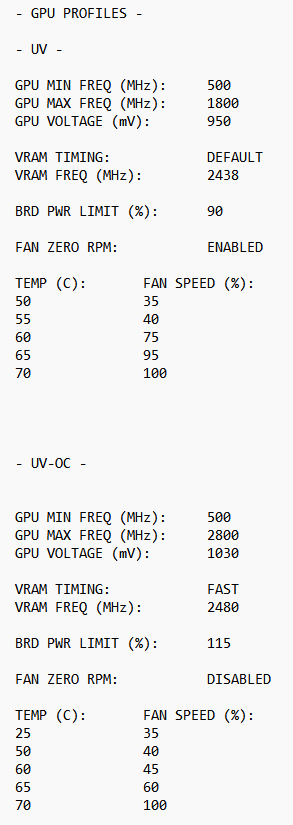
The UV profile is for the sole intent of keeping power draw as low as possible under low/light gaming loads, to extend the thermal headroom before 0RPM disables (50C). Cooling is very aggressive past 55C, as >55C is highly abnormal for such loads.
The UV-OC profile is the minimum possible voltage my chip can handle, and maximising core clocks by proxy of reducing TPD – cooling ramps up significantly past 60C, as this is where thermal equillibrium is achieved on this profile during a FurMark stress test. Real world performance hardly goes beyond 55C.
Both profiles are entirely stable for their stated use cases.
1 Comment
Edit: For my UV profile, I ended up slightly upping my core clk target to 2,000, not anticipating any loads approaching it, but to allow for peak spikes. Most importantly, I changed the VRAM timings to FAST. This has slightly reduced VRAM thermal efficiency under no load, but greatly incresed it’s load efficiency. Where previously, I saw higher temperature ranges, peaking faster, with fast VRAM, due to now reduced graphics render time, my low load temperature peaks have reduced from 45 to 40, despite a higher average, which is exactly what I want for a peak thermal efficiency profile.