
Everything below is based on NVIDIA’s RTX Blackwell GPU Architecture white-paper (Feb 2025)[¹] and early board-partner pricing.
Digging into NVIDIA’s RTX 50-series reveals changes far beyond mere price hikes or branding adjustments. NVIDIA hasn't simply raised prices—they've eliminated a tier and slid every other SKU down to fill the hole. This isn't marketing spin; it’s a fundamental restructuring of their GPU lineup.
What's Changed?
- RTX 5070 Ti and RTX 5080: Both use the GB203 die (378 mm²)[¹].
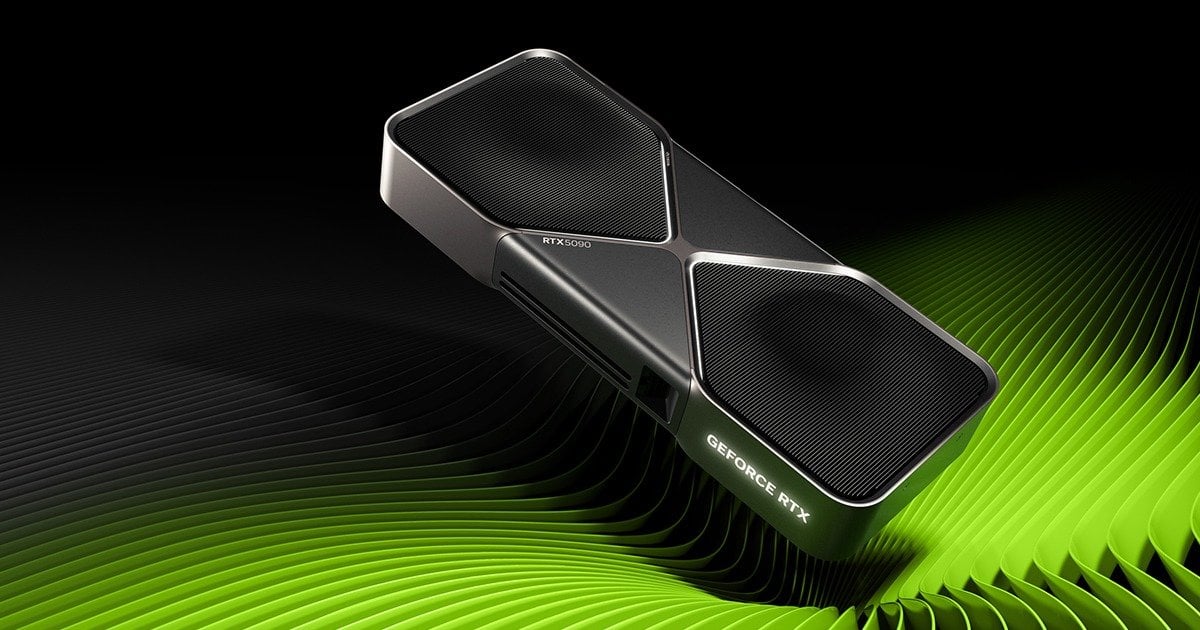
- RTX 5090: Uses the massive GB202 die (750 mm²)[¹].
- RTX 5070: Built on the smaller GB205 die (263 mm²)[¹].
Notably, there's no GB204 die, creating a substantial 372 mm² gap between the mid-range GB203 and the flagship GB202.
Historical Context
Traditionally, NVIDIA GPU tiers have been structured as follows:
- 60-class: Small die, mainstream affordability
- 70-class: Mid-sized die, balanced price-performance
- 80-class: Large die, historically offering near-flagship performance significantly cheaper than the top-tier model
- 90-class: Flagship die, largest silicon, maximum performance
Ada (RTX 40-series) had already shifted the 80-class to a smaller AD103 die, breaking the long-held tradition of large 80-class dies. Blackwell doubles-down by entirely removing an 80-class die.
Why Does This Matter?
Price Anchoring in Action:
The GB202 die is literally 98.4% larger than the GB203 die (750 mm² vs 378 mm²). NVIDIA leverages this enormous gap, pricing the RTX 5090 at $1,999, making the $999–$1,099 RTX 5080 appear relatively reasonable—even though the 5080 still uses mid-tier silicon.
Efficiency and Performance:
The RTX 5080 delivers ≈ 15 TFLOPs per 100 mm², triple the RTX 3080’s ≈ 4.7 TFLOPs per 100 mm². The density leap comes from process and clock gains, but the 5080 is still a mid-die sold at a near-flagship list price
Table 1: Die sizes by tier and generation
| Generation | 70-Class Die | 80-Class Die | 90-Class Die | Gap vs. 90-class |
|---|---|---|---|---|
| Turing | 545 mm²TU104 ( ) | 545 mm²TU104 ( ) | 754 mm²TU102 ( ) | 209 mm² |
| Ampere | 392.5 mm²GA104 ( ) | 628 mm²GA102 ( ) | 628 mm²GA102 ( ) | 235.5 mm² |
| Ada | 294.5 mm²AD104 ( ) | 378.6 mm²AD103 ( ) | 608 mm²AD102 ( ) | 229.4 mm² |
| Blackwell | 263 mm²GB205 ( ) | 378 mm²GB203 ( ) | 750 mm²GB202 ( ) | 372 mm² |
Notice how the die-size gap dramatically increases with Blackwell.
The gulf between mid-tier and flagship silicon nearly doubles with Blackwell.
AMD’s Counterpoint
AMD's RDNA 4 Navi 48 GPU, featured in the recently released Radeon RX 9070 and RX 9070 XT, has a die size of about 356.5 mm². Additionally, Navi 48 uses a 256-bit memory bus compared to GB202’s 512-bit bus, significantly influencing BOM cost. AMD’s approach clearly targets mainstream performance, avoiding direct competition with NVIDIA's extreme flagship.
Final Thoughts
NVIDIA's RTX 50-series isn't just about price hikes; it's a fundamental reshaping of GPU tiers:
- The traditional large-die 80-class GPU no longer exists.
- Mid-range silicon is now priced and marketed as high-end.
- The RTX 5090’s massive die creates an intentional performance and pricing gap.
Evaluate the silicon, not the sticker—because NVIDIA just moved the goalposts.
[¹] Source: NVIDIA RTX Blackwell GPU Architecture White-Paper, Tables 3, 5 & 7 (Feb 2025)
36 Comments
Oh no why would scumvidia do such thing!
Gamers Nexus did a cuda core count comparison that paints the picture better.
How likely will they make a 5080 Ti or Super? Are they even going to plug that massive gap in with such a card?
I think this may be partially due to yields, as the NVIDIA Cards are using quite mature processes. An extra tapeout for a chip inbetween only makes send if the yields for the higher one are too low or the lower one can’t hit its spec repeatedly. So for this example, the 5070 is a high bin of the 205 and the 5070ti and everything that will come out inbetween will be lower bins of the 203 chip, so no 204 necessary.
They did this back in the day with the GTX 680 too.
They use a monolithic architecture; they will soon hit a wall like Intel did against AMD. I hope so hard Nvidia will crash hard enough to reconsider using the same architecture again and again without any real update.
AMD is catching up, but most games are designed and optimized for Nvidia
The 5080 should be 750 max, the 5070 Ti 600 max and the 5090 max 1200
The 790mm die is created for AI. We get the binned version of it. Without AI customers this wouldnt exist anyway because of terrible yields.
Think of the investors

Interesting analysis, thanks for posting.
The traditional 80 die now goes into commercial market?
I miss 80ti class, that was just a but down version of the big flagship die. It was always my favorite card class to go. Which explains why my evga 3080ti is the last Nvidia gpu I bought…
That is something easily noticeable and I made post about this on a different subreddit – gap between 5080 and 5090 is too big. Both in terms of performance and pricing.
5070->5070 Ti->5080 is like a smooth ladder and then consumers need to jump over a canyon to reach 5090. There is a huge space left for 5080 Ti or for „Super refresh” somewhere in the future. Although, using a new die just for refresh would be wild… but with current Nvidia you can expect anything.
For the first time in my entire life I see the ‘buy now’ button on the Nvidia marketplace. And it has been like this for 2 days.
That shows how extremely terrible the RTX 5070 must be
https://preview.redd.it/87b9srnmhywe1.jpeg?width=1440&format=pjpg&auto=webp&s=c5038e2a813b9452108cef4d37d769f0aed8b324
That’s a surface-level read which doesn’t really grasp the larger context.
The reality is that the [cost per transistor has stagnated since 2012](https://www.tomshardware.com/tech-industry/manufacturing/chips-arent-getting-cheaper-the-cost-per-transistor-stopped-dropping-a-decade-ago-at-28nm). This means that you *expect* new dies with newer manufacturing techniques to be smaller than previous generations, while still providing more performance:
* RTX 3070 (Ampere): 8 nm process, 44.4M transistors per mm² – 17.4 billion transistors on 392 mm² – 5888 shading units
* RTX 4070 (Ada Lovelace): 5 nm process, 121.8M transistors per mm² – 35.8 billion transistors on 294 mm² – 5888 shading units
So the die got 25% smaller, but still has double the transistors and the same number of shading units (which in this case are more powerful in the newer Ada Lovelace architecture, but take more transistors a piece).
Even though the cost per transistor is the same, you still want to switch to a new process for higher power efficiency, which can be turned into higher clock speeds at similar TDP:
* RTX 3070: 1500 MHz base clock, 1725 MHz boost, 220 W TDP
* RTX 4070: 1920 MHz base clock, 2450 MHz boost, 200 W TDP
But since Ada Lovelace (RTX 4000), there has been an additional problem: Transistor prices are no longer just stagnating between different generations of manufacturing processes. The *same* 5 nm manufacturing process has been getting *more expensive*, with about 15-25% price increase between 2021 and 2025.
The 80 and 90-tier split in capability was a largely sensible response to these trends. The 80-series basically gives you the “reasonable high end” experience, which can run just about any graphics up to 4k. While the 90-tier is the “I don’t care about value per $, I want ultimate performance”-tier.
An 80-tier card with a chip that’s sized in between the 70Ti and 90 would see fewer buyers, since it would also be more expensive. And at that point they’d just go for the 90-tier card.
At the same time, these ultra-high end cards have become more ‘reasonable’ purchases because the expected lifespan of a GPU has dramatically lengthened compared to the 2010s and before. You can now expect a high-end card to deliver extremely good quality for 5 years and quite likely still be competitive with decent midrange cards after 8-10 years. So because you are likely to stick with a card for so long, getting the ultra deluxe option is now fairly attractive.
> AMD’s RDNA 4 Navi 48 GPU, featured in the recently released Radeon RX 9070 and RX 9070 XT, has a die size of about 356.5 mm².
The RX 9000 cards are liked for their pricing, but they show that AMD is still behind in technology.
They need a die that’s almost as big as that of the RTX 5080/5070Ti-sized, to compete with the 5070Ti/5070 on price and performance. They made some positive decisions to improve the value proposition for gamers (like not overspeccing on expensive GDDR7 VRAM), but the cheap pricing on those cards is a bitter pill for them to swallow.
Make no mistake: AMD and Intel are not selling their GPUs at these prices because they like gamers more. But because they have to do it to claw back *any* market share from Nvidia.
Thanks for the insight
There is nothing new here, this was brough up using the number of cuda core instead of the die size (wich both correlate anyway) since the first accurate leak in Autumn 2024.
Stupid post since all arguments fall apart if the 5090 did not exist.
This arguments asks NVIDIA to drop 90 series cards and sell them at twice the price under the Titan brand. According to your argument, NVIDIA would be better off and Blackwell would be a much better generation.
And that’s stupid.
Nivida runs 80% of their 50 gen marketing by bragging about the 5090 being even better. Which it is.
The other 20% are letting multi-framegen carry the 60-80 tier cards, because computationally the improvement is negligible. Which they know will only see limited success, as those cards are not even priced competitively as budget options.
But thats intentional, they let the lower performance tiers become stale and overpriced so that relative to that the 5090 is the only card that is even close to being cost-efficient.
40 gen technically did the same thing already, but with 50 series Nvidia is rubbing it in our faces that they control the market and if were gonna buy anything itll be on their terms.
And they know they only have two main groups of gamers to cater to. Budget-ish gamers, who will buy 5060-5080, whichever is the biggest they can afford, and gamers with no budget restrictions whom they can feed 5090s.
And with this they can pry the most money out of both groups.
does anyone care that this entire post was written by ai?
You know it’s one thing for GPUs to become overpriced but to couple that with half-baked games releasing with no significant strides to make them optimized not to mention them costing 70 usd now? Man, please take me back to 2008.
Its gotten so bad, there’s not one GPU in the 50 lineup that makes sense other than the 5090 and that thing can barely stay not on fire.
Im pretty much a lost customer to nvidia. They are pissing on people who don’t want to spend organ donor prives on a viseo cars.
People keep buying 💩 so nvidia will keep selling it
Glad I have the 5090.
Nvidia invented these “tiers” yet everyone on reddit seems to think they’re fundamental, natural parts of the universe. Each tier is what Nvidia says it is, idk why people insist on measuring things and comparing numbers to determine which tier it’s “supposed” to be in. What Nvidia says is the word of God when it comes to what tiers are.
In an ideal world the difference between the 5080 and 5090 maybe 75-80% the performance of the 5090. I think that would be fair. The 5080 should have had more VRAM than the 5070ti, at minimum 20 GB.
In the marked to upgrade from 3070 (lack of video memory is SEVERE, esp in games like FFXVI, even 1080p isn’t cutting it) . I’m really torn between 9070XT and 5070Ti. In my country, 5070Tis are like 100-150€ more than 9070XTs. Everybody says nVidia is the way to go to future proof: ray tracing, great DLSS tech. Yet AMD offers great power to performance ratio in comparison to nVidia.
So I don’t know what to do. Part of me wants to ditch nVidia because of these shenanigans. Part wants to get good performance.
I aim to 4K/1440p upscaled gaming with HDR and 60-75 FPS target.
Nvidia bad!
Already ridiculously expensive GPUs with terrible supply being shrinkflated. What a time to be alive!
The last paragraph just sounded like the class struggle. No more middle-high class, it’s either super rich, and the middle class is far less attainable. Seems just about right.
mmmmm, the 5080. The modern 2060 for 1700 dollars minimum 💀
What nvidia discovered is that instead of making the low/mid tier products provide great price/performance, you can gimp them and make your top tier, overpriced cards be the ones that are actually somewhat good in price/performance.
Upsell anyone that can afford it, the rest can fuck themselves.
I’m going with the 5090, because I don’t built or upgrade PCs often. Perhaps every 10 years or so.
The alternative is…to get an AMD card? There is no way I’m doing that.
Is using ChatGPT to farm karma the new meta?
https://www.reddit.com/r/pcmasterrace/s/uwXXDnC3yo
Nvidia sold everything up by one tier for 40 series, and one more for 50 series (see the boxes marked in red), hoping customers won’t notice. So the 5080 is really a 5060 or 5060 Ti in the old scale.
There has to be a 5080 Ti (Super?) with closer to 4090 performance coming to fit between the 5080 and 5090, it’s just to big of a gap…