
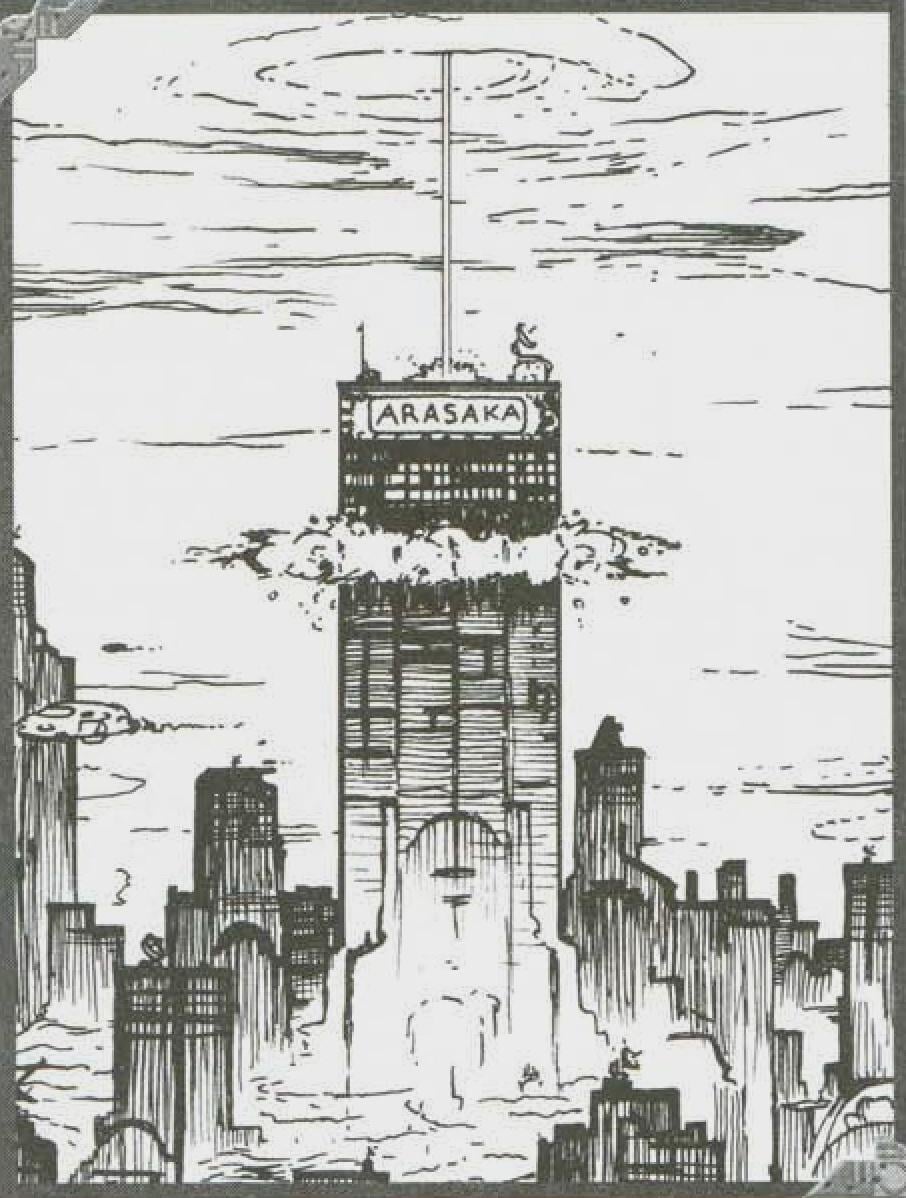
I have been playing through the campaign for the second time and I realized that Silverhand is treated as no more than a self centered terrorist and is implied that is used by Militech as a pawn, that Bartmoss's virus just paved the way for the corporations to take over the Net, that the only reason Rouge is alive is because she did some favors for the corpos… Are we to have as the moral of the story that you cant win against corporations, just survive?
26 Comments
Surviving long enough to do significant damage over time
i feel like an underlying message is no matter what you do, maybe certain outcomes are necessary or unavoidable and radical decisions may just make things worse, and most importantly that it can be done wrong or backfire. also that the little guy that thinks he can take on the big guy not only doesnt always win but *rarely* wins at all. the difference you make in night city also i feel follows this theme.
That’s part of cyberpunk as a genre, but there’s a bit more to it than that that honestly I feel like this game does really well
The main problem with Johnny’s methods is that he has no actual plan. He’s all about burning down the system, destroying the structures that keep corporations in power, nuking Arasaka, but then he… doesn’t have any followup plans. He’s just angry, and all of his ideas amount to Break Stuff. He has no ideology beyond “This is bad” to replace the capitalist oligarchy that the Cyberpunk world is in the grip of. He wants to break, kill, and destroy, and who gives a damn what happens to him because what’s the point, but that line of thinking ignores that Arasaka, Militech, Google, Apple, whoever, can always make a new one. You need an ideology, a plan, and you need to survive in order to implement it.
In 2077, it’s pretty consistent that the people who end up used, broken, their ideals trampled on, are the people who stick their necks out for no clear gain. Jefferson Peralez makes himself a target, and he’s summarily dealt with one way or another. Johnny pisses off Arasaka, and he’s killed and they make a backup of his brain to torture. Judy makes a big move for Clouds, but there’s no way for that to actually end well, because she doesn’t think through all of the What Ifs. If V ends up trusting Arasaka or the NUSA, they’re taken off the board one way or another.
But if you go with the Aldecaldos, V gets off pretty much scott free, with the best hope for the future of pretty much any ending. There’s no guarantee that they’ll find a cure, but V ends up living free, and with the help of the Aldecaldos, actually makes a fairly significant strike against Arasaka. That whole ending is a glimmer of hope, and it’s made possible because *the Nomads thought it through.* They came up with a comprehensive plan, they had a goal, and they accomplished it. They have an ideology, and they live in a way that doesn’t benefit the corpos and lets them live largely off the grid – an INCREDIBLE achievement in a society as technology-dependent as this. They’re smart, they keep their ears to the ground, and they survive.
There are no happy endings in Night City, but there’s the glimmer of a hope that someone might be able to change that some day. There are threads to follow that might actually pan out to make a real difference, and with time, maybe things won’t be so bleak.
i think the moral of the story is there is no winning at the end just making sure V sees tomorrow
The watchword for the setting is “Cyberpunk is a warning, not an aspiration.” Pondsmith quote, of course, man’s got tremendous gravitas.
But, with that in mind: pretty central to the setting, the reason you keep hearing it called the Dark Future, is that it is *already* too late. It does not have anything in particular to say about the value of revolution and rebellion itself, because what it is choosing to examine instead is what it’s like to be a revolutionary for a cause that’s already lost. And, more generally, the idea of “how do you choose to make the most of the time you have left when you know it’s ending soon?”
The entire world is locked into a death spiral there’s no pulling up from, and all the various stories told within it are about the poignancy of knowing it’s over and choosing to live well in the time you have. Hence the “glory and death” culture of mercs, and No Happy Endings, and, obviously, the entirety of V’s story. It’s about holding up a glass to toast the comet that will destroy the planet as it begins to light up the sky, and getting in one last kiss with the person you love before the water rises over your heads for good, and carving your name onto a stone no one else will ever see just because *you* are happy to know it will be there when you’re gone.
If it has anything to say about the value of revolution, it is that we’re not there *yet,* we still have a lot of chances and a lot of hope. The way every story in the setting ends up hurting, even as it’s often beautiful, is an incentive to make sure *now* that it never gets that far. Do what you can in your real life so this *never* comes to pass.
But, more than that, it’s about things ending. It’s about the way there is still beauty and joy right up until the last moments. It’s about the way everything dies in the end, and knowing that however scary it is, you can die with a smile. It’s not about fixing anything. It’s just about making sure that before you die, you *live.*
Nah, you can’t think about it like that Choomba. Look, the corps are a serpent, they got everything coiled up ready to be devoured.
Now how smooth a meal you wanna be? I’ll tell you I wanna be hard to swallow. I wanna take one of that bastards fangs with me. The reason why don’t matter in the end; I figure whatever keeps the fire under your ass from going cold is just fine.
No hands are gonna be clean and everyone is either hazing or getting hazed. If you can haze the corps instead of the poor bastard shilling paste he can’t afford for not enough eddies, so be it.
Cyberpunk genre is a warning about what the world can be
So cyberpunk stories will never have a good end, is always the worse that the world can offer
The theme of cyberpunk as a genre isn’t that revolution is unnecessary, it’s that sometimes a little revolution *is* necessary even if it’s doomed to fail
Silverhand is treated as no more than a self centered terrorist because he practically is one. Revolution is not just a tearing down of the current order, but the establishment of something better (or new). Silverhand had NO plans, he was angry and wanted to lash out at the symbol of capitalism. He had this grand delusion that if he just destroyed what he thought arasaka was, then the world would be a better place. But that’s not how it works.
What he did didn’t change anything, they just built a new tower. Bigger. Brighter. He places too much emphasis on the symptom (corporations) and not enough on the cause (capitalism).
Cyberpunk, both 2077 and the genre, is a future that has yet to come. Like others have said, a warning. Not an aspiration. The game has strong revolutionary themes, but I don’t think it doesn’t do a great job of elaborating on anything more than the themes.
You also do all stuff for cops, cops give no XP, everything about how they are actually private police is not explained and they seem like “good people doing their best”
I still want a reverse Cyberpunk mode: Gangs are fren (or at least you can join one), cops give XP and loot.
Yes
Not only because the game is a distopia, but because Johnny is a blanquist.
If you want to change the system, you need an organized working class. Usually through a vanguard party and a really strong mass movement. Johnny had the masses for a while, but with no centralized plan to topple and take over, with the intent maintaining some basic infrastructure to feed and house people, revolutions dont go far.
Can’t win just trying to make things a little better. Even in cyberpunk movies\shows where the main hero is not a rebel but instead a cop like *Ghost in the shell* and *Robocop* there isn’t any end to the actual dystopian setting….it just goes on
I thought this was luffy doing gum gum battle axe to arasaka
Cyberpunk (as a genre) is essentially hardboiled science fiction, not to be confused with hard science fiction. A staple of hardboiled fiction is the lack of ontological morality in the world and its characters. Phillip Marlowe isn’t here to take down the mob or root out police corruption. He’s a regular, flawed cat navigating a fallen world and hoping only to preserve his tattered soul and scope some gams along the way. If Marlowe started assassinating mob bosses it wouldn’t be hardboiled fiction. If Johnny Silverhand dismantled Arasaka and installed a co-op stakeholder enterprise gun manufacturer, it wouldn’t be Cyberpunk.
The whole theme is “no happy endings”
I don’t see it as anti-revolutionary, more that revolution comes at a price. The game isn’t glorifying the system, just showing how entrenched the system really is. Nuking one tower doesn’t fix the problem. Johnny’s problem – and this isn’t just 2077, but in the tabletop as well – is that he’s not a true revolutionary, he just uses it to get what he wants, to aggrandize himself. There’s a reason Morgan Blackhand was missing from 2077, along with a few other characters from the tabletop – 2077 wasn’t about the revolution, it was about just how institutionalized and systemic the problem really is.
I wouldn’t call it anti revolutionary. Moreso the hopeless nature of that world.
Cause the same shit happens in real life, look at Mangione. Man did something a lot of people seethe about doing and is now the media controlled by the powers that be are desperately trying to paint him as a “loser” and mentally ill, when he’s fucking right. Now that now one is buying their shit they’ll execute him to send a message and set an example of “stay complacent and complicit or end the same way little sheep.”
It’s more than a story, it’s a warning by Mike Pondsmith on what the world can become.
It’s not about saving the world, it’s about saving yourself.
It’s an anti corporatist game and overall anti authoritarian game.
I never saw that as anti-revolutionary. I also think it’s kind of reductionist to say that Johnny is only a self-centered terrorist. Like, yes he can be incredibly self-centered, and yes he does commit acts of grave terrorism. But he is *also* an idealist, he’s also sad at the things Night City has lost in its surrendering of self to the corps. Johnny Silverhand is an *incredibly* complex character, his moral stances often shifting from person to person, subject to subject. He’s shown as being both narcissistic manipulator, and a kind and caring friend. I feel like through him the game is trying to ask whether or not it is possible to be a revolutionary without acts of terrorism. It’s picking apart the complexities of oppressive governance, and the violence that brings.
That’s actually part of the critique of cyberpunk genre. That it’s essentially ideologically capitalist realism. “Shit’s fucked, it’s so so so fucked, oh what shall we do, it’s already so fucked”. And capitalist realism is pretty fucking bad, actually, it’s a defeatist ideology that doesn’t really have ground underneath it.
Doesn’t mean that it’s all cyberpunk the franchise ever is, of course. And there is artistic beauty to be found in any ideology, even a bad one. I think the feeling of defeat is a very interesting human emotion worth exploring in great depth, which makes cyberpunk really good still, even if you don’t agree with the (a) message.
Johnny has a quality common to a lot of iconclasts: He’s amazingly astute in his ability to observe and describe the rot that permeates his society and make you feel that something is terribly wrong, but he has nothing to offer in its place.
Not that “burn it all down” is, therefore, wrong, but this is where it can go.
I feel like one of the main themes of the game is the value of life, and not wasting it. At the beginning of the story, V is another cog in the machine of Night City, taking names and kicking ass in the hopes of reaching the same heights as legends like Morgan Blackhand or Johnny, risking life and limb in the process. So much so that they’re desperate enough to take a job full of mean red flags, including but not limited to messing with the Emperor’s son and a fixer with a horrible track record. V doesn’t care though, because nothing else but climbing the ladder matters, and if they can’t then they might as well die in a blaze of glory like their and Jackie’s hero’s.
Johnny was the same, and sought to burn the world down or get burned himself, because anything else would hurt his pride. Even after suffering as a child soldier and deserting, Johnny still saw himself as a soldier in a war, and used his charisma and impressive, uh, musical talent to wage that war. He couldn’t see that he had become just as manipulative and egotistical as the generals who used empty promises and morals to wage wars where innocents like he was got hurt, all while lying to themselves that they were actually changing anything. Johnny just let his rage consume him, to the point he was unable to form or maintain any meaningful relationships, and instead filled his life with empty pleasure to distract himself from his pain.
But now, stuck in V’s head 50 years later, he is ripped from his warped reality and sees what impact he really had on the world: none. The world is still at the mercy of corporate power, and no one has really changed, or tried to fight back. His music is only remembered by sad grandpas, and everyone that he really ever cared about, Rouge, Kerry, and Alt, have now escaped his abuse and reject him.
V, meanwhile, is faced with the harsh reality that their life, and even worse their individualism, will soon end through Johnny’s personality overtaking theirs. So, they fight like hell to save it; killing, betraying, and bleeding in order to survive. But now, they are accompanied by someone that, like them, sought to make an impact on the world through fire no matter the cost, and paid dearly for it. Johnny’s life, his mistakes, regrets and sins are laid bare to V, and V’s to Johnny. They both cut through each other’s bullshit, and in turn cut through their own.
In the end, both of these people wasted their lives, and paid for it. No matter what rep they had, V and Johnny and both characters with unceremonious deaths in a city built on unceremonious deaths. That’s why the best endings are when V or Johnny get the quiet life.
A lot of people point to The Star as the most satisfying ending, and V enjoying 6 months of life still underlines the message of valuing life, but the combo of Don’t Fear The Reaper and Temperance is in my opinion way more appropriate. In that ending, after attempting to go down in a blaze of glory, Johnny and V are faced with the dilemma of V only having 6 months to live and the body now belonging to Johnny. V could live 6 more months and Johnny could have his heroic sacrifice, dying in a blaze of glory to save his friend. Or V, realizing that their chance at life is over, gives Johnny another one in order to give him the opportunity to live the life that they both should have lived in the first place, instead of just surviving like animals.
This changes Johnny, and finally gives him real responsibility to honor V’s sacrifice and, consequently, leads to his redemption. A lot of people have problems with him ghosting everyone, but that just signifies that Johnny is still a coward and has survivors guilt, but is slowly changing. He grows up, and truly lives rather than just survive. He learns to value life, which is what I think is one of the biggest takeaways from the game. To value your life and to not waste your time on this earth, like the original Johnny and V did.
The best things that happen to V are the connections they make with others. They actually affect people’s lives for the better while Johnny’s violence has achieved nothing. And the only way for Johnny to move on and grow as a person is to come to terms with the marks he left on other people. I always read it as saying that human connection, the thing Night City is built to destroy, is the ultimate form of rebellion. Or maybe I’m just projected what I wanted to see.
Yes cyberpunk is a dystopia. There are no happy endings. It’s a warning.
“The Roleplaying Game of the Dark Future” is the tagline for the series. The moral isn’t that revolution is useless. The moral is that the revolutionaries have already lost. The Dark Future is here to stay.