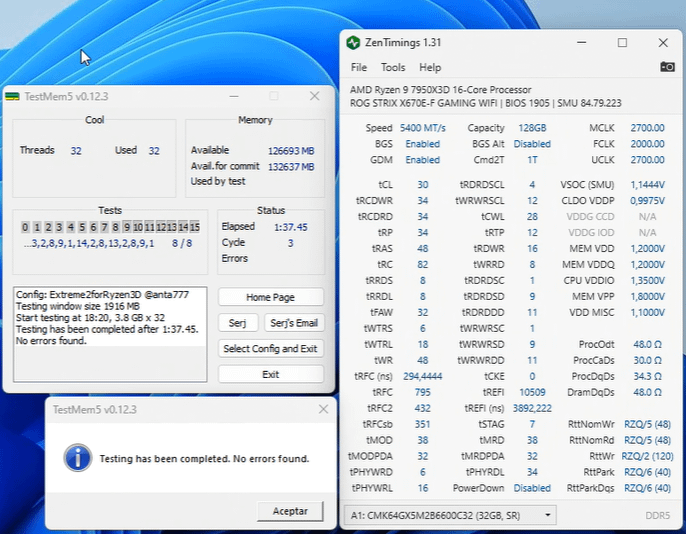
I have been trying for several days to get my RAM to work at a decent speed (I don’t want to beat any speed or latency records, just for it to work reasonably) and after hours and hours of testing the most I have achieved is 5400MT/s with mediocre bandwidth and latencies.
It is very likely that the problem comes from the fact that I do not fully understand the relationship between voltages and impedances and how voltage values must change when an impedance changes and vice versa. I am aware that having 4 modules from different kits (2+2) adds complexity to the already complex matter of driving 4 DIMMS, but the way it fails makes me think that it is not due to this but because the values I enter are not appropriate and that is why I come to ask for help, to see if someone with greater knowledge than mine is able to give me a logical explanation of the situation so I can continue trying to reach 6000MT/s with between 55 and 65ns of latency and a normal bandwidth for that speed.
The specs:
7950X3D (no OC, mainboard default settings)
128Gb from two 64Gb (2x32Gb) Corsair Vengeance CMK64GX5M2B6600C32 kits 6600@32-39-39-76 1.4V Hynix A Die (confirmed with Thaiphoon Burner)
Asus Rog Strix X670E-F Gaming Wifi motherboard with the latest Bios available today (1905) with Agesa version 1.1.0.2b
Asus TUF RTX4090
Corsair HX1500i
Corsair H150i Elite LCD XT
Although it is not necessary, I had an unused RAM cooler over here and I installed it as well (Corsair Airflow)
Some time ago I started trying because I thought that it wouldn’t be so complicated and I would be able to make it work, but after a couple of days reading and reading, trying and trying without making any progress, I decided to create an Excel sheet where I could write down what I was doing to not repeat the same values over and over again.
After all this testing, as I say, I have the feeling that I don’t fully understand how the voltages work and how the impedances must be changed as I increase the VSOC and VDDIO. I have read dozens of guides (there is not as much material for DDR5 as for DDR4) and I don’t know how many forum threads of people who have managed to make 4x32Gb modules work correctly. I took values from here and there for testing when I thought it made sense, but although I have made some progress (at first I couldn’t go above 3600 MTs), it seems that I have been stuck at 5400 for 2 days and I can’t go beyond that.
Something I don’t understand very well is why I can’t just go up to 1.4v VDD, VDDQ and VDDIO, put the VSOC at 1.25v and the VDDP at 1v to reach 6200 or 6400 even if it is not fully stable and then go down from there adjusting the rest of the values. If I set those mentioned values I have only managed to get it to start at 3600MTs, as soon as I increase the frequency it no longer does POST. This is what makes me think that my board or the IMC of my cpu are very delicate with the impedances that I apply and I have to set some value that allows those voltages at those exact frequencies.
Please can someone shed some light on this dark, dead end alley I seem to be on?
Obvious_Drive_1506
You can try increasing soc voltage to 1.25v just to see if it helps. But you’re probably not gonna get much more above 5400 maybe
ThisCupIsPurple
From what I’ve heard, running 4 DIMMs makes it significantly harder to achieve higher speeds.
You’d be better off with 2x48gb modules.
NobisVobis
This should not come as a surprise. 5400 is good for that much RAM on AM5.
Profetorum
I’m surprised 5400 even works, try a ycruncher vt3 run
nhc150
Running 4x dual-rank sticks puts too much stress in the IMC. You’re at the mercy if what your IMC can handle, and it’s entirely possible that no amount of voltage FAFOing can help.

6 Comments
I have been trying for several days to get my RAM to work at a decent speed (I don’t want to beat any speed or latency records, just for it to work reasonably) and after hours and hours of testing the most I have achieved is 5400MT/s with mediocre bandwidth and latencies.
It is very likely that the problem comes from the fact that I do not fully understand the relationship between voltages and impedances and how voltage values must change when an impedance changes and vice versa. I am aware that having 4 modules from different kits (2+2) adds complexity to the already complex matter of driving 4 DIMMS, but the way it fails makes me think that it is not due to this but because the values I enter are not appropriate and that is why I come to ask for help, to see if someone with greater knowledge than mine is able to give me a logical explanation of the situation so I can continue trying to reach 6000MT/s with between 55 and 65ns of latency and a normal bandwidth for that speed.
The specs:
7950X3D (no OC, mainboard default settings)
128Gb from two 64Gb (2x32Gb) Corsair Vengeance CMK64GX5M2B6600C32 kits 6600@32-39-39-76 1.4V Hynix A Die (confirmed with Thaiphoon Burner)
Asus Rog Strix X670E-F Gaming Wifi motherboard with the latest Bios available today (1905) with Agesa version 1.1.0.2b
Asus TUF RTX4090
Corsair HX1500i
Corsair H150i Elite LCD XT
Although it is not necessary, I had an unused RAM cooler over here and I installed it as well (Corsair Airflow)
Some time ago I started trying because I thought that it wouldn’t be so complicated and I would be able to make it work, but after a couple of days reading and reading, trying and trying without making any progress, I decided to create an Excel sheet where I could write down what I was doing to not repeat the same values over and over again.
This is the sheet:
[https://docs.google.com/spreadsheets/d/10gBxmR_8D6AkZo_7IZfr_y0uQW2ZXbIMDM1YZ0UVuqw/edit?usp=sharing](https://docs.google.com/spreadsheets/d/10gBxmR_8D6AkZo_7IZfr_y0uQW2ZXbIMDM1YZ0UVuqw/edit?usp=sharing)
After all this testing, as I say, I have the feeling that I don’t fully understand how the voltages work and how the impedances must be changed as I increase the VSOC and VDDIO. I have read dozens of guides (there is not as much material for DDR5 as for DDR4) and I don’t know how many forum threads of people who have managed to make 4x32Gb modules work correctly. I took values from here and there for testing when I thought it made sense, but although I have made some progress (at first I couldn’t go above 3600 MTs), it seems that I have been stuck at 5400 for 2 days and I can’t go beyond that.
Something I don’t understand very well is why I can’t just go up to 1.4v VDD, VDDQ and VDDIO, put the VSOC at 1.25v and the VDDP at 1v to reach 6200 or 6400 even if it is not fully stable and then go down from there adjusting the rest of the values. If I set those mentioned values I have only managed to get it to start at 3600MTs, as soon as I increase the frequency it no longer does POST. This is what makes me think that my board or the IMC of my cpu are very delicate with the impedances that I apply and I have to set some value that allows those voltages at those exact frequencies.
Please can someone shed some light on this dark, dead end alley I seem to be on?
You can try increasing soc voltage to 1.25v just to see if it helps. But you’re probably not gonna get much more above 5400 maybe
From what I’ve heard, running 4 DIMMs makes it significantly harder to achieve higher speeds.
You’d be better off with 2x48gb modules.
This should not come as a surprise. 5400 is good for that much RAM on AM5.
I’m surprised 5400 even works, try a ycruncher vt3 run
Running 4x dual-rank sticks puts too much stress in the IMC. You’re at the mercy if what your IMC can handle, and it’s entirely possible that no amount of voltage FAFOing can help.