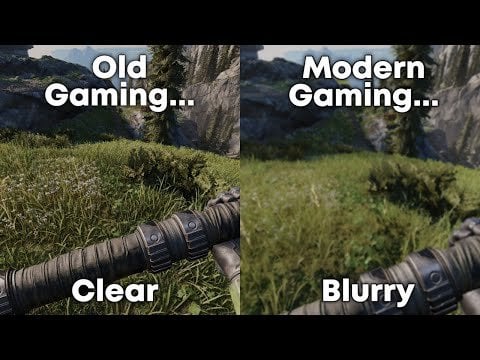
I don’t typically post my YT videos here but I felt like this is an important and under discussed topic, I hope people won’t mind.
Before anyone even watches the video – this is not a TAA hate video. This video discusses its strengths & flaws and why we use it, and only aims to shine light on how we can mitigate its downsides so we can better enjoy its strengths, so regardless of how you feel about the technology this will benefit everyone.
Also I have a new subreddit dedicated to the issue r/MotionClarity if you would like to contribute.
Ok_Ebb4712
I first noticed this when playing older 2000s 3D games on 1080p and then modern games on 1080p. Older games are crisp and clean, with clearly defined objects that only lack because of primitive lighting, geometry and textures, but it is still much more visible than the blurry mess of modern titles.
The blurriness is bad, but what makes it even worse is blurry object movement (some type of motion blur, FSR, TAA combo, I don’t know) in which you can see the object ghosting about. Yuck.
Top_Breakfast2992
Ive been using dldsr for a while now. Theres really no better image quality despite having a little bit of delay at times for noiser parts
AetherialWomble
Most people are too blind to notice. It’s been getting progressively worse for over a decade. Devs keep undersampling TAA further and further and people keep refusing to see it.
RDR2 is probably the most egregious example. The whole screen smears to complete shit the second you move the camera. Yet, people take a still screenshot and praise it as the best looking and best optimized game ever.
Devs are taking notes: “undersample TAA into infinity and people will praise you for fidelity and optimization”
I had to wait 4 years to get 4080 and play at 1440p DLAA+DLDSR 2.25x to make that game not look like smeared feces.
Point being, most people are blind and devs will cater to majority. If you’re in a non-blind minority, tough shit, get ready to spend a lot on your GPUs and play everything supersampled
Objective-Piece6498
I’ve been pointing this out for a couple of years and everybody has looked at me like I’m mad, games are very blurry and foggy nowdays, starfield was unplayable without mods for me, now its crystal clear.
WoWCoreT
i always disable motion blur and any kind of AA that is not SMAA, shit looks blurry af with those kind of effects
frsnate
Just use DLAA if you have a nvidia card it fixes this
BigManAvo
I also recently noticed this when playing dragon’s dogma, that looked clean just outdated models, then God of war 2018 that was super blurry with even slight movement
hala3mi
This video is pointless, people play games in motion not by viewing a single image, the most horrible forms of aliasing on modern engines happen between frames not just in single frames, and it’s this “TEMPORAL ALIASING” that shockingly TEMPORAL ANTI ALIASING is best equipped to handle, and it’s something that traditional methods of anti aliasing can’t handle, fact is in any high detail game with a modern physically based rendering engine will always be better off in TAA when viewed in motion rather than without TAA and with traditional AA methods, without TAA the image would be sharp but also extremely unstable between frames with lots of flickering and shimmering, besides reconstruction methods that have a temporal component are already vastly improving on TAA and getting better year by year while also getting rid of all the problems of TAA.
SolemnFuture
I first noticed this when playing Witcher 3 next gen with dlss (4070ti). Blurry and stupidly terrible texture detail. I played oldgen in 2017 native 4K (1080ti) and the game was unbelievably crisp for today’s standards.
QuantumQuantonium
Bruh “old gaming” was played on CRTs where the blurriness was caused by the “pixel” size
TheOneAndOnlySenti
r/fucktaa
urlond
This is why I prefer Raw rasterization vs DLSS, FSR, Xess. The look of native is far better than look of any type of upscale.
airforcevet1987
Wtf are you all arguing about??
QuantumQuantonium
Almost any antialiasing technique will cause some amount of blurriness. It’s a side effect of AA which is to eliminate artifacting by smoothing edges primarily. What is smoothing? Blurring techniques in a nutshell.
FXAA literally just blurs the screen, like I believe that is the bulk of the algorithm. It’s called Fast Approximate AA for a reason.
MSAA takes multiple samples of the view at slight different offsets and interpolates, resulting in areas with clear and constant colors but inaccuracies by edges. Less blurring but still blurs
TAA is like MSAA but it takes in temporal data to assist in reducing artifacts. This can be sort of like async space warp which fills in the gaps between frames, quite literally, based on screen velocity and depth data. TAA instead attempts to combine more accurately multiple frames to create an image with less artifacting and less sampling or “blurriness” as it’s using more scene data. However this becomes insanely complex and problematic when you consider for example transparency and complex effects, because now the stuff on top doesn’t match the stuff behind, this ghosting or noticable blurriness. TAA is still among the newest AA methods, considered as production ready as for example the PS1 which didn’t properly render textures and was inefficient, because back then modern graphics techniques taken for granted today weren’t realized yet.
The potential exceptions to this would be deep learning/neural network based AA, FSR, DLSS, XeSS. This is because, rather than using purely realtime image data to attempt to reduce artifacts, they also use the results of a neural network, trained to quickly eliminate artifacts in the clearest way possible, given the same inputs other AA methods receive. And these systems are far from perfect, or even preferred today- remember DLSS 1? If DLSS 2 hadn’t improved then it could’ve been likely the entire DLSS project would’ve been canceled because too much effort was put into making a worse image. Now why not just reconstruct the neural network into an applicable algorithm? Because for this ML, it took at most a few years to get a result that would’ve taken an entire research team 50+ years to discover.
The solution to blurriness? Render at native, and with ultra high density screens, to the point where you cannot visually see artifacting. Even super sampling can help with AA techniques. The issue however is that it is expensive GPU wise to render at greater resolutions, taking up resources for an unnecessarily ultra fine image. The tradeoff we’re seeing today is a preference to be able to do more, like global illumination or raytracing or even thousands of lights with shadows or complex shaders like subsurface scattering or advanced transparency, in exchange for wanting to display every single polygon (more specifically, every single fragment, or pixel in the fragment shader of the GPU pipeline created from the rasterizer) possible, a tradeoff that’s likely not to disappear for a long time since even the most powerful cards can’t just simulate a universe quickly.
And at least it’s not sharpening effects. I’d rather take a bit of TAA blur over TAA sharpness because there’s nothing more like using a border detection algorithm to really highlight all those edges and make the image ~~toasty~~ crispy.
Lo_jak
And this is why DLDSR is a much better solution if you have the power to run it
blood_omen
I’m so glad I’m not crazy. I always thought that the ps3 era games had such better graphics and were way more impressive than modern era. The only release I’ve been impressed with lately was Hogwarts.
Clippo_V2
This is the kind of shit that I came to this subreddit for. Not circle jerking around GTA 6’s lack of PC announcement or the 1 millionth shattered glass side panel.
Godspeed @OP 👊
JubaM24
I can’t play any game without using Nvidia Sharpen filter.
jcagswastaken
This is why I personally disable AA in 4k resolution.
Yofroshi
Chromatic aberration is an abomination
Wooden_Sherbert6884
I dont care about taa, gives you more realistic image also some games outright look like shit without taa for example Witcher 3 or Ghost recon Wildlands, Dark souls 3
DIO4C
Alot of people now don’t seem to note that majority of fuzziness or blurriness is from improper upscaling, I’m going to use minecraft bedrocks new deferred rendering pipeline as an example, when it first realeased the upscaled player model when crouching or other thing would become unstable looking and look fuzzy as all hell, but now you can barely tell. This isn’t all games however some just look fuzzy for no reason.
its_probably
Gaming is like Christmas.
Christmas : We take the lights from inside and put them outside. Then we take the tree from outside and bring it inside.
Gaming : We make a sharp game and make it blurry. Then we take the blurry game and sharpen it.
Quelanight2324
I thought I was getting blind because I found games to be so blurry nowadays
tmobley03
This is why I don’t use AA. Well, this and the performance hit. Call me crazy, but I believe the jagged, sharper look is better. Even at 900p.
Wirexia1
I had a massive “WHATT THE FUCK IS WRONG” when I played the Witcher 3 on PC, it’s textures were razor sharp and very crisp, it was before the raytracing update so I guess it was still “low” res

29 Comments
I don’t typically post my YT videos here but I felt like this is an important and under discussed topic, I hope people won’t mind.
Before anyone even watches the video – this is not a TAA hate video. This video discusses its strengths & flaws and why we use it, and only aims to shine light on how we can mitigate its downsides so we can better enjoy its strengths, so regardless of how you feel about the technology this will benefit everyone.
Also I have a new subreddit dedicated to the issue r/MotionClarity if you would like to contribute.
I first noticed this when playing older 2000s 3D games on 1080p and then modern games on 1080p. Older games are crisp and clean, with clearly defined objects that only lack because of primitive lighting, geometry and textures, but it is still much more visible than the blurry mess of modern titles.
The blurriness is bad, but what makes it even worse is blurry object movement (some type of motion blur, FSR, TAA combo, I don’t know) in which you can see the object ghosting about. Yuck.
Ive been using dldsr for a while now. Theres really no better image quality despite having a little bit of delay at times for noiser parts
Most people are too blind to notice. It’s been getting progressively worse for over a decade. Devs keep undersampling TAA further and further and people keep refusing to see it.
RDR2 is probably the most egregious example. The whole screen smears to complete shit the second you move the camera. Yet, people take a still screenshot and praise it as the best looking and best optimized game ever.
Devs are taking notes: “undersample TAA into infinity and people will praise you for fidelity and optimization”
I had to wait 4 years to get 4080 and play at 1440p DLAA+DLDSR 2.25x to make that game not look like smeared feces.
Point being, most people are blind and devs will cater to majority. If you’re in a non-blind minority, tough shit, get ready to spend a lot on your GPUs and play everything supersampled
I’ve been pointing this out for a couple of years and everybody has looked at me like I’m mad, games are very blurry and foggy nowdays, starfield was unplayable without mods for me, now its crystal clear.
i always disable motion blur and any kind of AA that is not SMAA, shit looks blurry af with those kind of effects
Just use DLAA if you have a nvidia card it fixes this
I also recently noticed this when playing dragon’s dogma, that looked clean just outdated models, then God of war 2018 that was super blurry with even slight movement
This video is pointless, people play games in motion not by viewing a single image, the most horrible forms of aliasing on modern engines happen between frames not just in single frames, and it’s this “TEMPORAL ALIASING” that shockingly TEMPORAL ANTI ALIASING is best equipped to handle, and it’s something that traditional methods of anti aliasing can’t handle, fact is in any high detail game with a modern physically based rendering engine will always be better off in TAA when viewed in motion rather than without TAA and with traditional AA methods, without TAA the image would be sharp but also extremely unstable between frames with lots of flickering and shimmering, besides reconstruction methods that have a temporal component are already vastly improving on TAA and getting better year by year while also getting rid of all the problems of TAA.
I first noticed this when playing Witcher 3 next gen with dlss (4070ti). Blurry and stupidly terrible texture detail. I played oldgen in 2017 native 4K (1080ti) and the game was unbelievably crisp for today’s standards.
Bruh “old gaming” was played on CRTs where the blurriness was caused by the “pixel” size
r/fucktaa
This is why I prefer Raw rasterization vs DLSS, FSR, Xess. The look of native is far better than look of any type of upscale.
Wtf are you all arguing about??
Almost any antialiasing technique will cause some amount of blurriness. It’s a side effect of AA which is to eliminate artifacting by smoothing edges primarily. What is smoothing? Blurring techniques in a nutshell.
FXAA literally just blurs the screen, like I believe that is the bulk of the algorithm. It’s called Fast Approximate AA for a reason.
MSAA takes multiple samples of the view at slight different offsets and interpolates, resulting in areas with clear and constant colors but inaccuracies by edges. Less blurring but still blurs
TAA is like MSAA but it takes in temporal data to assist in reducing artifacts. This can be sort of like async space warp which fills in the gaps between frames, quite literally, based on screen velocity and depth data. TAA instead attempts to combine more accurately multiple frames to create an image with less artifacting and less sampling or “blurriness” as it’s using more scene data. However this becomes insanely complex and problematic when you consider for example transparency and complex effects, because now the stuff on top doesn’t match the stuff behind, this ghosting or noticable blurriness. TAA is still among the newest AA methods, considered as production ready as for example the PS1 which didn’t properly render textures and was inefficient, because back then modern graphics techniques taken for granted today weren’t realized yet.
The potential exceptions to this would be deep learning/neural network based AA, FSR, DLSS, XeSS. This is because, rather than using purely realtime image data to attempt to reduce artifacts, they also use the results of a neural network, trained to quickly eliminate artifacts in the clearest way possible, given the same inputs other AA methods receive. And these systems are far from perfect, or even preferred today- remember DLSS 1? If DLSS 2 hadn’t improved then it could’ve been likely the entire DLSS project would’ve been canceled because too much effort was put into making a worse image. Now why not just reconstruct the neural network into an applicable algorithm? Because for this ML, it took at most a few years to get a result that would’ve taken an entire research team 50+ years to discover.
The solution to blurriness? Render at native, and with ultra high density screens, to the point where you cannot visually see artifacting. Even super sampling can help with AA techniques. The issue however is that it is expensive GPU wise to render at greater resolutions, taking up resources for an unnecessarily ultra fine image. The tradeoff we’re seeing today is a preference to be able to do more, like global illumination or raytracing or even thousands of lights with shadows or complex shaders like subsurface scattering or advanced transparency, in exchange for wanting to display every single polygon (more specifically, every single fragment, or pixel in the fragment shader of the GPU pipeline created from the rasterizer) possible, a tradeoff that’s likely not to disappear for a long time since even the most powerful cards can’t just simulate a universe quickly.
And at least it’s not sharpening effects. I’d rather take a bit of TAA blur over TAA sharpness because there’s nothing more like using a border detection algorithm to really highlight all those edges and make the image ~~toasty~~ crispy.
And this is why DLDSR is a much better solution if you have the power to run it
I’m so glad I’m not crazy. I always thought that the ps3 era games had such better graphics and were way more impressive than modern era. The only release I’ve been impressed with lately was Hogwarts.
This is the kind of shit that I came to this subreddit for. Not circle jerking around GTA 6’s lack of PC announcement or the 1 millionth shattered glass side panel.
Godspeed @OP 👊
I can’t play any game without using Nvidia Sharpen filter.
This is why I personally disable AA in 4k resolution.
Chromatic aberration is an abomination
I dont care about taa, gives you more realistic image also some games outright look like shit without taa for example Witcher 3 or Ghost recon Wildlands, Dark souls 3
Alot of people now don’t seem to note that majority of fuzziness or blurriness is from improper upscaling, I’m going to use minecraft bedrocks new deferred rendering pipeline as an example, when it first realeased the upscaled player model when crouching or other thing would become unstable looking and look fuzzy as all hell, but now you can barely tell. This isn’t all games however some just look fuzzy for no reason.
Gaming is like Christmas.
Christmas : We take the lights from inside and put them outside. Then we take the tree from outside and bring it inside.
Gaming : We make a sharp game and make it blurry. Then we take the blurry game and sharpen it.
I thought I was getting blind because I found games to be so blurry nowadays
This is why I don’t use AA. Well, this and the performance hit. Call me crazy, but I believe the jagged, sharper look is better. Even at 900p.
I had a massive “WHATT THE FUCK IS WRONG” when I played the Witcher 3 on PC, it’s textures were razor sharp and very crisp, it was before the raytracing update so I guess it was still “low” res
The Four Horsemen of the apocalypse:
* Chromatic Aberration
* Bloom
* TAA
* Motion Blur
I much prefer jaggies to blurries