I used Intel’s XTU to OC the CPU and set thermal limits. Can’t run a negative voltage offset in XTU because? maybe because of the required undervoltage protection setting that has to be enabled. So, the OC on the CPU is a little weaker than what I was hoping for. This processor gets really hot.
For the GPU, the MSI afterburner wouldn’t let me go much beyond 3GHz-core without detunning back down to 3GHz. For the memory though, I could push the memory farther, the problem is that as the memory gets faster, more artifacting appears, so I tried to hit a mid-point between performance and quality with OCing the memory.
Ram: I just hit the go faster button, XMP. OC to 6000MHz 36-36-36-96. Works as advertised. Not sure how to push this farther, or if I even should.
Any suggestions to help out a newbie overclocker??

1 Comment
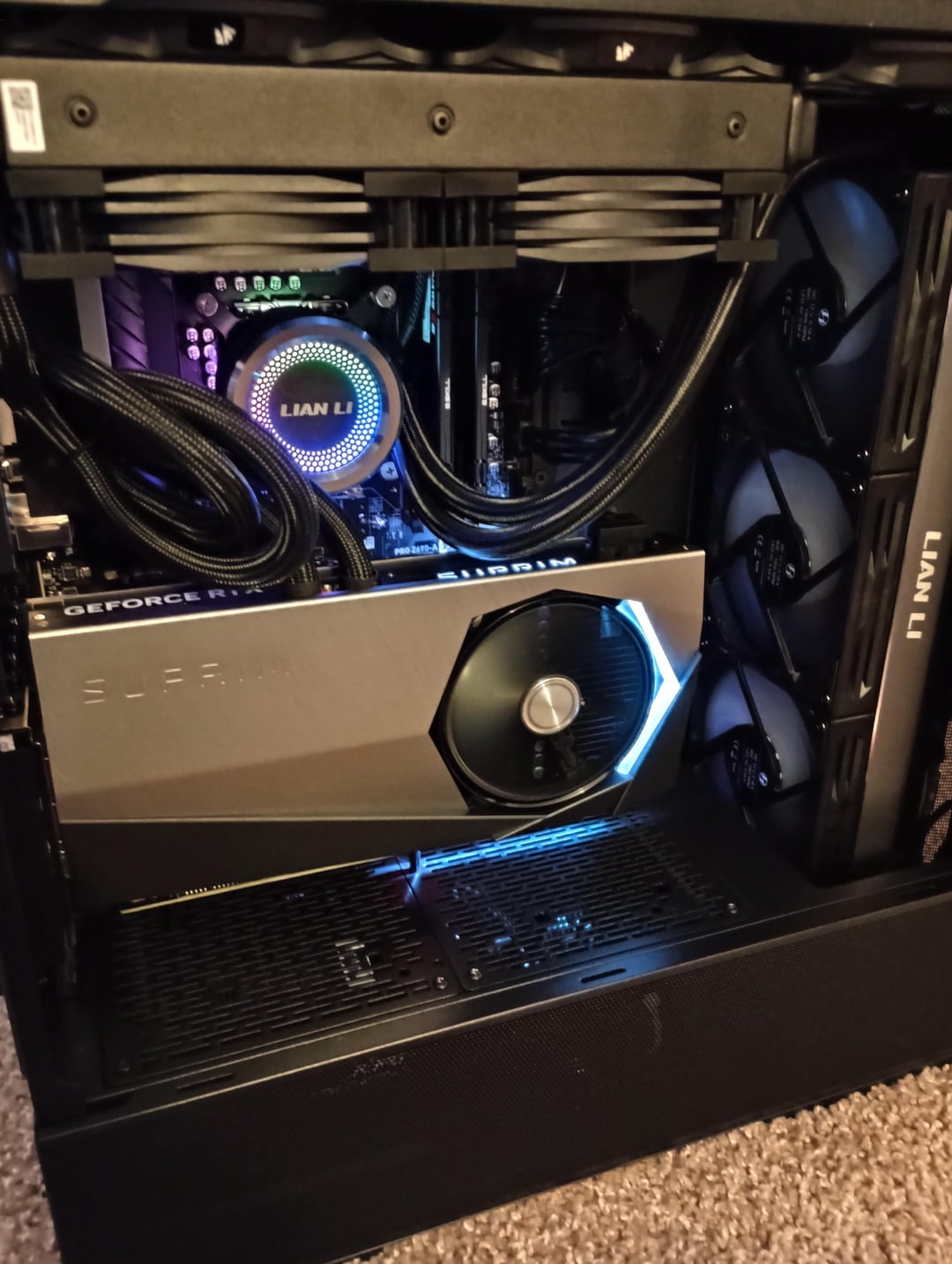
The GPU: MSI RTX 4090 SUPRIM X LIQUID – OC: 3000MHz core, 11800MHz memory
CPU: i9 14900K – OC: 5.8GHz-P, 4.5GHz-E, 5.0GHz Cache
I used Intel’s XTU to OC the CPU and set thermal limits. Can’t run a negative voltage offset in XTU because? maybe because of the required undervoltage protection setting that has to be enabled. So, the OC on the CPU is a little weaker than what I was hoping for. This processor gets really hot.
For the GPU, the MSI afterburner wouldn’t let me go much beyond 3GHz-core without detunning back down to 3GHz. For the memory though, I could push the memory farther, the problem is that as the memory gets faster, more artifacting appears, so I tried to hit a mid-point between performance and quality with OCing the memory.
Ram: I just hit the go faster button, XMP. OC to 6000MHz 36-36-36-96. Works as advertised. Not sure how to push this farther, or if I even should.
Any suggestions to help out a newbie overclocker??