
Follow us
Add us as a preferred source on Google
Newsletter
Subscribe to our newsletter
With the Scope of Authority Warbond bringing new sniper rifles, ghillie armour, and mine grenades to Helldivers 2, we asked Arrowhead concept artist Christian Forsgren how that kind of hardware goes from Blender blockout to an in-game weapon. The answer is speed. “I can see how it actually handles in a player’s hands straight away, not weeks later,” he says. For weapons and machinery, that matters: a badly judged few centimetres can be the difference between convincing military hardware and something from a toy shop.
Each asset starts with a brief and a team brainstorm. Forsgren then builds a rough 3D blockout in Blender, refines the functionality, materials and finish, and pushes it into Arrowhead’s Stingray engine to see how it behaves in real time.
That loop helps give Helldivers 2 its battered, believable look. Weapons have to be mechanically plausible, and procedural materials add edge wear, grime and volumetric detail “without ever doing a single second of UVs”. Forsgren has also built a Blender pipeline for the game’s Warbond banners, producing renders at a higher fidelity than the game itself can manage, in the series’ propaganda-poster style.
There’s plenty here for Blender users beyond games, too: the scripts and add-ons Forsgren uses to speed up his work, the custom tools Arrowhead uses to move assets between Blender and the engine, and why the studio lets artists build their own workflows. The takeaway is that the best pipeline helps artists make better decisions, faster, with fewer hand-offs.
For more on Helldivers 2, visit Arrowhead Game Studios.
You may like
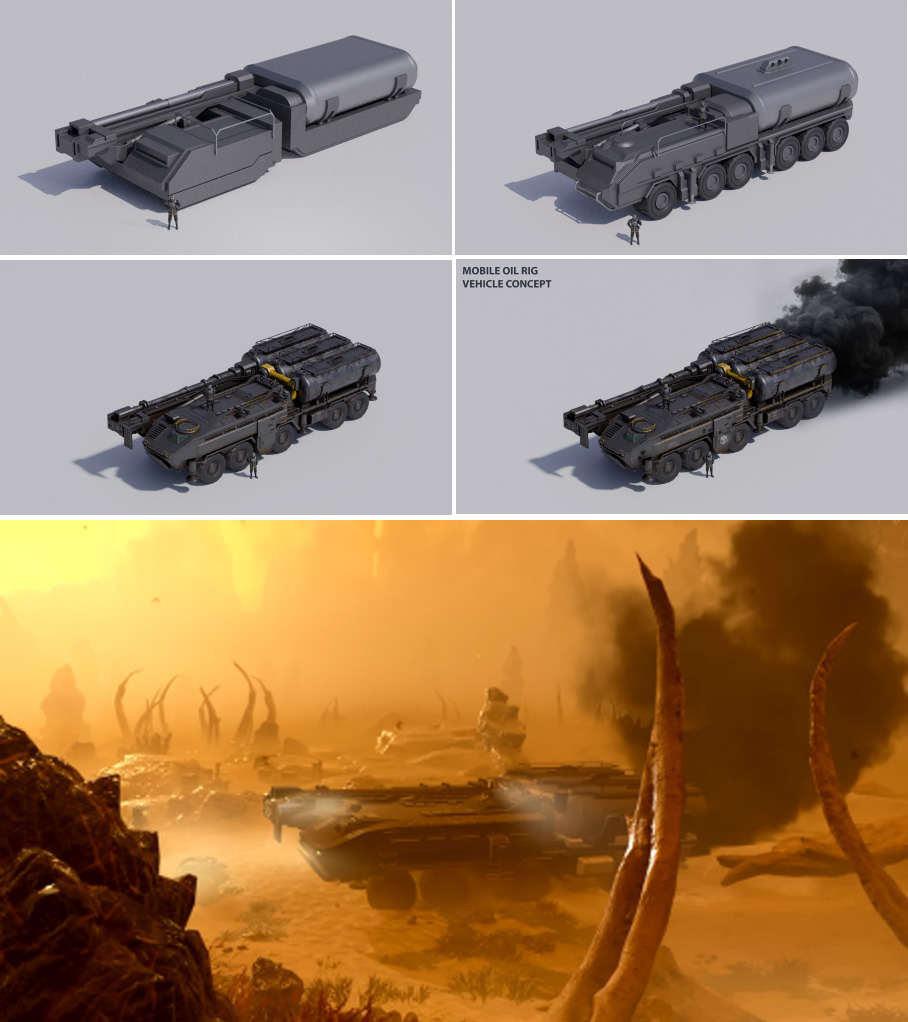
From top left, the process: “First 3D blockout of a two part vehicle… Amended to 6 wheeled vehicle… The final version of the concept model… Added textures and colours in Photoshop… Final in-game screenshot”. (Image credit: Arrowhead Game Studios)Creative Bloq: Walk us through a single asset’s journey – from concept sketch to final in-game render. Where does Blender’s role start and end, and where does the Stingray game engine take over?
Christian Forsgren: It starts with a brief, then it’s team brainstorming. After that team brainstorm I take over and focus on ideas we have landed on and take it to a point where we can start to iterate. Say I’m building a weapon: I take the agreed upon brief and build the concept model in Blender, sometimes I do simple sketches depending on the asset to bounce around the team but most of the time it’s straight into Blender for easy blockouts to help with scale and animation approximations. When that has reached a reasonable state I take it further and focus on functionality, materials, and how we want the finished asset to look like.
When that is greenlit Blender’s job ends once the asset’s ready to live in the game. We push it straight into Stingray, the game engine, and we’re play-testing it in real time so I can see how it actually handles in a player’s hands straight away, not weeks later. That’s where Stingray takes over: real lighting, real scale, how it sits next to everything else. Then it’s a loop with coders, designers, 3D artists and animators until it actually fits the game, not just looks good on its own.
CB: What does Arrowhead’s “customised Blender workflow” consist of – are these custom add-ons, modified shortcuts, in-house scripts, or something else?
CF: My own setup runs on scripts I’ve built and collected over time. Everything from camera related addons that help me manage the compositor, HDRI’s, Lights, focal length and Depth of field. Addons that help me create procedural materials in the shader editor. Pie menus to help me speed up access to all different kinds of Blender nested menus. The asset library is an insanely helpful addition to Blender to help me keep track of textures, materials, assets, animations and have them always available without opening a file explorer. The ecosystem’s incredible and most problems I hit, someone’s already solved it.
At a studio level, Arrowhead’s built custom exporters and importers to bridge Blender and our engine. The problem we were solving was speed and consistency. Without that bridge, every asset needs manual rebuilding or re-checking every time it crosses from Blender into the engine, and that adds up fast across a whole team.

The recent Scope of Authority Warbond DLC brought a new sniper rifle to the online shooter. (Image credit: Arrowhead Game Studios)CB: Helldivers 2’s art has a distinctive, gritty, lived-in military aesthetic with a touch of 20th-century propaganda. What Blender techniques (texturing, sculpting, procedural detailing) are doing the heavy lifting to achieve that look?
CF: Military realism drives a lot of it. Every weapon, like the arm-mounted cannons on our Exosuits (the mech suits players pilot in Helldivers 2), has to be functionally plausible, with every part sized to actually fit how it works mechanically. That attention to real, physical logic is a big part of why it reads as lived-in rather than designed.
Blender’s procedural tools do a lot of heavy lifting too. I can generate complex backgrounds like planets and star systems without hand-painting any of it, and Cycles with some simple HDRIs gets me high-quality results without a huge amount of manual tweaking. That procedural system is always handy when it comes to the nitty-gritty textures as well; I can get there very fast with the procedural texturing tools inside Blender. All the nodes available to me make it a breeze to create edge wear, grungy textures and interesting volumetrics without ever doing a single second of UV’s.
For the war bond banners specifically, I built a proper Blender pipeline to replace what used to just be in-game screenshots with simple text put on top; now it has grown to larger marketing material where the most important part of the image is made in Blender in conjunction with studio tools to get in-game assets into Blender to be rendered at higher fidelity than we could ever achieve in-game to really row home that gritty propaganda feel we always strive for.
CB: How does the Blender-to-Stingray pipeline handle iteration?
CF: Because we can export an asset into Stingray and see it working within a few hours, we iterate fast, and the feedback loop with coders, designers and animators continues until the design fits the game.
All games go through late asset iterations, it may be because what we initially thought was something fitting of the fantasy has changed because other assets in the game brought this particular one into the wrong direction so now the concept has to change.
Since Helldivers is such a vast world we often find other uses for assets that maybe not made the cut so we try to salvage things at later stages or for different themes just so interesting ideas don’t get lost but since we built the workflow to use 3D early and iterate on blockouts early it rarely happens.
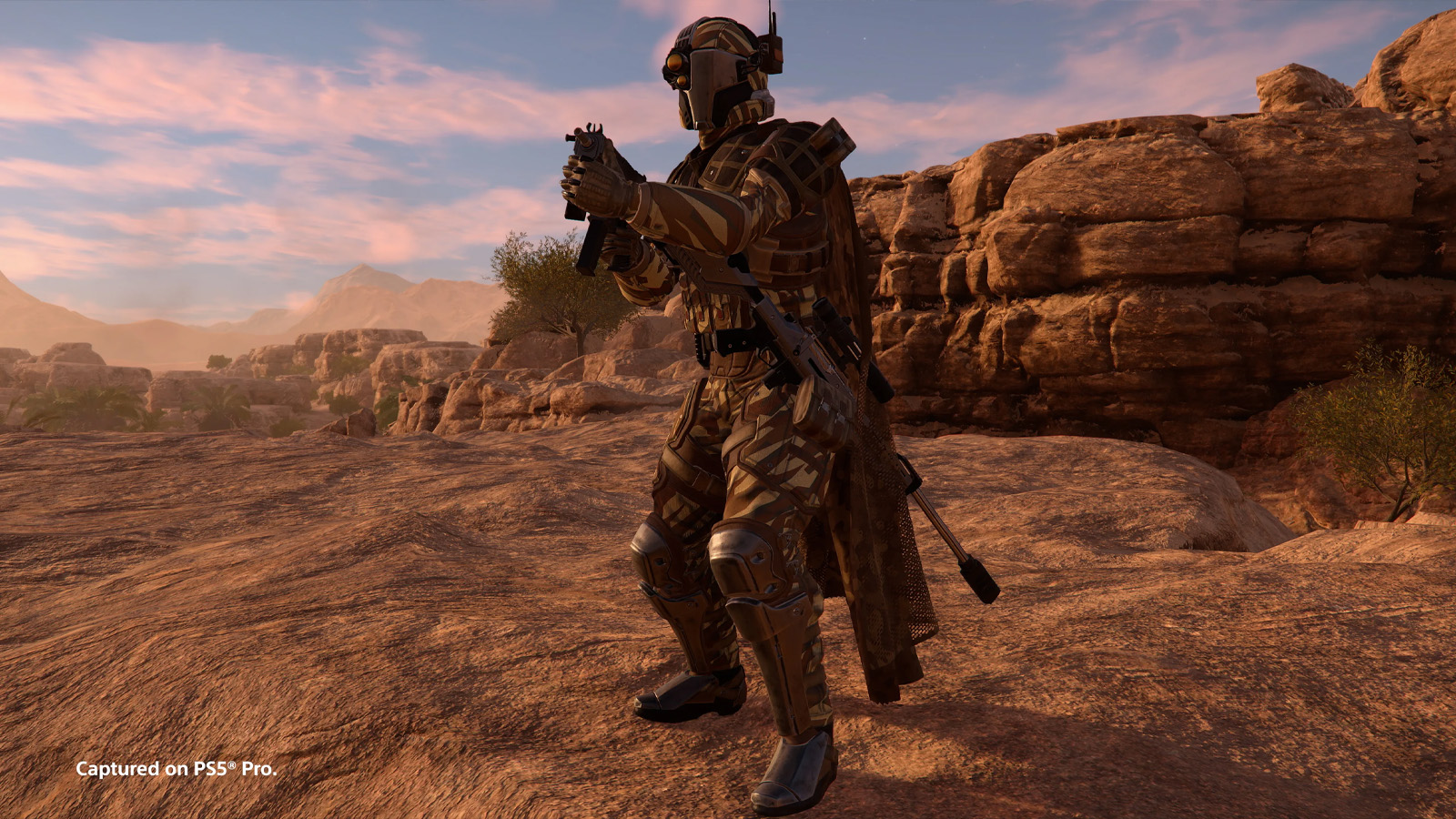
Helldivers 2 has a realistic military aesthetic peppered with gritty dystopian totalitarian propaganda. (Image credit: Arrowhead Game Studios)CB: Does Blender do anything better than Stingray’s own tools for this kind of asset work, and vice versa? Where does the team draw the line between the two?
CF: Blender is my all-in-one package for modelling, animation, texturing,simulation and rendering, so I don’t have to jump between programs, which is why I prefer it to other 3D packages which are more specific in their use cases. Blender is also the most user friendly, working with other packages was always way too daunting as a concept
artist, but there was something in the way Blender did everything I wanted in the same package that made it a go to choice.
Creative Bloq: How prescriptive is the customised toolkit – do artists still have room for individual style and experimentation, or does the pipeline push everyone toward consistency first?
CF: Arrowhead gives us creative freedom to choose our own tools and workflows but we have some specific ones everyone uses to bridge the game engine and Blender. A lot of the 3D artists at the studio have very different setups based on how they like to work, which I think is really important. Pushing everyone to use the same exact
setup can have some advantages, but giving team members the tools to customise Blender how they like to is what keeps that individuality.
The studio-specific tools are there to get finished work from Blender into the engine, not to dictate how that work is made. Everyone has their own setup when it comes to the tools they like to work with, be it specific add-ons if you are an environment artist or if you are a hard surface artist or character artist. All these use vastly different workflows, so empowering them to use what they think is best is super important, and it also helps create an environment where different disciplines can empower each other.

Helldivers 2 is a team-based online ‘extraction shooter’ for PlayStation 5 and PC. (Image credit: Arrowhead Game Studios)CB: What workflow habit or tool did the team build for Helldivers 2 that you didn’t expect to become essential?
CF: Honestly, it’s being able to push early concept blockouts straight from Blender into the engine and have it working almost immediately. I didn’t expect that to become as central as it has. It’s changed how fast we can actually iterate, because I’m not waiting around to see if something works now we can test animations, scale and overall look within the engine in the blink of an eye.
CB: For artists outside games – illustrators, product designers, VFX artists – what’s transferable from how Arrowhead builds and adapts its Blender workflow?
CF: What transfers, I think, is the mindset more than any specific tool. We lean on Blender because it’s open source and shows what you can do without breaking the bank, whether you’re a studio or working completely solo, it gives you real, tangible results rather than something generated for you. Having modelling, texturing and animation all in one place matters most if you’re working alone and don’t want to juggle five different programs.
The other thing that transfers is freedom in your own process. Arrowhead gives artists a lot of freedom in which tools and workflows they use, and everyone on the team works a bit differently. On my end, that shows up in small ways. Procedural tools save a lot of time by generating things like backgrounds automatically instead of building them by hand, and I do colour and exposure work right inside the render with the Photographer add-on instead of switching to Photoshop.
CB: If you were setting up this pipeline from scratch today, knowing what you know now, what would you do differently?
CF: The industry is always changing, so it is very hard to be on top of what works and what doesn’t. But with the knowledge and connections I possess today, I could more easily create workflows that would be in line with how I can work more closely with the rest of the teams. How can we bridge the gap between artists, animators and designers? For example, it’s an everlasting process of building pipelines, so who knows what is on the horizon.
Today’s best Sony PlayStation 5, Sony PlayStation 5 Pro, Sony PlayStation 5 Slim, Sony PlayStation 5 Slim Digital and Sony PlayStation 5 Slim Disc Drive deals