

Gears of War E-Day takes the franchise back to its origins, before its glory days, and tells the story of humanity’s first contact with the Locust. Like many franchises that run out of steam, Gears developer The Coalition has decided to look back before continuing its commitment to move the story forward. However, the gamble seems to have paid off, with E-Day becoming one of the stronger entries in the series. While its story is content with revisiting characters and resetting their emotional toll, its gameplay injects a much-needed amount of freshness.
E-Day arrives around seven years after Gears 5, bringing with it a new approach to world building, exploration, and combat. The Coalition has painstakingly recreated the franchise’s feel in Unreal Engine 5 while delivering one of its longest campaigns in the biggest playground. Where it falters narratively, it more than makes up for it in its core game design. Sure, it makes some of the ideas in the original trilogy feel quaint in comparison, but ultimately, the players get something more meaningful over a standard, safe prequel.
The Fall of Kalona

E-Day refers to Emergence Day, the devastating introduction of the villainous Locust to humanity. Set in Kalona City on planet Sera, it follows Marcus Fenix and Dominic Santiago dealing with the arrival of the Locust and the destruction of the city. The game also provides the origin story for Bravo Squad, the chainsaw Lancer, the political tension within the Coalition of Ordered Governments (COG), and much more. It is, primarily, a story of establishing brotherhood and facing new perils while struggling with one’s inner demons from past conflict.
The emotional growth of Marcus and Dom isn’t the central hook here, with the plot instead putting the spotlight on other characters.

The emotional growth of Marcus and Dom isn’t the central hook here, with the plot instead putting the spotlight on other characters. The developers understand that there isn’t too much ground to cover narratively with its lead duo. Instead, The Coalition has chosen to add more flavour to the world by exploring the other characters, Mags and Lucas Reyes, who bring their own personalities to Bravo Squad. For the most part, this works, creating a fun dynamic exploring different elements of the human psyche and response to emotional trauma through all squad members.
I am a little disappointed by the repetitive nature of the campaign’s narrative.
The star of E-Day is Kalona City, and its eventual destruction. Throughout its campaign, players will revisit many locations across the city in different states of distress. You see Kalona’s fall from grace in real-time, rendered in egregious detail with Unreal Engine 5. Chunks of debris from skyscrapers fall right in front of your eyes while multi-storey buildings get broken by ballistics. E-Day even takes inspiration from open-world games in a couple of its acts, letting players explore much of the city in any manner they choose. Players will battle the Locust across the metropolis, the airport, a jungle, and the city’s tunnels.

Changing the control scheme was a risky move, but it pays off in spades.
I am a little disappointed by the repetitive nature of the campaign’s narrative. Most of the game boils down to the COG trying to suppress the Locust while evacuating civilians, and it never really goes beyond that. That’s the trap of a prequel, since the game can’t drill into specifics that future elements tackle. Most of the new characters serve the story well, except Vraakh, a mostly mute brute whose only job is to look menacing while leading the enemy monsters. Gears has long been commended for its character work, which appears one-dimensional at first glance but offers much more for players who actually sit through the campaigns. The same is true here.
E-Day Takes Combat to New Heights

E-Day’s improvement on the franchise’s combat mechanics is its best quality. Changing the control scheme was a risky move, but it pays off in spades. It replaces the iconic roadie run with the standard sprint, but gives more control to players over momentum. With it, players can now sprint, slide, and manually jump, creating more avenues for getting into, under, over, and out of cover. It’s the smoothest, most responsive Gears has ever felt.

The new movement complements the new weapons well. Like all previous titles, E-Day excels in delivering the impact of its weapons. New tools such as the Incinerator, Gore Hook, and the Gut Puncher live up to their name, offering new ways to take down the enemy in gruesome fashion.
More like this Gears of War: E-Day Campaign Video Review
The core of Gears’ combat has always been satisfying, and E-Day revels in its use of newfound verticality. Due to the new movement mechanics, E-Day emphasises combat from different levels of elevation. You can take out an enemy with the Lancer on the third floor, slide down right up to another’s face, and blow them up using a shotgun, get into cover, and take aim at a distant combatant with a sniper rifle, all within a few seconds. E-Day doesn’t want you to just sit behind cover.

The cover itself keeps changing on the battlefield. New low-ground cover changes the way you approach an enemy wave, while destructible cover keeps you on your toes. Slide under vehicles to take out the Locust with close-range weapons, or keep chipping away at them, blowing chunks off the vehicles from afar. You get more options than ever before. Boss battles offer spectacle on a scale Gears is known for, but don’t require much strategising. The repetitive nature of the exploration also ensures that there are few truly unique bosses, which is slightly disappointing.
Gears of War: E-Day PC Performance
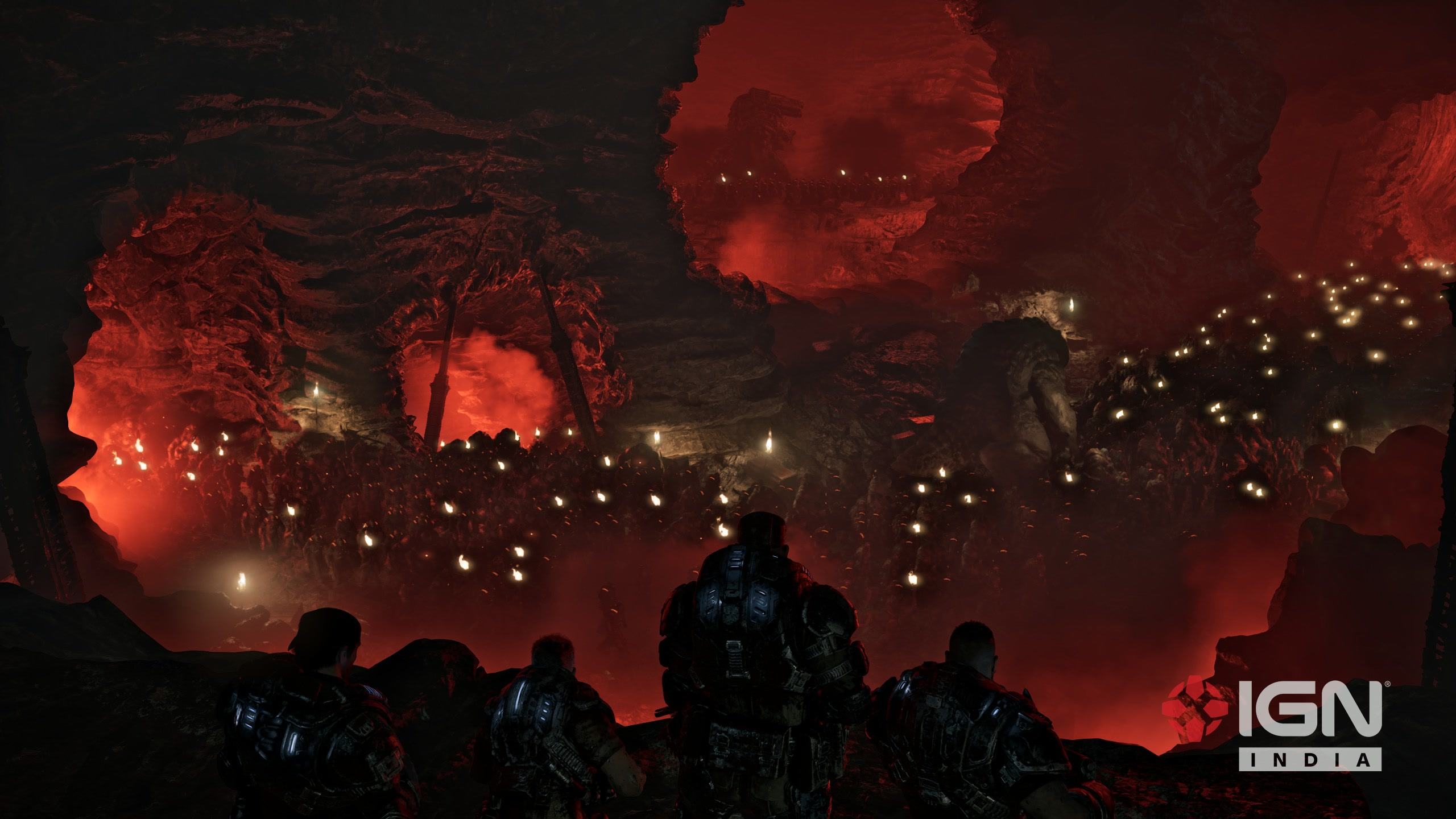
I played Gears of War E-Day on a PC with an Nvidia GeForce RTX 5070 (12GB GDDR7 VRAM), an AMD Ryzen 7 5700X3D CPU, and 32GB DDR4 RAM. On PC, E-Day showcases new technologies such as RTX Mega Geometry, advanced MegaLights, advanced ray tracing, and more. Turning all of these features on required the use of frame generation to keep a steady, playable frame rate. Without them, I could stick to 60fps at 1440p on a mix of high and ultra settings.
As pretty as E-Day’s contrasting shadows can look, its bigger issue is a constant boiling effect on said shadows and reflections. The built-in denoiser doesn’t seem to work as well as it can, and turning up the settings for a cleaner image has a negative impact on performance. For those with an RTX 5070 or similar GPU, I recommend locking the output frame rate to 120 fps, and using DLSS frame generation at 3X while keeping those advanced graphical options turned on.

For everyone else, turning off RTX Mega Geometry and Hair Strands is the easiest fix. Unfortunately, most PC players will still have to contend with unusually high CPU and RAM usage. Those with 32GB systems will see memory usage being almost maxed out, even at 1440p or 1080p. There is work to be done here, both in terms of improving performance and image quality of the ray-traced effects.
Is Gears of War: E-Day Worth Your Money?

Gears of War: E-Day starts at ₹5,499 on Steam and Xbox Series X|S. While you’re getting a complete package, with 4-player co-op, a lengthy campaign, and multiplayer, it still feels a little too steep for the Indian market. We recommend waiting for a discount if you want to own it. However, those who don’t mind playing it through Xbox Game Pass can absolutely choose to do so. E-Day can also be enjoyed for cheap through a mix of Game Pass and Nvidia GeForce Now, which can be another viable alternative for those with optimal internet connections.
Gears of War: E-Day is one of the franchise’s strongest entries with improved mechanics and jaw-dropping visuals, but its narrative doesn’t break any new ground. It’s a testament to the franchise’s enduring appeal and willingness to experiment with its core design, but the nature of being a safe prequel holds it back from perfection.