
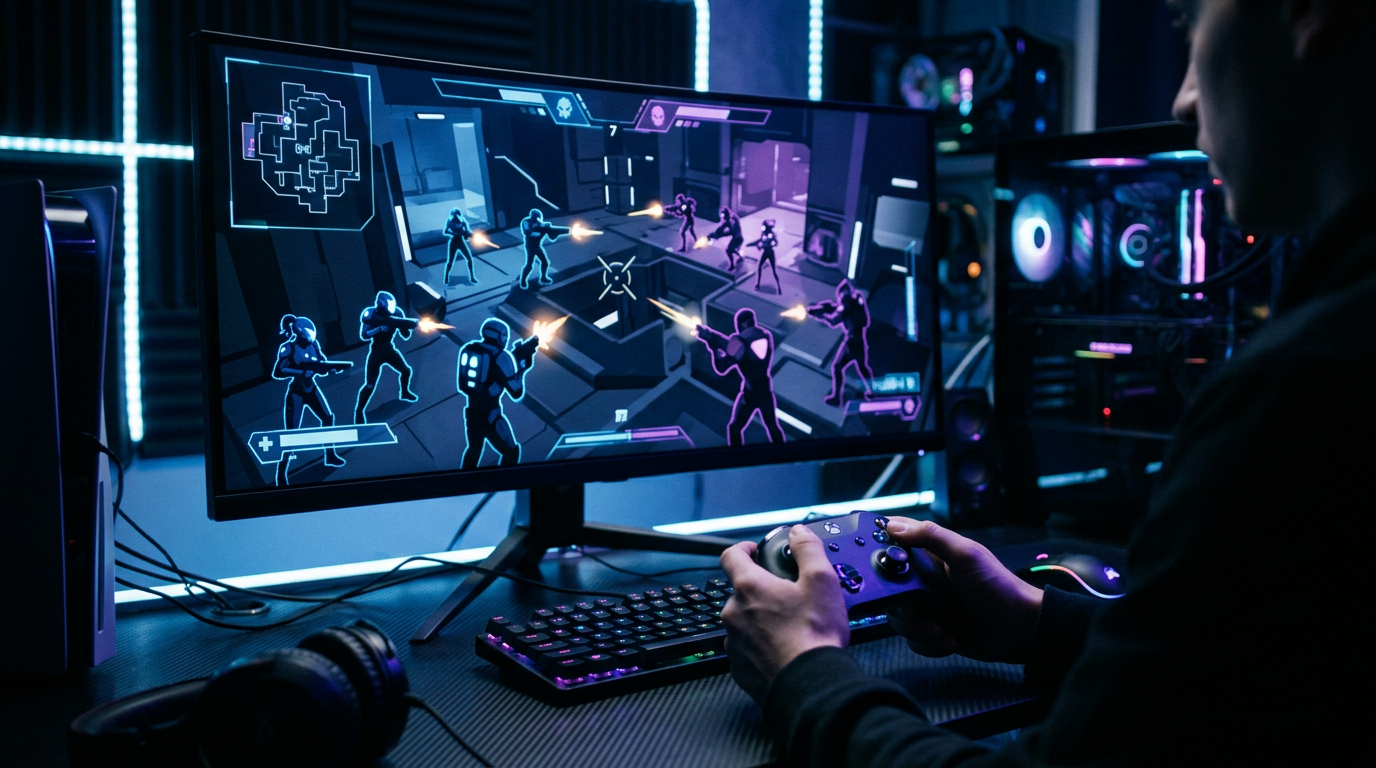
Valorant reached PS5 in 2024, first through a limited beta and then as a full release. Riot put more effort into the controller conversion than most PC studios bother with, and it shows in how the game feels on a pad.
What did not change is the shape of the thing. Valorant is a shooter where a large share of the skill sits in knowing rather than aiming.
That makes it an unusual fit for console, where the habit has generally been to learn a game by playing it. Valorant quietly expects some homework, and it never really tells you so.
Knowledge Is Half the Game
There are 29 agents, each with their own abilities, and 13 maps with their own callouts and sightlines. Every round turns into a small argument about which of those pieces the other team is still holding.
Then there is the economy, which decides whether your side can afford rifles or has to save. Getting that wrong costs two rounds rather than one, and the arithmetic behind it appears nowhere in the interface.
Add the weapon set on top of that. Nineteen guns with distinct damage falloff and spray behaviour, where the gap between a body shot and a head shot settles a round far more often than raw reaction time.
Where Console Players Go to Look It Up
Because none of that is explained in game, a reference layer grew up around it. ValDB is one of the larger examples, holding 1,366 weapon skins, 212 bundles, 29 agents and 19 weapons built from the game files, with 13 maps carrying roughly 300 official callouts plotted on interactive minimaps.
The parts a console player actually reaches for are the practical ones. There are 505 professional player setups with crosshair codes you can paste straight in, a sensitivity converter for anyone moving between devices, and damage and economy calculators that answer the questions the game leaves hanging.
The skin catalogue matters more than it first appears, because Valorant sells bundles on rotation rather than permanently. Having 1,366 finishes and 212 bundles listed in one place is mostly a way of judging whether the thing currently in the shop is genuinely scarce.
A glossary defines 37 terms the game never bothers to explain, which is more useful than it sounds when the rest of your lobby is using them casually. It is an independent project rather than anything Riot runs, and it tracks file changes rather than waiting for announcements.
The Console Release Was Deliberately Narrow
Riot did not ship everywhere at once. The plan for console availability covered the United States and Canada, Europe, Japan and Brazil, with the beta concentrated on current generation hardware such as PS5 and the Xbox Series machines.
That caution looks reasonable in hindsight. A tactical shooter with a competitive ladder does not easily recover from a bad launch, and a smaller footprint made the first months far easier to manage.
The narrow rollout had a side effect too. It kept the early console population dense enough for sensible matchmaking, which is usually the thing that quietly kills a competitive port.
The Ladder Is the Long Game
Valorant runs 25 ranks from Iron 1 up to Radiant, and the top of that ladder is a live leaderboard rather than a fixed threshold. Radiant cutoffs move by region, so identical performance can mean different things depending on where you play.
Placement is the part console players ask about most. Five games decide where you begin, and the system weighs those results heavily enough that one bad evening can follow you for weeks.
Console players inherited all of it, including the parts that grate. Ranked progress rewards consistency over highlights, which is either the appeal or the problem depending on your temperament.
What Still Feels Different on a Pad
Aim assist does not solve everything, and Valorant’s abilities were designed for a keyboard with plenty of spare keys. Console bindings work perfectly well, but they ask more of your thumbs than most shooters on the platform.
Crossplay is the other consideration, and Riot kept console and PC pools separate for ranked play. That call has aged well, because the two versions really are playing slightly different games.
Communication is another gap. Voice chat carries a tactical shooter, and a console audience that leans on party chat loses information the PC version simply assumes.
The remaining difference is pace. Console lobbies tend towards a slower, more deliberate round, and that is a different metagame rather than a worse one.
The Short Version
Valorant on PS5 has settled, and the console version is no longer treated as an experiment by anybody involved. The open question is how much of the PC reference culture makes the crossing with it.
A fair amount already has, judging by how quickly crosshair codes get swapped around console lobbies. Our editorial section has more on how PlayStation players adapt to games that were never really built for them.