

Maxim Boldson
GAMES
October 10 2026
Views: 22324
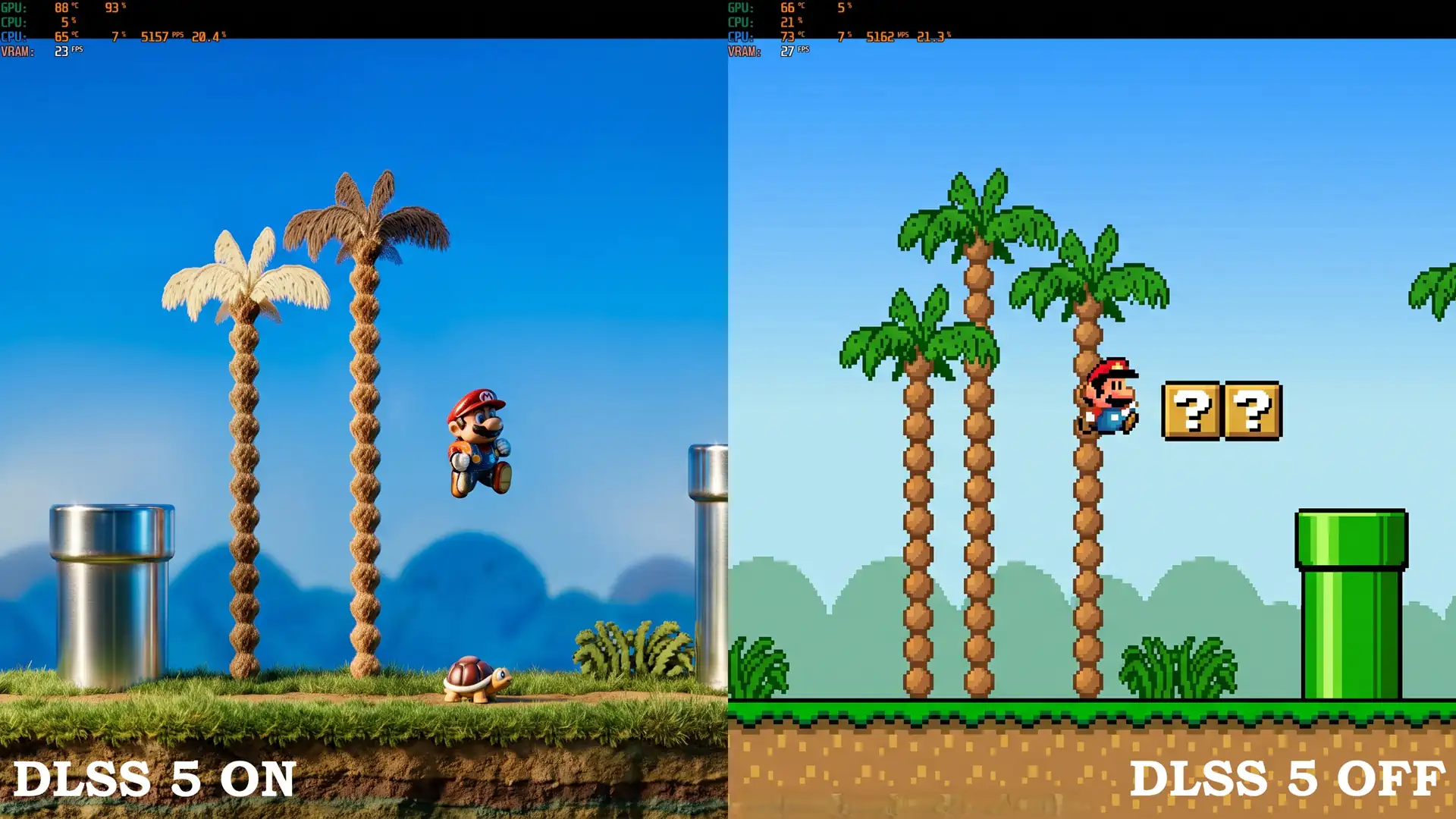
The original Super Mario Bros. platformer, released by Nintendo in 1985, was benchmarked using DLSS 5.0 neural network rendering technology. The classic 8-bit game was run through the DOSBox emulator, without native integration into the engine or any changes to the source code. Modern image generation algorithms were implemented using a combination of RenoDX and ReShade utilities directly into the frame output pipeline, with Multipass x4 enabled. Introduced by NVIDIA in 2026, DLSS 5, a real-time neural network rendering technology, complements or completely replaces traditional pipeline stages with AI-powered pixel, lighting, and material generation.

During the demo, all four available performance profiles were tested on the starting level, World 1-1: Natural, Default, Cinematic, and Denoise. The Natural profile provides moderate processing and preserves the familiar block geometry of the level. The Default profile attempts to restore Mario’s facial features beneath his mustache, imbuing the pixelated figure with a pseudo-volumetric anatomy. The Cinematic profile completely transforms the Goomba enemies and adjusts the lighting contrast to create a dramatic, cinematic scene. The aggressive Denoise mode applies excessive filtering to the frame, obliterating the green pipes, background clouds, and the final flagpole, turning the scene into an eye-watering mess.
The technical benchmarking conducted clearly demonstrates the behavior of modern generative machine learning models when processing 40-year-old 2D assets. The AI algorithms attempt to render photorealistic surfaces over flat sprites, radically altering the visual style of the original. Meanwhile, jump timings and the overall physics of character movement remain unchanged across all four modes, ensuring an original gameplay experience. The experiment demonstrates the limits of the applicability of a universal neural network pipeline when directly applied to early pixel art without specialized model training.
DISCUSSION CENTER
@GameGPU_com
Join the discussion, share your benchmark results, and debate hardware performance in X.
Discuss on X