
If you were around during what many consider the golden age of PC gaming, back when SLI was still possible, and, going back even further, when gamers put dedicated PhysX cards into their PCs, the latest trick shown off by modder, Marcelo Guibout, on YouTube. Guibot showed off a gaming setup using two NVIDIA RTX 5060 Ti 16 GB GPUs in tandem to split the rendering and Neural Rendering workloads.
[Editor’s note: Our in-depth analysis of the DLSS 5 model leaked in the NBA2K27 and in use here is now live]
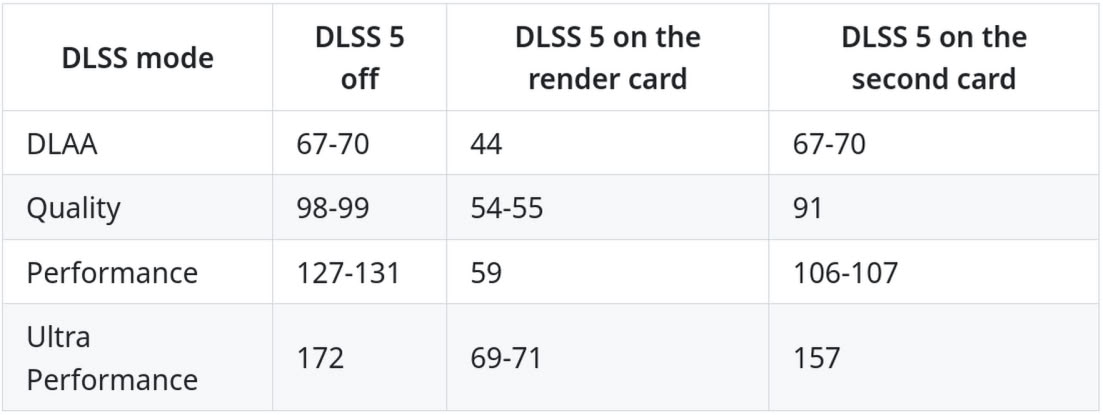
Similarly to the example of PhysX cards, the idea is to split the workloads between two GPUs, theoretically allowing for improved performance on the GPU doing the primary rendering, since it will be able to use resources on raster or ray tracing rendering that might otherwise be used for DLSS 5 Neural Rendering. With the Neural Coprocessor enabled using the multi-GPU processing setup, frame rates improved anywhere from 59% to 125% compared to running DLSS 5 on the same GPU—performance was still down compared to DLSS 5 off, however.
 The modder used Neural Coprocessor (or MGPU Bridge), a public add-on for ReShade, to test DLSS 5 in Cyberpunk 2077 and The Blood of Dawnwalker, whose results can be seen below in the embedded YouTube videos. The add-on basically uses the PCIe link to pass the completely rendered frame from the primary GPU to the dedicated Neural Rendering GPU, which then outputs the resulting frame to the monitor after the DLSS 5 pass. It can also be tweaked in the same control ReShade control panel that DLSS 5 Swapper uses, in order to refine performance and quality.