

 GT7 Photo Mode image by oldvictory
British motoring magazine evo has published a wide-ranging interview with Gran Turismo creator Kazunori Yamauchi, covering everything from the challenges of tire physics to Polyphony Digital’s relationship with Sony.
It was conducted at the FAT Ice Race in Zell am See, Austria, earlier this year, where Yamauchi joined Polestar as the company continued its promotional tie-in between the Polestar 5 and Gran Turismo 7.
Much of the ground covered will be familiar to GTPlanet readers, but there are a few comments worth digging into, including an interesting one about the pressure Yamauchi used to face from Sony.
Sony Pushback Has Eased
 Gran Turismo 5
When asked whether he has ever been told by his bosses at Sony to cut corners or that his team is taking too long to produce new games, Yamauchi gave an answer that will raise eyebrows among anyone who followed the series through the late 2000s: “Up to about Gran Turismo 5, yes. Nowadays, not so much.”
Of course, Gran Turismo 5 had one of the most protracted and publicly scrutinized development cycles in the series’ history with two significant announced delays, so it’s interesting to hear Yamauchi acknowledge that corporate patience was being tested during that era.
Yamauchi also repeated the now-familiar figure that a single car takes roughly eight months to complete. That covers both the graphics model and the physics work required to make it behave like the real thing, compared to roughly two hours per car back in the original Gran Turismo days. Recreating the Nürburgring Nordschleife, he said, took four years.
Tires Remain the Hardest Problem
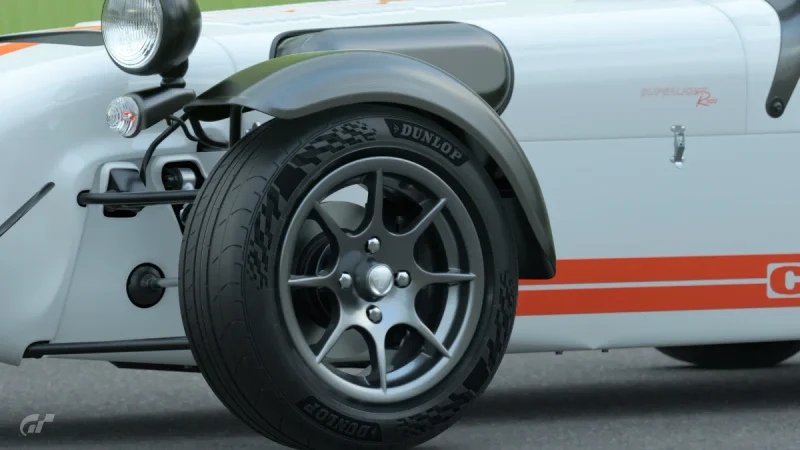 GT7 Photo Mode image by 05XR8
On the simulation side, Yamauchi was frank about where the biggest challenge lies: tires.
Components like suspension and drivetrains can be modeled with little gap between simulation and reality, but tires are a different story, with some of the finer details difficult to pin down even when working with tire manufacturers. The specific difficulty is the contact patch, and how its behavior shifts with heat, wear, and surface conditions.
“The level of grain that happens when you have certain conditions on the track, it’s something that we just don’t have yet,” Yamauchi admitted.
This challenge has been going on for a while. Yamauchi described tire modeling as Gran Turismo’s most difficult simulation challenge as far back as 2017 when he accepted his honorary doctorate degree in Modena, Italy.
Although Yamauchi made these comments to evo earlier this year, this week’s Update 1.71 brought yet another revision to the tire physics algorithm, including changes to slip behavior, rolling resistance, heating, wear, and grip loss. Neither update’s notes mention the contact-patch behavior or graining, suggesting those remain areas of development.
Modern cars aren’t making the job any easier. Electronic management systems for drivetrains and differentials vary substantially from car to car and manufacturer to manufacturer, and EVs push the required level of detail higher still.
Yamauchi cited the Polestar 5’s behavior on ice as markedly different from a Porsche Taycan. He also said he personally test drives the cars at the end of the development process as a final check before they are added to Gran Turismo 7.
How Cars Make the Cut
 GT7 Photo Mode image by PettyWingman
Yamauchi reiterated that Gran Turismo’s car list isn’t planned through any single process.
Some cars come about when manufacturers approach Polyphony with new models, while others are models Yamauchi himself simply wants to include, and player requests can tip the balance too. He says community feedback has drawn his attention to cars he might otherwise have overlooked, including the continuing appetite for ’90s Japanese machinery and more utilitarian vehicles.
As for which manufacturers he has turned down? “I cannot answer,” was the reply, delivered with what evo describes as a wry smile.
The interview also touches on the audience playing Gran Turismo today, which Yamauchi says spans teenagers to players over 60, and the pattern of early Gran Turismo players growing up to hold senior positions within car manufacturers themselves (something he has spoken about before).
Polestar’s head of brand, Michael Manske, added a notable figure of his own, telling evo that 160,000 players signed up to drive the Polestar 5 during its GT7 time-trial campaign. That kind of exposure is exactly why Polestar leaned so heavily on Gran Turismo for the 5’s launch.
The full interview first appeared in evo issue 348. It’s now available on the magazine’s website and is well worth reading in full.
See more articles on Kazunori Yamauchi.