

As the hype train for Crimson Desert keeps rolling (and rightfully so), one underrated element may have slipped your notice. This game has the best water I have seen in a proper open-world AAA title, maybe ever. It’s looking good enough to put my currently-backed top horse for that race to second place, and to ascend the throne of video game water fidelity convincingly.
As other enthusiastic water-watchers may have guessed, this other game I’m referring to is Sea of Thieves. Right now in hot water for cheaters galore and content starvation, it’s still got arguably the best ocean and general water graphics in gaming history. Not for much longer, though.
Crimson Desert’s attempts at Shoreline Simulation is a big step for AAA games
Water physics in video games doesn’t move all that fast. A very straightforward way to prove that point is that Sea of Thieves (which I claim has the best water at the moment) doesn’t do much differently than Assassin’s Creed: Black Flag, at least on a visual level.
Black Flag (and to some extent Assassin’s Creed III) had jaw-dropping visual fidelity with its wide-open seas over a decade ago.
Not shabby for a 2013 game (Image via Ubisoft)
The tech Ubisoft used were a composite of Gerstner waves (basically layered wave equations to procedurally simulate how ocean waves behave), and wind/weather conditions that dynamically change its parameters. With some smart, economic use of tesselation to make the geometry more detailed up close, and a fake foam particle simulation on the crests, they managed to make a very convincing case.
Sea of thieves doesn’t have PS3-era console hardware limitations to worry about, so it uses the Hollywood CGI-standard FFT Ocean tech, also used in other modern games with notable water visuals (Horizon Forbidden West is the other standout example).
FFT uses its fancy math to simulate how the crushing of a thousand waves would look like in one grid, and then puts them on a heightmap to render the mesh.
The art direction has smudgy foam, but the look is immaculate (Image via Xbox Game Studios)
So after a lot of fancy math, basic vertex displacement is doing all the work in the end, the same way F.E.A.R or Half-Life 2 did it in the early 2000s. Which brings us back to my point: water physics are sort of swept under the rug in most open-world games where you don’t spend much time in water.
Contrast Hydrophobia (a relatively obscure 2010 game) with Cyberpunk 2077 for the best example of a cutting-edge tech demo that cheaps out on real water physics. To be fair, this can be a case of intentional processing-power budget cuts on a game that already struggled to run on consoles at launch. An alternative interpretation is CD Projekt RED thought it’s not that important of a design element.
In more recent 3D games with dynamic water that serve a gameplay purpose, Enshrouded’s Wake of Water update added fluid water sim. It’s voxel-based like the game’s terrain, and simulates water draining at a very slow rate to keep it economical on your cores.
It’s basically the same as Minecraft, with just slightly better looks. I say slightly because it’s plasticky and just average compared to other examples I’ve cited so far. Enshrouded is still in early access and Keen Games has improved a lot on other visual fronts (especially lighting), so perhaps it will surprise me in the future.
It’s not hard doing a particle-based simulation for water, but most games shy away from it due to the computational expenses that would bring. DrainSim did it well enough.
Crimson Desert is the only AAA open-world in recent times to up its water game. At large, the game emphasizes game physics in a lot of its design elements. It’s a game filled with envrionmental physics and destruction. You can slingshot yourself off trees near the point of splintering, or off plain old bigger orc-kin enemies. It’s not a surprise that water physics is something Crimson Desert’s BlackSpace engine tries to do better than the competition. Specifically, its absurdly realistic shoreline water simulation.
What makes Crimson Desert’s water better than Sea of Thieves?
Crimson Desert, from what we have seen so far, does not have the swelling high water of Sea of Thieves. Even though sailing at least a middle-sized boat is de-facto confirmed, Pearl Abyss’ upcoming game probably doesn’t have any deep sea adventures.
It uses the same FFT Ocean simulation tactics as Sea of Thieves, if a bit dialled back. So you won’t exactly get the obvious spectacle of turbulence you can see in Arkham Knight, for example.
Leaving aside physics fidelity, the visuals alone are commendable (Image via Pearl Abyss || Youtube @DigitalFoundry)
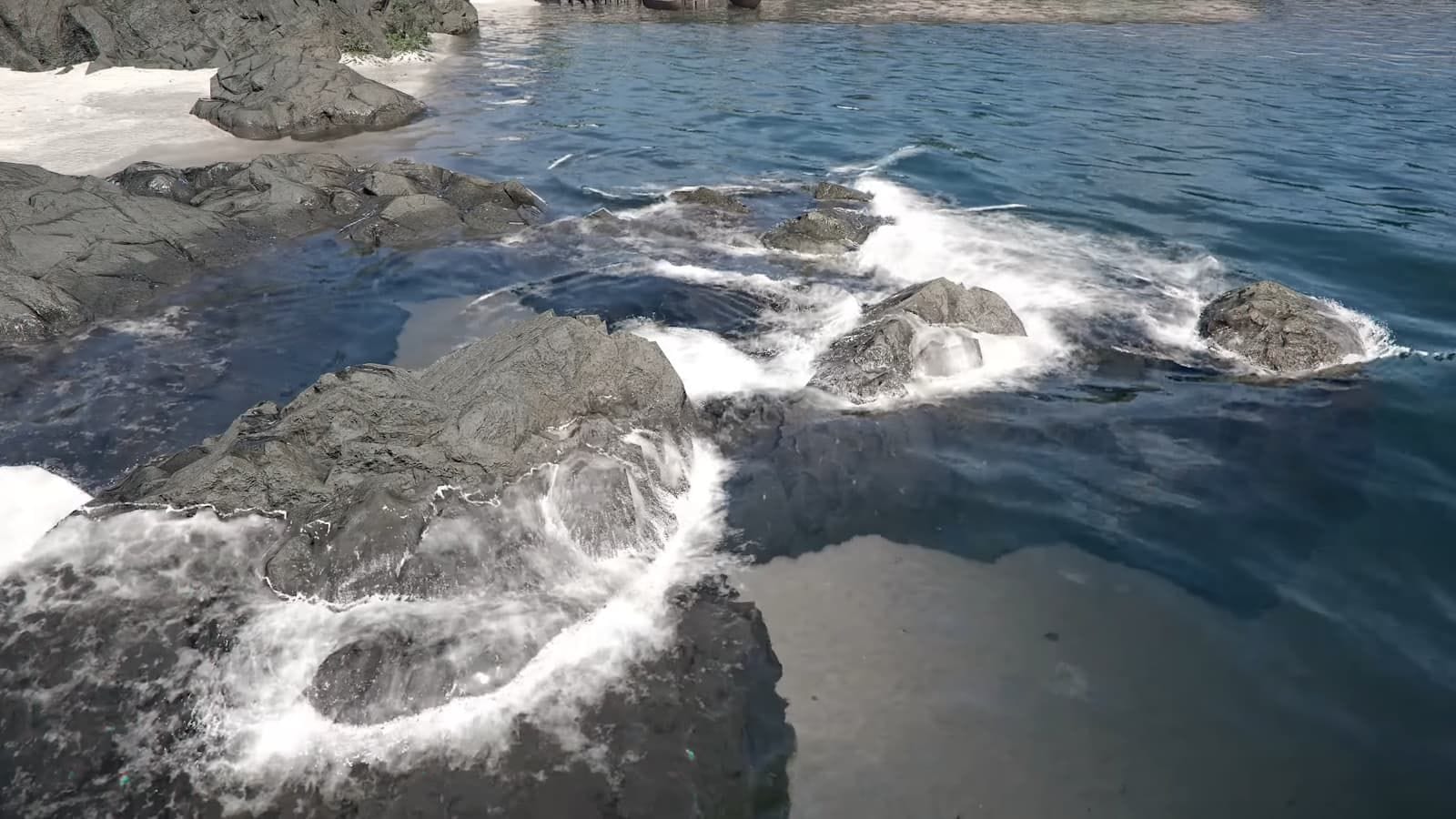
Where Crimson Desert really shines, though, is having the most visually accurate representation of water behaviour at shorelines. Waves come to shores and edges of water and recede naturally, and natural cups inside rock formations and terrain lap it up temporarily, too, leaving a pool of water till the next wave comes and takes it away.
Games as early as Just Cause 2 try to recreate some form of dynamic shoreline visual, and this is also present in Sea of Thieves. However, once you look at how well Crimson Desert does it, all past exampels are not remotely in the same league.
You can also see some very pleasant wave formation physics in this game (Image via Pearl Abyss || Youtube @DigitalFoundry)
This is achieved by a particle simulation that looks up local SDF to compute water behavior accurate to the geometry, as revealed in a recent Digital Foundry interview with Pearl Abyss:
“It’s a particle simulation that solves the Shallow Water Equation. It simulates up to 250,000 particles near the camera. The particles collide with boundary conditions such as terrain height and shoreline SDFs, and also collide with each other. When particles collide with an obstacle, the pressure between them is increased, causing the upper particles to rise. These particles then fall back down due to gravity.”
This approach is not computationally expensive, too, and the average RTX 20-series card possibly gets it done without much overhead. The same shoreline simulation also affects anywhere there’s shallow flowing water, like on brooks, streams, rivers, and waterfalls throughout Pywell. The foam and water crest textures are well-done enough that it’s lifelike.
What about water physics in general? Well, it’s certainly not frugal on particle effect overstimulations, so it gives you splashes and ripples to a generous extent even in calm waters (and Crimson Desert is essentially a CAG, so there will be a lot of that going around). You can see a good example even in the 2024 Crimson Desert Gamescom gameplay, where Kliff goes to a wetlands area to take on a goblin hoard.
Overall, the water graphics in general are so remarkable that it stood out to me even beyond how good this game looks in nearly every other category. There’s a bunch of finer details that push it up further, like light sources illumiating beyond the water surface, and puddles naturally forming and evaporating after rainfall.
Lighting beyond the veil (Image via Pearl Abyss || YouTube@DigitalFoundry)
Does it have the awe-inspiring grandeur of king tides lit by a sunset same as Sea of Thieves? That exact scenario remains to be seen, but even without it, Crimson Desert blows it out of the water.
Why did you not like this content?
Cancel
Submit
Was this article helpful?

Thank You for feedback
Edited by Sambit Pal