
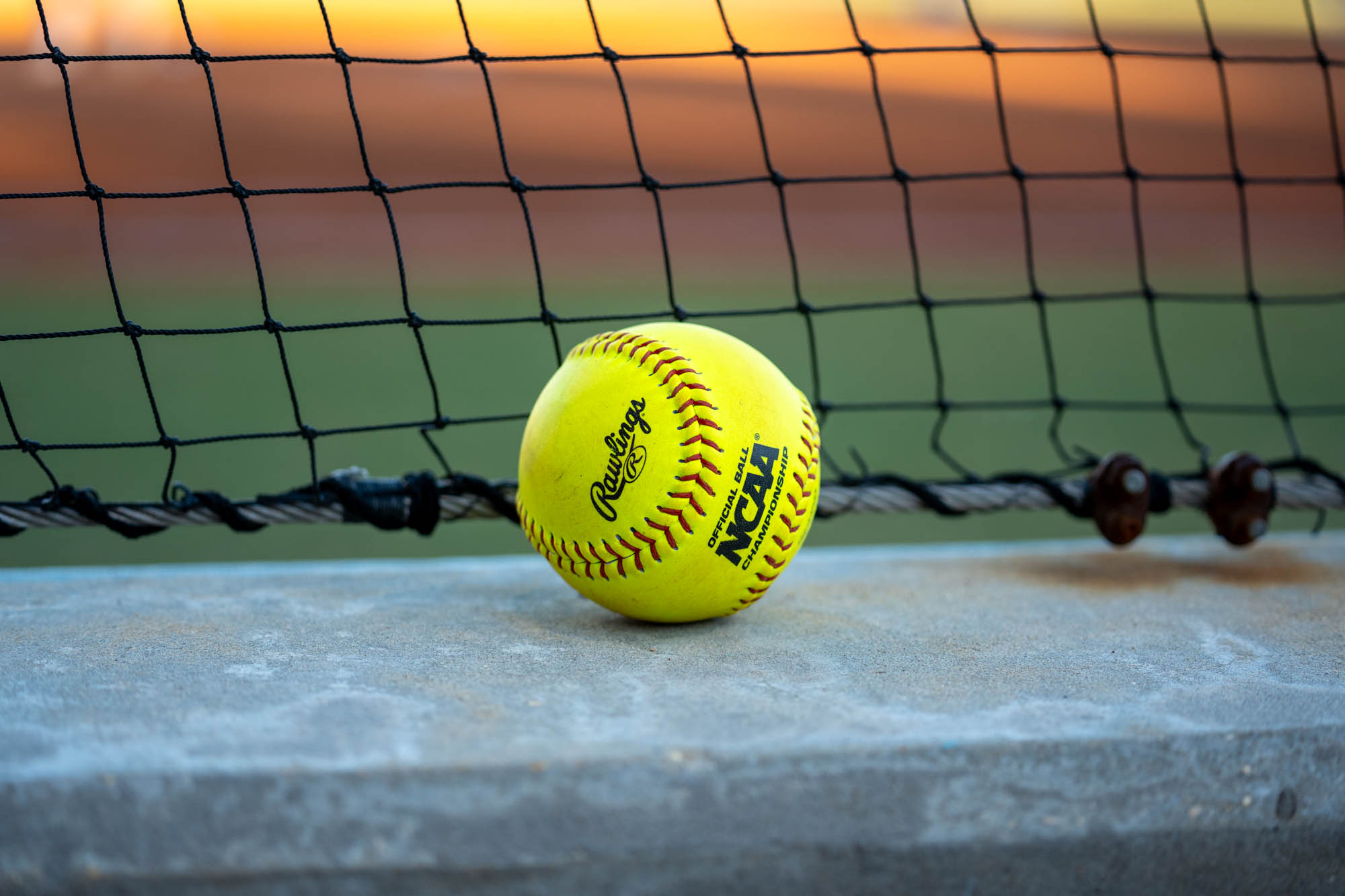
Meet Trackman, the software LSU math professors and students are using to help softball coaches build teams that win by combining probability with preparation.
Trackman is a doppler radar system that tracks every pitch and batted ball in 3D, capturing data about the ball such as velocity, spin rate and launch angle. Doppler radar systems are also known as “weather radar” because they are often used by meteorologists to track rainfall.
One researcher helping to launch Trackman is Nadia Drenska, an assistant professor in mathematics. Drenska is also a faculty advisor for the Math Consultation Clinic, a capstone project for seniors which helps units on campus make sense of their data, in collaboration with Zach Jermain and Beth Torina of LSU Softball.
“The data consists of information for every pitch thrown during a softball game here at Tiger Park,” Drenska said. “We record all sorts of metrics about it.”
Drenska sees this as a win-win for LSU Softball and the mathematics department: it’s an opportunity for mathematics students to build machine learning algorithms to analyze the probability of each ball thrown and hit and an opportunity for softball players to learn where to hit and where to throw for the most consistent results.
“What we try to do is to help make sense of all this data,” Drenska said. “Each game has around 200 to 250 pitches, which is a lot to analyze.”
According to Matthew Lemoine, a graduate teaching assistant with the LSU College of Science, both graduate and undergraduate students will be able to work with the data.
“The classes are structured to help undergraduate students work with graduate students to learn coding, machine learning, algorithms and things like that,” Lemoine said. “We’re using the softball data as a project to work on and to learn from.”
According to the researchers, Trackman is helpful at displaying a math model of a zero sum game, where one side has the clear advantage over another. These models are particularly useful for students enrolled in Math 4997, a vertically-integrated research class.
According to Gowri Priya Sunkara, a doctoral student at LSU who worked on the project, Trackman data can be used in all sports, regardless of how the ball is hit, thrown or kicked.
“For any kind of sports, Trackman is going to work,” Sunkara said. “It’s going to work for statistics, like exit velocities, how the ball spins and where it is going to land. So with that data, yes, it can be used anywhere.”
Trackman has already been used in sports other than softball, like baseball and golf.
But as a math Ph.D–turned–Director of Player Performance and Analytics for LSU Softball, Jermain was eager to use Trackman to help his team win games.
Lemoine helped to explain how the data can be applied to softball games.
“Whenever a batter goes up to home plate to hit the ball, if they’re left-handed or right-handed, they’re going to hit it in a certain way, and we want to analyze which way is it most likely to go,” he explained. “If they’re going to hit it more to left field, we need to move out outfielders towards left field so they’re more likely to catch the ball.”
Drenska says that Trackman helps LSU win in multiple ways — both through practical sports analysis and by providing crucial gametime statistics to help LSU softball form a winning team.
“I feel very proud of my students,” Drenska said. “I feel like everybody has done a really good job, and we’ve made some tangible progress to help our teams win.”