
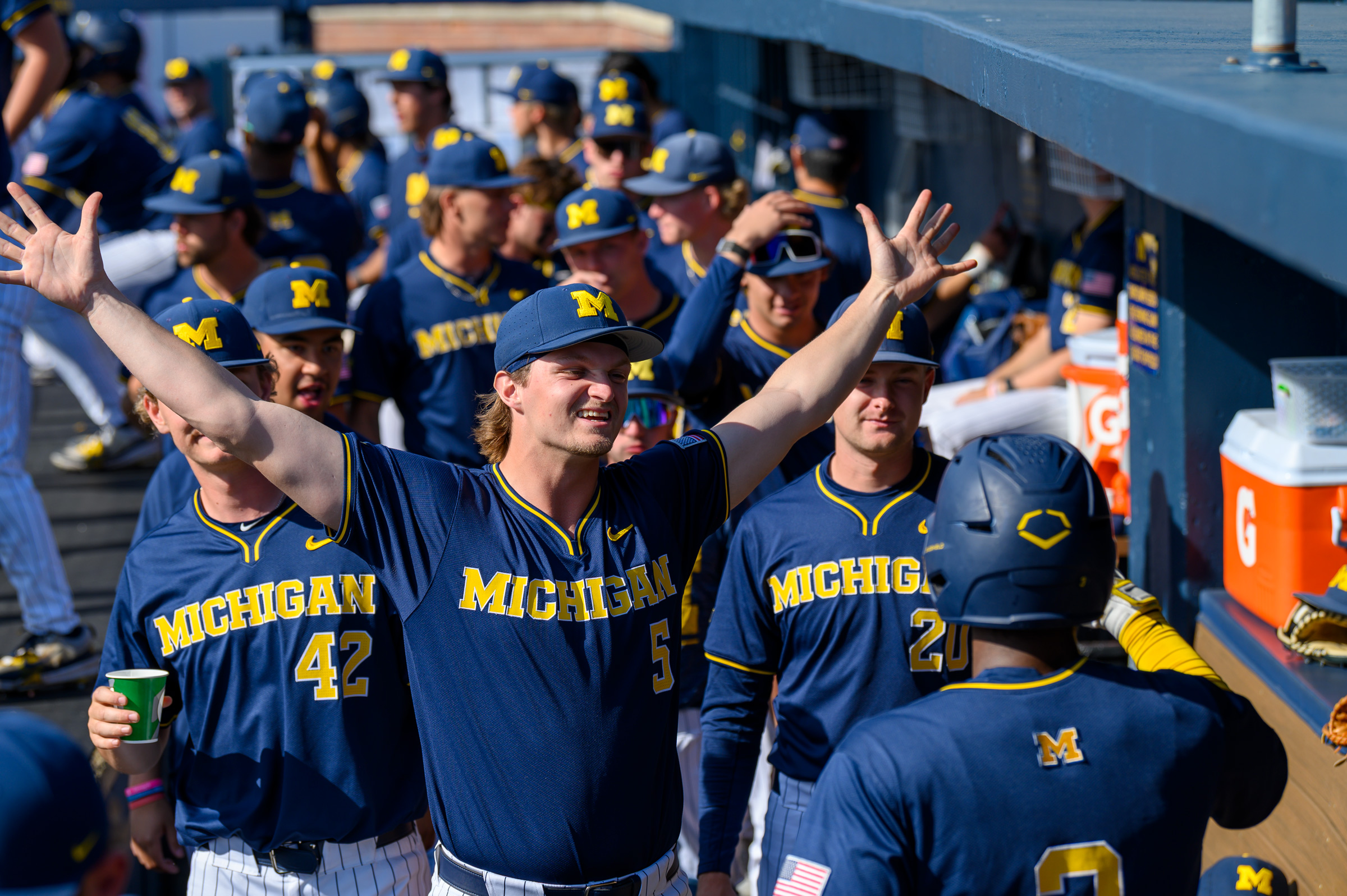
In the wake of evolving conference and team compositions, both the Big Ten and the Michigan baseball team have struggled to define a place for themselves in the NCAA Tournament. Last season, four new-member schools diluted the pool for the Big Ten Championship title, and an up-and-down season led the Wolverines to miss out on an NCAA Championship berth for the third consecutive year. Only three Big Ten schools — UCLA, USC and Oregon — represented the conference for the national title, and only UCLA made a College World Series appearance.
But that was last year, and 2026 brings the same seventeen teams into a fresh chapter with fresher history. Two second-year Big Ten schools bookend the college baseball rankings: No. 1 UCLA, shut out in the 2025 conference finals by Nebraska, and No. 25 USC, which crept into the leaderboard Sunday with an undefeated record to date, including a sweep against Illinois. The Big Ten is putting itself on the map, and with that comes additional internal pressure.
Michigan, a recent stranger to championship runs, ended conference play last year with a middle-of-the-road standing. As it attempts to shake that legacy in a conference that’s becoming more charged each game, it’ll have to outlast the rest of the Big Ten to make good on a goal four years coming. As the hours run down to the Wolverines’ first pitch at home, The Michigan Daily analyzes the history, recent changes and trajectory of the Big Ten in the 2026 season.
The Heavy Hitters
UCLA remains the favorite to win beyond the Big Ten itself, and it certainly conserves its momentum from last year’s trip to Omaha. It only helps that Big Ten Tournament MVP Roch Cholowsky returns as a high-power shortstop. And although the Bruins’ pitching rotation only retains Michael Barnett from last year, San Diego transfer Logan Reddeman already averages just a 2.95 ERA over 21.1 innings. The transfer portal also shored up their roster, bringing Will Gasparino from Texas, who leads UCLA’s individual batting averages by a wide margin with .434. But the team isn’t impenetrable. Its two losses this season come from games where San Diego State University and UCSD went for above-average homers, with three and four, respectively.
But the top-ranked team has more local competition. After 15 games, USC has accumulated a 1.47 team ERA — less than half the runs allowed of any other school in the Big Ten. While its team batting average and fielding percentage aren’t outstanding for the conference, the Trojans’ arms kept them as the only undefeated Big Ten team remaining so far this season. This development happened even with high turnover in the pitching staff, much like it did for UCLA. Andrew Johnson is the only returner and most lenient pitcher for USC, with a still-knockout 1.77 ERA.
Another former PAC-12 team entered 2026 with the taste of the NCAA Championships a recent memory. Like UCLA and USC, Oregon replaced nearly all of its starting pitchers. Only Collin Clarke remains, although he’s credited with the Ducks’ singular Big Ten loss against Michigan State. The new pitching staff ranks third in the Big Ten, with an average ERA of 3.48.
On the other side of the ball, Oregon is more dominant, holding the second-highest team batting average of the early season at .312, just behind another rising star, Iowa, at .340. Following a conference semifinal exit at the hands of UCLA, Iowa recovered 10-5 to start 2026, with the conference’s highest fielding percentage at .988. If there’s anything that inflates the Hawkeyes’ dark-horse initial statistics, though, it’s Iowa’s relatively lightweight schedule — its opponents collectively have a 8.95 ERA and lag behind the Hawkeyes in batting and fielding.
On Deck
There’s one title-winning team that hasn’t quite renewed its success from last season: Nebraska. The most recent Big Ten Tournament champion kicked off 2026 going 10-5 overall in a three-way tie for fifth in the conference with Iowa and Maryland. While it’s already taken one undefeated series against Michigan State, the Huskers’ 10th-inning, 5-4 win provides evidence that their aggressive batting is a high-risk, high-reward strategy. Returning shortstop Dylan Carey boasts a .456 batting average over all 15 games that he started in, which, along with the team’s overall .308 average, makes the gamble pay off just enough for one of the conference’s better records.
Another one of those better records belongs to Minnesota, which has the same 12-3 standing as Oregon. But like Iowa, it suffers from opponents batting .236 overall with 8.85 ERA — a schedule that could obfuscate some of the Golden Gophers’ weaknesses. Still, Minnesota already has 21 home runs to its name, and Easton Richter enters his second year on the team with six of them. As conference play begins, the Gophers could become an unlikely candidate for an improvement from their second-to-last regular-season placement last year.
The other potential wild card, boom-or-bust teams of the Big Ten have constructed less eye-catching statistics for themselves so far. But either as a function of their efforts against ranked opponents or improvement on elements that were missing last season, they’ve nestled into the solid center of the Big Ten.
Purdue’s offensive leader Logan Sutter, who slashed .367/.471/.709 in 2025, graduated the same year. Without him, the team’s current early-season batting average sits at .290. But where the Boilermakers retain a glimpse of their excellence is their defense, where all of their starters have perfect fielding percentages after 14 games. Purdue felled Oregon 2-1 in game 2 of their series, and its ironclad defense in those nine innings kept the new Big Ten giant from taking another victim.
Now 8-6, the Wolverines lie around this range of the Big Ten. Of the seventeen teams in the conference, Michigan is decidedly average. It ranks seventh in batting average with a .290. It also ranks eighth in fielding percentage with a .979. And it ranks eighth as well in ERA with a 4.66. Where former infielders Mitch Voit and Benny Casillas left a hole in the diamond, an array of freshmen and transfers have been offered up to fill it.
Where Rutgers differs in this lineup is the solution for its 2025 absences. Zack Konstantinovsky returns from an injury that sidelined him all of last year. Now, he’s logged 1.69 ERA over 21.1 innings pitched. As a whole, the Scarlet Knights bat .302, with returner Peyton Bonds hitting .431 to lead the team. But still, even with a statistically undemanding schedule, Rutgers settled in with an 8-6 record to open the season.
For a team on deck, Maryland shares the same problems as Nebraska — its schedule can’t predict its outcomes. But recent Big Ten Freshman of the Week Ryan Costello is a rising star pulling the team’s offense up with him. With respect to their record, a single three-game series against Louisiana is responsible for most of the Terrapins’ losing tallies. As far as Big Ten competition goes, Maryland could be on the up-and-up.
Caught Off-Base
Growth hasn’t been fully equitable in the Big Ten. Many programs in the conference plateaued at the bottom of the leaderboard years ago. Others join them early this season and look to reverse that trend as conference play gets underway.
Washington stalled after a sixth-place regular season finish in the Big Ten last year. While its early statistics place it towards the tail end of the conference, its 5-10 record is skewed by the Puerto Rico Challenge, where it unsuccessfully took on two ranked opponents: then-No. 17 North Carolina State and then-No.21 Wake Forest. The Wolfpack are now No. 10 and the Demon Deacons leapt to No. 12, putting the Huskies’ losses into perspective.
Last weekend, Indiana took one game against Washington before falling twice. Indiana’s edge in game 1 was a gift from the Huskies: a higher-than-typical number of walks. When Washington’s defense tightened up the next two games, the Hoosiers folded. After losing key pieces Korbyn Dickerson and Devin Taylor to the MLB draft, Indiana rebuilt, much like Michigan had to, but with less success so far.
Northwestern, like Washington, also struggled against a tough schedule, facing then-No. 5 Georgia Tech thrice and losing each time. A 6-7 record for the Wildcats is presaged by a bottom-five finish in the regular season last year, especially because they lost several players. Vincent Bianchina, an experienced outfielder primed to return from injury in 2026, is one of those losses, having entered the transfer portal after last season. But the Big Ten mainstay still looks to maintain — and possibly improve — its current standings for the potential of the first winning record since 2000.
Penn State, however, slipped for other reasons. Last season, its .500 record put it squarely in the middle of the Big Ten. High-profile pitcher Ryan DeSanto and outfielder Paxton Kling both left for the MLB Draft, and the Nittany Lions’ ERA and fielding percentage followed suit. An 8.71 ERA is the most allowed on average for any team in the Big Ten, and Penn State’s .966 fielding is only .001 higher than that of Indiana.
At the First Pitch Invitational, Michigan State and Illinois met in only the third week of play. After ten innings, the Fighting Illini came out on top. Statistically, this follows from the major batting, fielding and pitching rankings — Illinois sits thirteenth, ninth and sixth, respectively. On the other hand, the Spartans claim the lowest batting average of the Big Ten by a significant margin with a .188.
The Spartans aren’t alone, though. The next-lowest batting average belongs to Ohio State at .229, who also finished last in the 2025 regular season. And while the team entered this year hopeful about a full class of transfers and recruits, the Buckeyes have fallen to their own pitching staff — who average a 6.79 ERA — several times this year.
If there’s one thing that the Big Ten can call its own this year, it’s tumult. The former PAC-12 influx is still palpable in the early-season results, and there’s early upwellings of a reversal from the 2025 season’s conference rankings. While top-ranked UCLA currently claims one of the most well-rounded spots in the Big Ten, it’s joined by No. 25 USC, an Oregon team that didn’t quite live up to last year’s high expectations and a potential threat in Iowa. As for Michigan, it lurks in the median right now, waiting to get swept up in the change for better or for worse.
Related articles