
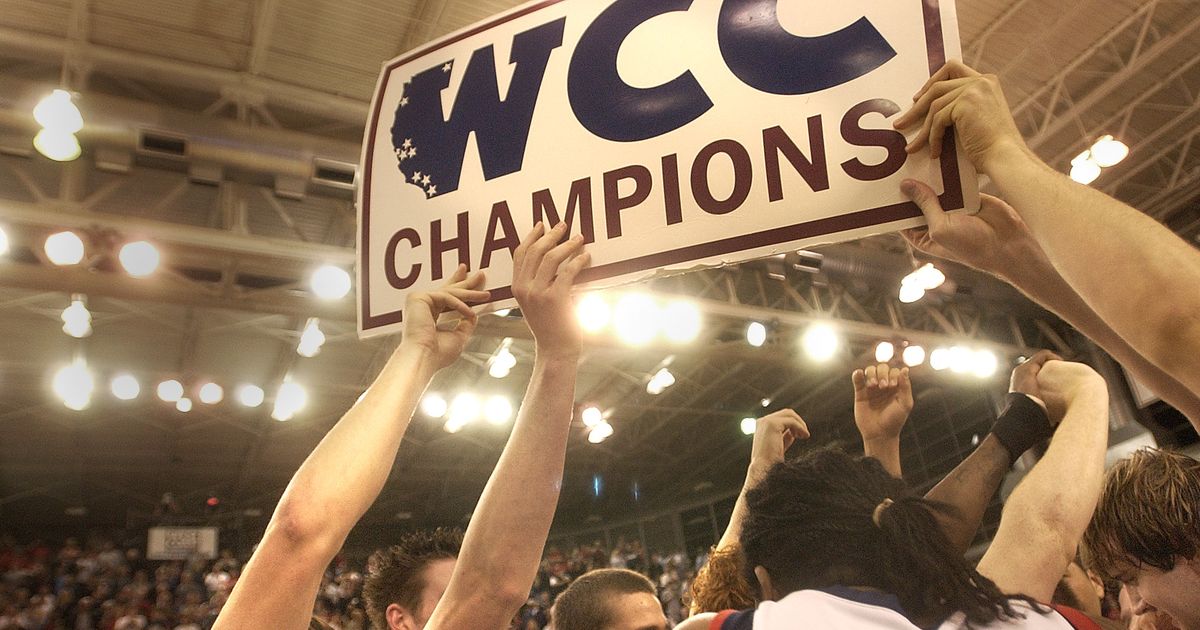
Gonzaga is bound to make more memories at the conference tournament when it officially leaves for the Pac-12 in a few months’ time. There’s a good chance the Zags will make many of those in Las Vegas, not far from where they’ve played the last 18 conference tournaments a couple miles off the Strip at the Orleans Arena.
But after 39 years, Gonzaga will officially bid farewell to the West Coast Conference Tournament next week. The top-seeded Zags (28-3) open with Monday’s 6 p.m. (ESPN) semifinal against an opponent still to be determined – either Portland, San Francisco or Oregon State.
Gonzaga’s appeared in every WCC championship game since 1998, winning 21 titles during that span. The Zags own a 68-17 record all-time at the tournament and a stellar 54-6 record under 27th-year coach Mark Few.
Before they travel to Orleans Arena for the final time, we took an extended trip down WCC tourney lane to revisit the players, recapture the moments and rehash the memories that have defined the last four decades.
The heroes
Twenty-two Gonzaga players have earned the distinction of WCC Tournament MVP. A select group of three have claimed the event’s top individual award twice. Rather than run down the full list of 22, we trimmed it down to the trio of multi-time winners and highlighted two other MVP recipients that delivered for the Zags in big moments.
Dan Dickau: The sharpshooting guard stuffed dozens of memorable performances into his two seasons at Gonzaga and never had a bad game at the conference tournament. Dickau won back-to-back MVP honors in 2001 and ’02, scoring 133 points over six conference tournament games, or an average of 22.1 points.
Concerned about Dickau’s slow start in the 2002 title game against Pepperdine, Few said to one of his assistants: “Man, Dan isn’t playing very well right now.”
It didn’t take him long to get going. The guard still finished with 29 points, making 10 of 19 shots and 4 of 9 from the 3-point line in a 96-90 victory.
Ronny Turiaf: There’s two things you may recall about the 2004 tournament. Both probably involve Turiaf. The center was crucial in a narrow semifinal win over Santa Clara, scoring four of his 10 points in the final 41 seconds – including two go-ahead putbacks – to help Gonzaga prevail 63-62.
Turiaf’s efforts weren’t needed down the stretch of the championship game the following day. That’s mainly because he did most of his work early, scoring 29 points and grabbing 14 rebounds to help the Zags gain separation and cruise past Saint Mary’s for an 84-71 victory.
Adam Morrison: The All-American was a scoring machine his final two seasons at GU and did some of his best work at the conference tournament, nabbing MVP trophies in 2005 and ’06.
Morrison was responsible for a large share of Gonzaga’s offensive production in the 2005 tournament, scoring 55 points – including a career-high 30 in the title game against Saint Mary’s – to go with 11 assists over two games.
He returned to light up the same event as a senior, totaling 47 points, 10 rebounds and seven assists to help Gonzaga edge San Diego 96-92 in an overtime game and then clip LMU 68-67 in the championship.
Kyle Wiltjer: In the same vein as Dickau, Wiltjer arrived at Gonzaga as a transfer and left as a two-time WCC Tournament MVP.
The sharpshooting wing did a little of everything for the Zags during a run to the 2015 championship, nearly averaging a double-double – 18 points and nine rebounds – while connecting on roughly 60% of his shots.
Wiltjer scored 59 more points in Vegas the next year, helping the Zags navigate a tight semifinal against BYU with 29 points anf eight rebounds.
Killian Tillie: The double 3’s on the back of Tillie’s jersey were fitting for what the forward did in the 2018 tournament. The Frenchman was an easy choice for MVP after he scored 72 points and finished 13 of 14 from the 3-point line in three games against LMU, USF and BYU.
“Whatever he did, whatever he’s eating I want to get on the same plan,” Gonzaga guard Josh Perkins said. “He was fantastic.”
Tillie looked at ease shooting in Vegas the following year, drilling 4 of 5 from behind the arc against Pepperdine and Saint Mary’s.
Had to be there
Gonzaga’s dominated the WCC Tournament, losing just a handful of games under Few and winning every game since 2008 against opponents not named Saint Mary’s. But many of the games haven’t been cakewalks, requiring clutch performances down the stretch, buzzer-beating shots and everything in between.
‘Back again’: After stomping Saint Mary’s 105-65 in the quarterfinals and overcoming a 14-point first-half deficit in a semifinal against San Diego, the Zags established a 13-point lead against Santa Clara in the championship and appeared to be coasting to their third straight title.
But the Broncos rattled off 11 quick points and the Zags had to survive 10 second-half 3-pointers to secure an 80-77 win. It required clutch free-throw shooting from Dickau, who went 6 of 8 in the final 96 seconds to help the Zags maintain their cushion.
“This is so sweet because everyone expected us to drop off,” Casey Calvary said. “But we’re back again.”
Dickau delivers again: Dickau’s calmness was tested again the following year as the Zags faced the Pepperdine team responsible for their only WCC loss. After an 88-79 setback in Malibu, the Zags ripped off 13 straight wins before meeting the Waves in the championship game.
Hours after earning the No. 6 AP ranking, the highest in school history, GU entered the title game looking to set records for single-season wins (29) and consecutive wins (14).
They accomplished both, but not without a bit of drama.
Gonzaga watched a double-digit lead melt away late and only led by five with under a minute left. Pepperdine’s Jimmy Miggins sent Dickau to the ground on an inbounds play, then received an intentional foul for shoving the GU guard back to the floor moments later.
On a 29-point night, Dickau calmly made the free throw to open up a six-point lead the Zags wouldn’t relinquish.
P-Mac attack: On a 34-point night for Adam Morrison, the Zags still needed a final push to overcome a resilient San Francisco team in the championship game at McCarthey Athletic Center.
And they needed it to come from someone other than Morrison.
With the game tied at 72-72, the nation’s leading scorer was trapped by two USF players in the closing seconds. Morrison couldn’t shoot, but he managed to swing the ball to Pierre Marie Altidor-Cespedes, a sophomore averaging four points.
Altidor-Cespedes rose, fired and connected with one second remaining, lifting the Zags to a thrilling victory that guaranteed a second straight unbeaten WCC season.
“There was no doubt when it left his hands it was going in,” Few said.
Quarterfinal drama: More often than not at the WCC Tournament, the Zags have cruised in quarterfinal or semifinal games before facing real adversity in the championship game. It was the exact opposite in 2014.
In a first-round game against Santa Clara, the Zags were up by five points in the final minute, but a Broncos team led by star freshman Jared Brownridge managed to make two quick baskets and tie the score just 24 seconds later.
With nine seconds remaining, David Stockton curled around a ball screen, drove to the basket and made a twisting layup to help lift the Zags to a 77-75 victory.
Gonzaga stayed in control the rest of the tournament, beating Saint Mary’s 70-54 in the semifinals and BYU 75-64 in the championship game.
26-0: Six-thousand fans would’ve loved to watch Gonzaga cut down nets in Vegas, capping a perfect regular season with a WCC Tournament crown, but none were permitted in 2021 due to tight COVID-19 attendance restrictions.
The Zags breezed past Saint Mary’s in their semifinal game, but a team that wasn’t accustomed to experiencing turbulence found some in the championship game against BYU. The Cougars led by as many as 14 points in the first half, but a Jalen Suggs-led GU team came out with guns blazing in the second, outscoring BYU by 22 points after the break to win 88-78.
Had to have it
Few’s reminded fans over the years – more times than he can count, probably – that NCAA Tournament appearances at Gonzaga aren’t a birthright. A handful of his teams can relate to that message better than others. The vast majority locked in at-large NCAA status before traveling to the WCC Tournament, but a smaller pool of teams – five by our count – actually had to play their way in. What a concept, right?
1995: The school’s initial NCAA Tournament appearance didn’t look like it was going to happen for long stretches of the 1994-95 season. Certainly not after a wretched start to start conference play that saw the Zags lose six straight games.
Apparently, the Zags just needed to get to the WCC Tournament. Once there, they dispatched three straight opponents, winning by no fewer than 10 points in any of the games to punch the school’s first ticket.
It was all thanks to a really good tournament – or, “Rillie” good tournament – from a certain Australian guard.
John Rillie scored 96 points over three days, totaling no fewer than 30 in a single game, to send the Zags dancing for the first time in school history.
2000: “The streak” was all of one year old (and by definition, not a streak yet) when the Zags traveled to Santa Clara for the tournament in 2000, carrying a number of quality wins but also eight losses.
There’s no telling if Gonzaga would’ve made a second straight appearance had it failed to beat Saint Mary’s, San Diego and Pepperdine in consecutive days to clinch an automatic bid.
The Zags won convincingly against the Gaels and Toreros, but flirted with disaster against the Waves, narrowly losing when Pepperdine’s Tezale Archie missed a potential game-winner at the end of regulation. The tournament finale went to overtime, where Gonzaga would score the first eight points and sweat out a few more nervous moments to win 69-65 and punch their ticket.
“I’m just happy to be back at the Dance,” guard Matt Santangelo said. “It’s just nice to come down and get it out of the committee’s control and do it ourselves.”
2007: A rugged stretch during nonconference play saw Gonzaga lose six of 10 games at one point and NCAA Tournament hopes were put into serious jeopardy when Few’s team dropped four more games before the WCC Tournament arrived.
Without suspended star Josh Heytvelt, the Zags managed to play their best basketball when it was needed, handling San Diego 88-70 in the semifinal before defeating Santa Clara in the championship game, thanks in no small part to the 28 points supplied by Derek Raivio.
2011: A three-game losing streak is nearly incomprehensible for Gonzaga these days, but the 2010-11 squad had multiple, losing nine total games in the regular season with five of those coming by one or two possessions.
The Zags finally came out on the right end of one of those against San Francisco in the semis, winning 71-67, then broke away from Saint Mary’s in the second half of the championship game. Rob Sacre, Steven Gray, Marquise Carter and Sam Dower all reached double figures for GU.
“It’s a great feeling knowing that come Sunday, we’re not sitting there sweating,” Gray said. “It’s a great feeling to know we’re in.”
2016: The stakes couldn’t have been higher for a group that had to overcome injuries, poor luck in close games, inconsistent backcourt play and a tough BYU team that nearly sent the Zags packing in the semifinals.
Wiltjer wouldn’t allow it to happen, scoring 29 points on five 3-pointers to help Gonzaga fend off BYU for an 88-84 win, setting up a championship tilt against Saint Mary’s.
With seven losses, an automatic bid was considered to be GU’s only chance of stretching its NCAA streak to 18 years. Playing with a level of desperation, the Zags got 58 combined points from Eric McLellan, Josh Perkins, Domantas Sabonis and Wiltjer to win 85-75 and secure their bid.
“This group, what we had to go through with all the adversity, the sky is falling stuff, to be able to power through, stay positive and get it done makes this one really special,” Few said.
Heartache and heartbreak
The pleasant memories greatly outweigh the dreadful ones, but it hasn’t always been a perfect ride for Gonzaga at the WCC Tournament. We look back at five memories fans won’t necessarily want to revisit once the Zags officially part ways.
Starting on a sour note: Gonzaga will hope things go much smoother in its final WCC Tournament than they did in the first. During the inaugural WCAC Tournament in 1987, heavily-favored Gonzaga (18-9) opened with a home game against struggling Pepperdine (10-17) – the victor traveling to San Francisco’s War Memorial Gymnasium for the remainder of the event.
“San Fran or Bust!” one Martin Center sign read.
After a stunning 76-73 victory that required Pepperdine to make key free throws down the stretch, it was the Waves who’d be making the trip, thanks in large part to 28 points from guard Craig Davis, who was 0 for 11 in two previous matchups against Gonzaga. Dale Haaland, father of current Gonzaga senior Noah Haaland, had 13 points and 13 rebounds for GU.
More Pepperdine pain: Gonzaga had designs on spoiling Pepperdine’s 30-game WCC win streak roughly two weeks earlier, but came up short in a 75-63 loss. The Zags bought themselves another opportunity, making their first WCC championship game in 1992.
Gonzaga played the Waves closer than it did in the previous meeting, but a Pepperdine team led by tournament MVP Doug Christie – now the head coach of the Sacramento Kings – prevailed 73-70 to win its 33rd straight game and second straight WCC championship.
Grier gets his moment: Longtime Gonzaga assistant Bill Grier had a hand in many of the program’s best moments from 1991-2007. In 2008, he was also responsible for one of the worst.
After leaving GU’s staff to accept the head coaching job at San Diego, Grier quickly built the Toreros into an NCAA Tournament-caliber team. But actually grabbing a bid meant going through his old employer in the championship game.
Failing to make a 3-pointer for the first time in 491 games, the Zags still clung to a second-half lead before the Toreros sped off on a scoring run to eventually capture a 69-62 victory.
“I’m really happy for Billy, he’s like a brother,” Few said. “He’s done a great job with this team.”
Delly digs deep: If Gonzaga fans weren’t already tired of seeing standout Saint Mary’s guard Matthew Dellavedova, imagine how they felt after the title game in 2012. The Australian point guard had 46 points in two matchups with the Zags earlier in the season and planted the final dagger with 22 points in a 78-74 overtime win.
Dellavedova didn’t come off the floor, playing 45 minutes and hitting four critical free throws inside the final 40 seconds.
Streaks snapped: The Zags hadn’t lost a game since dropping consecutive contests to Tennessee and North Carolina during nonconference play. They hadn’t squandered a WCC title since 2012, winning six straight.
Both streaks were extinguished in 2019 for a group ranked No. 1 in the nation.
Gonzaga’s 21-game win streak came to an end on a night when Few’s team couldn’t find the bottom of the net. The Zags finished 2 of 17 from the 3-point line and were held to their lowest point total of the season – by a considerable margin – in a 60-47 loss.