
We may receive a commission on purchases made from links.
2025 both was and wasn’t a great year for gaming hardware and gadgets. On the positive side, Nintendo’s Switch 2 launched to much critical acclaim and record-breaking sales, even if we thought its $449 launch price was on the high side in our review. On the flipside, AI-driven RAM price hikes were a downer for PC gamers hoping to upgrade toward the end of the year, and may have even led to Valve delaying its Steam Machine.
Of course, there’s a lot more to gaming gadgets than big-ticket consoles and gaming PC components. In that regard, 2025 was quite an interesting year no matter your persuasion. Plenty of interesting gadgets came to market across those 12 months, targeting PC and console gamers alike. From high-end controllers and cutting-edge wireless headphones to modern recreations of retro consoles and some very funky (and ground-breaking) peripherals, let’s take a look at some of the coolest gadgets that 2025 had to offer.
Dry Studio Battleye 74.5 RT
Generally speaking, it’s hard to make a cool gaming keyboard. Don’t get us wrong: There are plenty of great, highly-rated gaming keyboards available, but they’re generally only for keyboard nerds. The Dry Studio Battleye 74.5 RT, though, is a bit different.
Fundamentally, the Battleye is nothing too new. It’s a 75%-ish Hall effect keyboard that offers all the benefits of the technology, including improved durability, adjustable actuation, and rapid inputs. Where it stands out, though, is the design. First up, the feet. While most keyboards have feet that are either extended or retracted, the Battleye’s feet can be adjusted between 6 and 11 degrees in increments of 0.5 degrees.
That said, the Battleye’s highlight is undoubtedly its body. It’s a CNC aluminum case with a honking big rotary knob and circular touchscreen in the top-left. The knob lets you switch keyboard modes, while the screen lets you keep track of said modes. It even shows a “power gauge” that indicates how hard you’re pressing a key — the sort of funky touch we appreciate, even as all these end up ballooning the cost of the keyboard to more than $300.
My Arcade Sonic the Hedgehog Mighty Player
Retro gaming has come back in a big way in the 2020s. We have FPGA home consoles like the Analogue 3D, a ton of Android-based handheld emulation devices for those who like to game on the go, and also casual tabletop devices like the My Arcade Sonic the Hedgehog Mighty Player.
The My Arcade Mighty Player is the result of a collaboration between My Arcade and Sega, and came out at the tail end of 2025. Like other My Arcade products, it’s a mini arcade machine dedicated to a particular game, or series of games. In this case, it’s those featuring Sega’s famous mascot, Sonic.
The Mighty Player is a three-button machine retailing for around $120 that lets you play four old-school “Sonic” games. These are “Sonic the Hedgehog,” “Sonic the Hedgehog 2,” “Sonic Spinball,” and “Sonic 3D Blast.” It displays the games on a 3.5-inch display and features some nice touches, like a light-up Sega marquee, to help recreate the authentic arcade experience. My Arcade also released a smaller and more affordable Sonic Joystick Player, which only features the first two Sonic games and has a different three-button layout.
NZXT Capsule Elite
There are plenty of microphones out there, but few look quite as classy as the NZXT Capsule Elite, which the company announced (alongside other Elite gear) at the start of 2025. The $140 device does what every gamer-friendly mic needs to do, but ups the ante with great audio quality and a sleek, minimal look that would look equally at home on a Twitch stream or in a serious Zoom meeting.
As with other gamer-focused mics we’ve reviewed in the past, like the Razer Seiren V3, the Capsule Elite is a USB microphone that connects directly to your computer via USB-A. However, it stands out for supporting 192-kHz, 24-bit audio, which it captures via a relatively large condenser capsule. It’s not just marketing, either; reviews found that the Capsule Elite sounds great, with voices sounding clear and natural, with a pleasing warmth.
The Capsule Elite also has an integrated pop filter, an adjustable stand that also lets you tilt the mic sideways, and support for software-level tweaks via NZXT’s Cam software. These include noise removal, equalization, and a compressor.
GameSir G7 Pro
GameSir has made a name for itself with some great-quality and affordable controllers, and the G7 Pro is another home run from the Chinese company. The GameSir G7 Pro is a higher-end version of the G7 SE that made it onto our list of the best PC-compatible controllers that reviewers say rivals the $200 Xbox Elite Series 2 at less than half the price.
Where the G7 SE was a pretty basic controller, barring a novel vibration motor setup, the tri-mode G7 Pro comes loaded with a selection of more premium features that justify the Elite Series 2 comparison. These include drift-proof TMR analog sticks, Hall effect analog triggers, mini bumpers, lockable back buttons, and optical ABXY buttons. It also has a gyroscope, which is a nice feature, if one that’s PC-only.
Now, the G7 Pro isn’t perfect, with one major issue being its wired-only Xbox connectivity — PC users get 2.4 GHz, while Android gamers can use Bluetooth. Reviewers also weren’t impressed by the D-pad, which may be a dealbreaker for some. Beyond that, though, the G7 Pro offers impressive value for $80 or so, especially since it comes with a charging dock in the box as well.
Analogue 3D
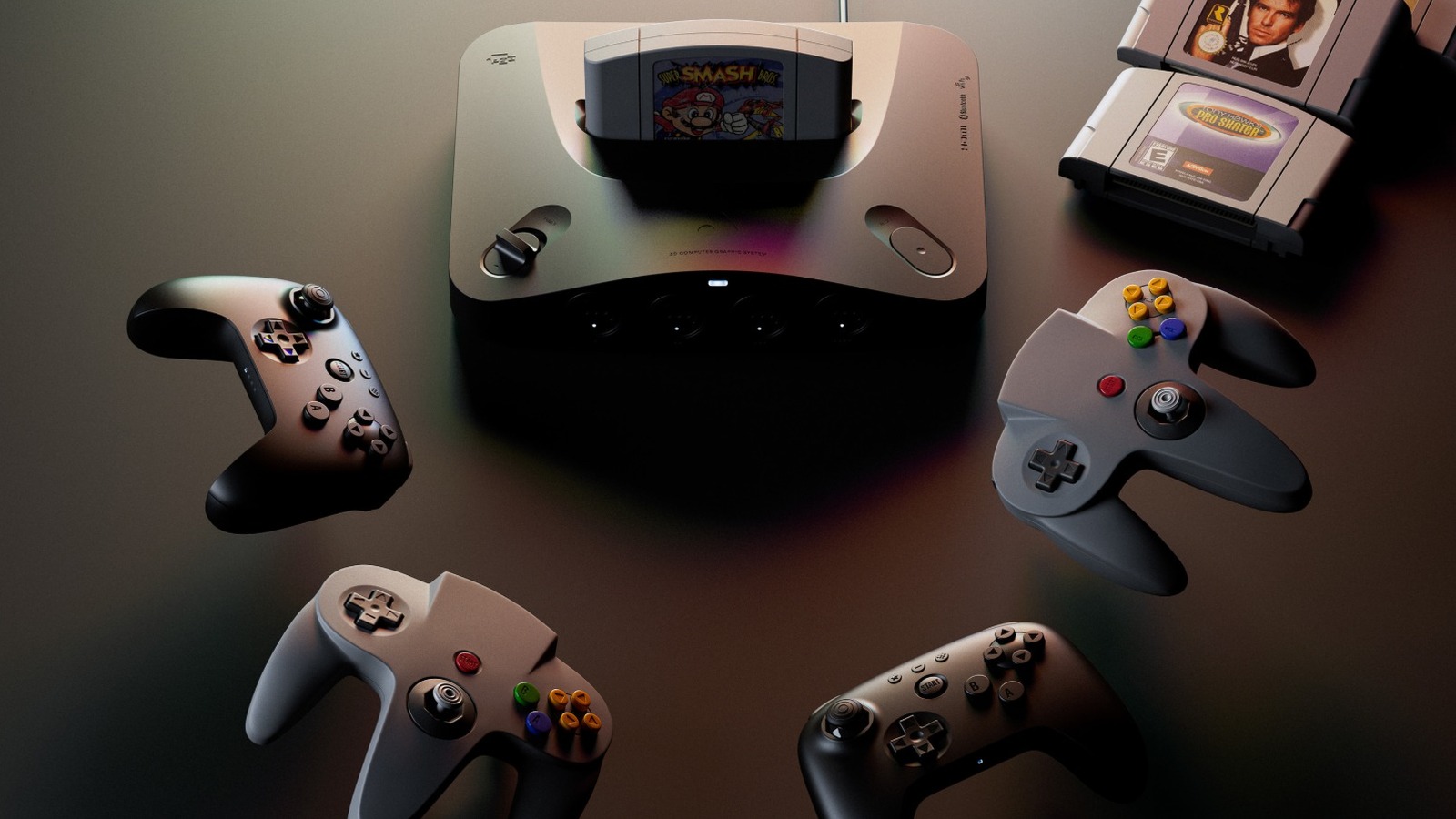
Gamers love the Nintendo 64, not least because it was the home of classics such as “Super Mario 64” and “The Legend of Zelda: Ocarina of Time,” to name a couple. In 2025, the long-delayed Analogue 3D finally debuted, bringing this classic library into the modern day.
The Analogue 3D, which the company first announced in 2023, is an FPGA gaming console that faithfully recreates the original Nintendo 64 hardware without relying on emulation. This allows it to offer a fully-authentic N64 experience without any inaccuracies or compromises, but one that’s also blissfully free of the headaches often involved with retro gaming. Thus, you won’t need an upscaler, nor will you be tethered to the console with wired controllers.
Analogue’s N64 recreation comes with a host of improvements, of course. These include, but aren’t limited to, 4K output (with CRT emulation filters for that old-school look), Bluetooth connectivity, dual-band Wi-Fi, and an overclocking feature for those who want to sacrifice authenticity for a performance boost. Reviewers loved the Analogue 3D, and it looks to have been well worth the wait, even with its $270 price tag.
G’aim’e light gun
Old-school CRT monitors have several advantages over modern flat-screen panels, but one perhaps under-acknowledged advantage is flawless support for light gun games like “Duck Hunt.” Now, flat screens can sometimes work with light guns, but it’s not consistent. That’s where products like the G’aim’e, come into the picture.
The G’aim’e light gun, designed in collaboration with Bandai Namco, uses a combination of AI smarts and a barrel-mounted camera to recreate the light gun experience on modern flat-screen TVs. The camera tracks your movements, while a small set-top box mini console runs the game and does the rest. Reviews have generally been quite positive, although it’s not quite on par with old light guns: There is some latency, and the gun’s aiming does exhibit some jitter.
The G’aim’e won’t entirely render light guns obsolete, then, especially for gamers who want the most authentic experience possible. It’s also limited, as far as we can tell, to the games available on the console, with the cheapest $99 version only coming with “Time Crisis.” So, while it definitely has limitations, it’s a pretty way to get some light gun action in your life without having to make space for a bulky CRT.
Orbital Pathfinder
For most of their history, computer mice — including the best gaming mice — have generally had fixed shapes from the factory, with users relying on trial-and-error to find the right configuration. Some companies have experimented with modular mice, but 2025 saw what is probably the most serious attempt to offer a properly modular mouse thus far in the form of the Orbital Pathfinder.
The Pathfinder is a $190 gaming mouse from Thailand-based Orbital Works that stands out from the crowd with its extremely customizable — if still right-handed-only — body. The company claims that the mouse has more than 3,000 configurations, with users able to swap the left- and right-side panels and the hump, as well as add spacers to adjust the mouse’s length and width.
Beyond that, the Pathfinder has all the specs necessary in a high-end modern gaming mouse. That means, essentially, a top-tier PixArt sensor, 8,000 Hz polling, sub-60-gram weight, and long-lasting optical switches. Reviewers generally liked the Pathfinder, but even if they didn’t, it would still be one of the most interesting mice to come out in a long time.
Anbernic RG 34XXSP
Nintendo’s Switch may be the handheld success story of our times, but it’s really just the latest in a long series of Nintendo handhelds with iconic form factors. It’s also not the only one to inspire a whole legion other consoles like the Anbernic RG 34XXSP.
The “SP” in the Anbernic’s name is a reference to the Game Boy Advance SP, a clamshell version of the Nintendo Game Boy Advance that debuted in 2003. It’s a refinement of the company’s RG 35XXSP in a smaller case that almost perfectly replicates Nintendo’s 2000s handheld — with some physical updates, of course. These primarily come in the form of dual analog sticks at the bottom, additional shoulder buttons, a much-improved D-pad, and a larger (but still 3:2) screen.
While the Anbernic follows the GBA SP’s form factor, it’s a Linux-based machine that can do a lot more. That said, the weak processor means that your best bet is to stick to PS1-era and older titles. Its 3:2 screen also isn’t an ideal fit for other systems (many of which were designed for 4:3 displays), but the extra bezels are perhaps a small price to pay if you’re seeking a GBA-first handheld.
Gamakay x NaughShark NS68
Hall effect keyboards have come a long way since Wooting first launched a crowdfunding campaign for its 60HE keyboard in 2021. What was once niche tech is now ubiquitous in e-sports circles and has become supremely attainable even for the most budget-restrained gamers. One of the most notable examples of this is the Gamakay x NaughShark NS68.
The NS68 debuted at $40 yet packed all the essentials a modern competitive gamer would need: It boasts a compact layout, durable PBT keycaps, hot-swappable Hall effect switches, 8,000 Hz polling, and software configuration. The latter allowed access to signature Hall effect features like adjustable actuation (rapid trigger), dynamic keystrokes, and Razer Snap Tap-style functionality.
Of course, you’re making some sacrifices here, notably in the form of a relatively flimsy plastic case (and a typo on the strap on early versions). But it’s hard to argue against what the NS68 offers for $40, and it’s a great way to dip your toes into the Hall effect world. The NS68 is available in wired and tri-mode versions.
SteelSeries Arctis Nova Elite
It’s hard to make gaming headphones stand out, but SteelSeries gave it a go in 2025 when it debuted the Arctis Nova Elite. These gaming headphones are a properly high-end pair that will set you back $600 — pricey, but not entirely unjustifiable based on its features.
The key feature of SteelSeries’ Arctis Nova Elite headphones is an upgraded GameHub base station, which now has three USB-C inputs, analog line in (and line out), and Bluetooth connectivity. You can use the inputs simultaneously, as SteelSeries’ software lets you mix these streams to your liking. It also lets you EQ the headphones and the mics, engage spatial audio, and download (and apply) presets, among other features.
The Nova Elite headphones have a two mics: a retractable boom mic with AI-based noise canceling and a lower-quality beamforming mic. It also comes with two batteries, and you can charge one in the GameHub base station while you’re using the other and quickly swap between them. On top of that, they also sound really good, too, making these potentially an appealing pair for the gamer who already has it all.
Angry Miao Infinity
The 2020s have seen gaming mice converging on a set of similar shapes, features, and aesthetics, with usually only minute details separating one from the other. That’s not the case with the Angry Miao Infinity, though, which released in 2025.
The Infinity’s most novel feature is its hot-swappable battery, which the manufacturer advertises as having a 1.2-second charge time. This is admittedly perhaps a bit gimmicky, but it’s still a nice feature — especially when it doesn’t seem to have major downsides. Angry Miao’s $130 mouse also has an interesting design, with a look inspired by the Lotus Evanora concept car. The futuristic-yet-minimalistic design also has the bonus of keeping weight down to 49 grams with the battery, or 39 grams without.
Angry Miao pairs these features with the usual hardware one would want from a $100-plus gaming mouse. Thus, we get a top-tier PixArt PAW3950 sensor, 8,000 Hz polling, and TTC optical switches rated for 100 million clicks.
Backbone Pro
Mobile gaming has come a long way; today, you can even play some PC games on an Android phone thanks to emulators like GameHub. Input methods have evolved, too, with controllers like the Backbone Pro proof of just that.
The Backbone Pro is, as of 2026, the company’s newest offering. It’s a step up from its previous Android and iPhone gaming must-have, the Backbone One. Like the One, the Pro is a telescoping controller that clamps your phone between its two halves. It connects via USB-C or Bluetooth, with the latter meaning that you can use it as a standalone controller too. Other hardware highlights include full-sized ALPS joysticks, a set of extra rear buttons, and Hall effect triggers.
Backbone has an app that offers additional functionality, including button remapping and game launching. The basic features are free, but Backbone locks features like built-in emulators behind a $3.99/month subscription. This may be a bit of a downer for some, especially considering the Pro’s $170 MSRP. Still, there’s no faulting the hardware itself, with its great materials, build, and feel.
Super Pocket Neo Geo Edition
The original Neo Geo was one of the most expensive game consoles of all time, debuting in 1991 and offering an arcade-perfect experience for the princely sum of $650. Those days are long past us, though, as the Super Pocket Neo Geo Edition proves. This portable gives you access to all of that arcade-honed 2D goodness for just $70.
The Super Pocket Neo Geo is a small, Nintendo Game Boy-styled handheld console that, as the name suggests, focuses exclusively on emulating Neo Geo games. It has a 2.8-inch, 240p IPS screen, comes with 14 games, and also supports Evercade cartridges. The latter means that buyers have access to the whole Neo Geo catalog if they pony up for the Blaze Evercade Neo Geo Arcade Collection cartridges.
The included games are definitely designed around encouraging users to buy the Evercade carts, with the standard selection lacking any sort of “King of Fighters” title, for instance. That said, games like “Metal Slug X,” “Last Resort,” and “Samurai Showdown II” are good fun and offer a nice taste of what the Neo Geo could do.
Konkr Pocket Fit
As distressing as it might be for some, consoles like the PS2 and Nintendo GameCube are also now properly retro too, opening them up to emulation on a handheld device. Enter the Konkr Pocket Fit, a product from Ayaneo’s Konkr sub-brand that it debuted in 2025 to plenty of critical acclaim.
The Pocket Fit is an Android handheld with a Qualcomm Snapdragon G3 Gen 3 SoC that handles consoles like the PS2, GameCube, and Wii with aplomb. Older consoles run perfectly fine too, of course, but there’s no need to stop there. The Pocket Fit also has enough grunt for more modern experiences, with Nintendo Switch and Windows emulation possible to some extent. The fact that it’s an Android machine also means you can also use cloud streaming to play a modern AAA PC titles.
Konkr wraps all of this in a solidly-built exterior with great controls and a solid 144 Hz IPS display. On paper, then, the Pocket Fit looks like a great choice for a do-it-all handheld, with one caveat: Availability is spotty, so it may not be easy to get hold of one.
Nacon Revolution X Unlimited
Razer’s Wolverine V3 Pro is possibly the best third-party Xbox controller available, but it didn’t have the $200 market all to its own in 2025. Nacon’s Revolution X Unlimited controller also hit store shelves in 2025, and we’d probably give the nod when it comes to cool factor — even if not everyone thought it was the better controller.
The Nacon Revolution X Unlimited is likewise a premium product with all the bells and whistles expected of modern Xbox-compatible controller. Thus, it has micro switch buttons, Hall effect sticks, a low-latency (1 ms) PC mode, extra buttons, extensive software configuration, and a customizable layout. Nacon claims around 60 potential configurations, thanks to the two D-pads, three sets of weights, four joystick rings, and six joystick tops included in the packaging.
But Nacon’s most notable feature has to be the built-in screen. It’s a quick settings menu that lets you adjust audio settings (for headphones connected via the included headphone jack), pairing, and button mapping on the fly, all which can be useful. As you may expect for $200, the Revolution X Unlimited comes with a charging dock and case.