

Sadly, MTG has had a cheating problem for a long time. Some of the game’s mechanics, like the constant shuffling caused by Fetch Lands, give bad actors many opportunities to stack the game unfairly in their favor. Combine this with the surprisingly light punishments that cheaters receive, and there’s little incentive for bad actors not to take advantage.
Unfortunately, thanks to sleight-of-hand tricks, catching cheaters with irrefutable proof enough to take action is easier said than done. This week, however, we saw exactly this happen, sparking massive controversy online. While this has led to the player being banned from a tournament circuit, this might not go far enough. If you ask us, the way competitive MTG tournaments are played needs to be changed entirely.
The Vampiric Fetch Land Ban
After being called out by the MTG community for multiple instances of cheating, MTG player Biagio Cantone has been banned from all 2026 tournaments by the European Tournament organizer 4Seasons Tournaments. This follows Cantone’s appearance at 4Seasons Tournaments’ Modern main event on February 28th, where players identified four separate cases of cheating.
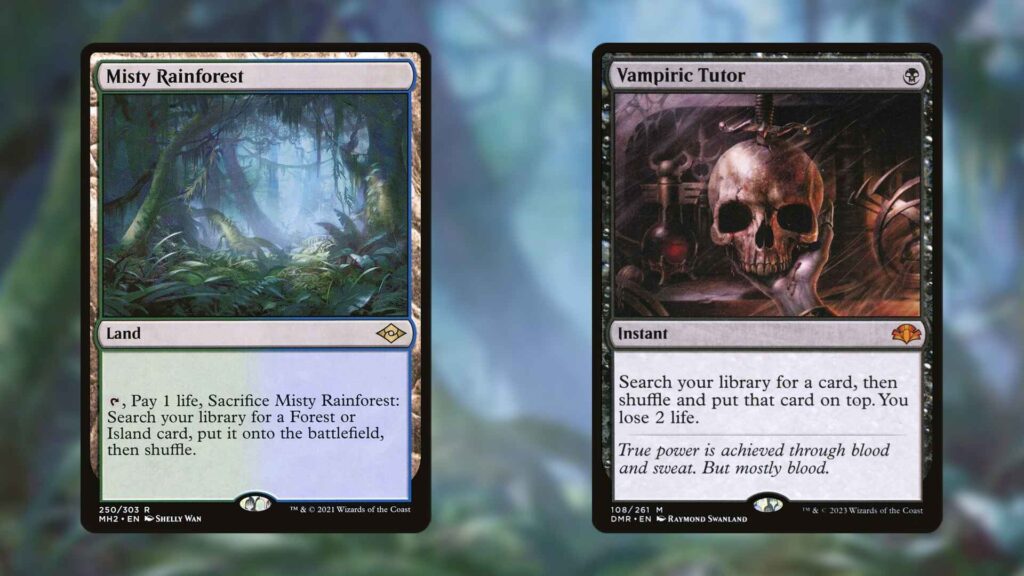
During their matches, Cantone utilized the infamous ‘Vampiric Fetch’ cheat, where needed cards are purposefully shuffled to the top of a library. This effectively gives the offending player a free Vampiric Tutor off of a Fetch Land’s search effect, hence the cheat’s name.
While it’s often difficult to determine if a player was cheating, the video evidence against Cantone in a feature match against Ruby Storm is pretty damning. Due to this, a showcasing Cantone moving an Endurance to the top of their library caused immense controversy this week. As if this wasn’t bad enough, , the Ruby Storm opponent, stated that the tutor for a Deceit in game 2 was far more devastating.
While it’s refreshing to see action being taken against a cheater, many players agree that just banning Cantone for 2026 is not a severe enough punishment. While Cantone intends to walk away from Magic permanently following this scandal, this is a self-imposed sanction. We’ve seen previously that past cheaters have un-retired and gone on to cause additional problems. While this may solve the few high-profile cheating scandals, however, it won’t help fix the many cheats that go unnoticed off camera.
Cutting Isn’t Good Enough
 Fleeting Distraction | MTG Foundations
As nefarious as the Vampiric Fetch cheat is, it’s not like this is the first time the community has ever seen it. Fetch Lands have been a mainstay in older MTG formats forever, and players have been abusing the shuffle mechanic for as long as they have existed. It’s for this reason that cutting, or shuffling, an opponent’s deck after each search is standard protocol at a competitive MTG event. Shuffling the opponent’s deck at the start of the game, in fact, is actually mandatory at a certain competitive level.
In the case of the Cantone drama, Flexolexo never actually cut the offender’s deck, which would have prevented the tutor attempts. That said, when a malicious cheater is involved, it’s rarely that straightforward. Flexolexo mentioned that Cantone would always shuffle his library while he was doing something else, like “checking the life total on the tablet or resolving his endurance etb trigger.”
With so much going on in the average MTG game, finding opportunities like this is too easy for bad actors. Thanks to this complexity, as a player, catching MTG cheaters can be far more difficult than it looks, . Thanks to this, while the current deck cut etiquette certainly helps, it doesn’t solve the issue.
Even with a renewed effort to try to fix the cheating problems in paper magic, a true solution to the problem doesn’t really exist. Thanks to human error, it will remain difficult for judges to determine whether a player is maliciously cheating or just made an accidental mistake. As bad as the cheating issue is, honest players being branded a cheater by the community for a mistake would be a far worse alternative. For this reason, the best solution to uphold competitive integrity would be to move the vast majority of competitive events to be exclusively digital.
Moving Competitive Magic Online

In my opinion, making any tournament above an RCQ level exclusively digital would solve a lot of paper magic’s biggest problems. Since Magic Arena and Magic Online handle shuffling for you, players would never need to worry about the kind of cheats that Cantone executed. In addition to this, marked cards, sleeves, boxing, knocking cards on the ground, and warped foils would also no longer plague competitive MTG players.
Since these clients also handle card interactions and abilities, you also wouldn’t have to worry about misrepresented board states, angleshooting, or missed triggers. As complexity creep becomes more and more apparent in MTG, even the game’s best players are making massive blunders on camera related to this. A misinterpretation of the level of an Artist’s Talent, for example, caused a massive rewind at the 35-minute mark in the 2025 World Championships between two eventual top-eight players. In most cases, this mistake wouldn’t have been caught or fixed.
That said, the biggest problem that this change would fix is slow playing, whether intentional or unintentional. Players winning their first game of a best-of-three set and slowing down their pace of play to win in a timeout is frustratingly common in competitive Magic. Even if it’s unintentional, slower matchups, like control mirrors, also have this problem.
Thanks to the nature of online Magic, this problem would be easy to solve. When playing online, players use chess clocks, giving them a dedicated time bank. In the extremely common event that one player takes up more time than the other, it won’t negatively impact the time that the faster player has to think.
All of that said, even if Wizards of the Coast made the shocking decision to move all its Pro Tours online, that wouldn’t entirely solve the cheating issues. Players could still have multiple players looking in on one monitor, making decisions as a hive mind. There’s also the occasional client bug that can cause unintended balancing issues, but these bugs could be tightly policed by Wizards.
This Would Never Actually Happen
While moving competitive Magic online would solve most of the cheating problem, making this solution work effectively would require significant effort. For many players, competitive MTG is more about The Gathering than actually playing the game itself. As Covid-19 demonstrated, removing this part of MTG would likely make competitive MTG much less popular and could even kill the game long-term.
That said, competitive events can still be held in person and online at the same time. Similar to Pokémon VGC events, high-level competitive MTG tournaments could easily be held as LAN events. This has been done for MTG Arena-hosted World Championships in the past, allowing MTG to move past its cheating issues while keeping the competitive drama and The Gathering alive.
Even with this solution, however, moving competitive Magic online seems like a near impossibility. Magic is a business first, after all, and having competitive Magic events in paper sells paper cards. The removal of high-stakes paper events like Pro Tours, Regional Championships, and Spotlights could kill a ton of the demand for two-player paper cards.
While it’s impossible to know for sure how this would affect the sales of paper MTG cards, it almost certainly won’t be for the better. Sadly, this is likely the nail in the coffin for moving competitive MTG online, despite it fixing many of the paper format’s unsolvable flaws. For now, all players and judges can do is try to keep improving the current system.
Stick with us at mtgrocks.com: the best place for Magic: The Gathering coverage!