
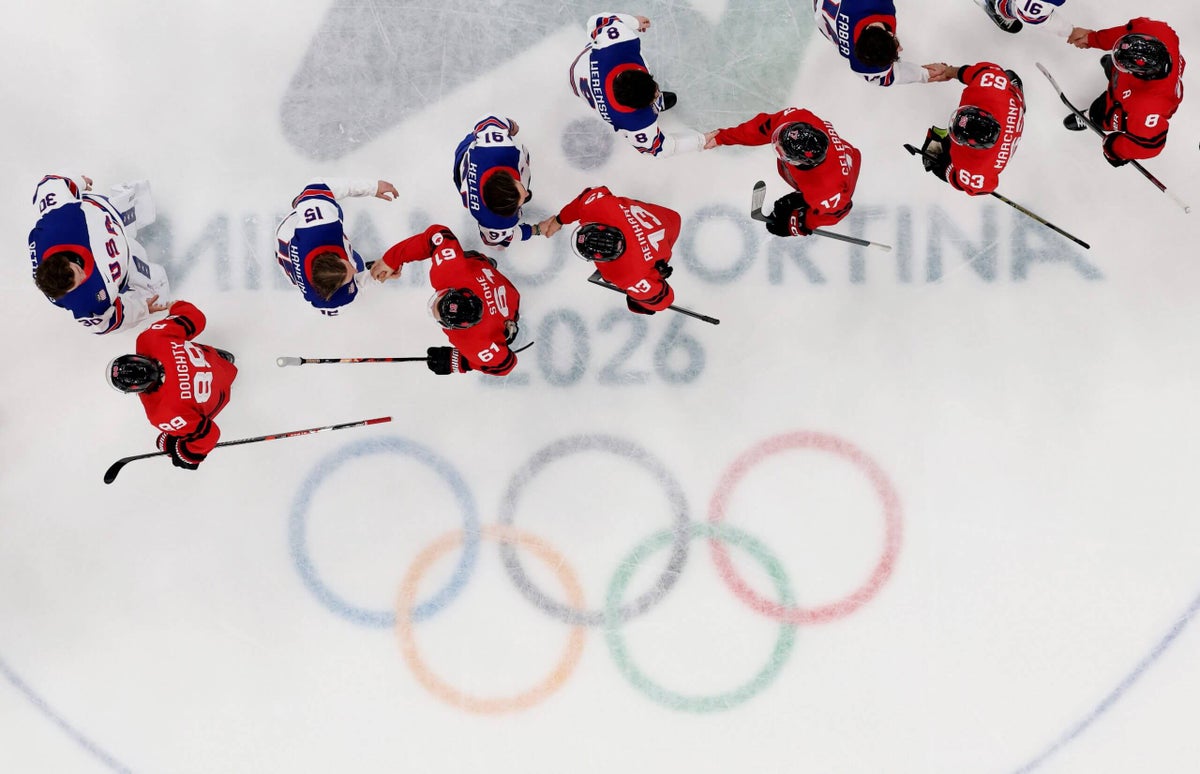
Chris Pronger is a guest columnist for The Athletic during the 2026 Milan Cortina Olympics.
What a game.
I’ve played in Olympic gold medal games, in playoff overtime games and in the Stanley Cup Final. For me, though, sitting on my couch at home on Sunday watching the men’s gold medal final, that was incredibly stressful to watch.
Seriously, I was watching the ridiculous pace, and I was oooh-ing and ahh-ing on every opportunity, every pass, every puck going toward the net.
Personally, I find watching a game like that to be far more stressful than playing in it. At least when you’re playing in a game like that, you have a hand in it. You can have some impact on the outcome. When you’re watching that gold medal game, you have no say whatsoever. You’re just sitting there, getting anxious and waiting for something to happen.
It actually got to the point that I was yelling at my TV so loud that my son had to give me a little kick. He actually reminded me, “Hey, you know they can’t hear you, right?!”
It was just that sort of game. An instant classic.
The pace was stunning. I don’t think people watching from home quite realize just how fast that game was. This game wasn’t a chess match. This was pedal to the metal, this was balls to the wall. This was the two best countries going all-out to try to win gold, and ultimately, the United States prevailed in overtime.
We know the margins are thin in single-game elimination, but this game was really, really tight.
Canada was flat-out dominant at five-on-five, but you can look at a handful of situations where they just didn’t take advantage of their chances. The five-on-three, Devon Toews with the empty net and Connor Hellebuyck makes the desperation save, Macklin Celebrini on the breakaway, Connor McDavid on the breakaway, Nathan MacKinnon at the side of the net. It’s just brutal to think about those as a Canadian hockey fan.
The way I saw it, Canada took over from the drop of the puck in the second period. The ice wasn’t tilted just a little bit, it was tilted straight downhill. Canada was coming at the United States in waves, and once they got the Cale Makar goal, they kept pushing.
Canada had their chances to win. They left it all out there and there should be no regrets. They emptied the tank.
The game went back and forth, Canada controlled everything to a spectacular level, they laid the boots to them, outshot them almost two-to-one in regulation, and they still lost. All that mattered was the goalie, and he stole the show.
When I think about it, I’m not sure exactly what else you think Canada could’ve done on Sunday in terms of how they played and how they built this team. They didn’t capitalize on their chances. Sometimes it’s that simple.
They played their best game of the tournament in the gold medal game and came up just a bit short in the three-on-three. That’s hockey sometimes.
What it really comes down to is a handful of exceptional performances from the winners. That starts with Hellebuyck. He won that game. He was, without question, the MVP of that game and that team.
I’m sure if you’re the Winnipeg Jets, you wish this performance had happened last year, when they had the type of team where Hellebuyck building confidence off this might’ve mattered. This guy has been one of the best, most consistent goaltenders in the NHL for a while. A performance like this in a huge game is great for his career — it certainly answers all the questions that people had about him and his play in big games.
I was also very impressed by how sound a defensive game Auston Matthews and Jack Eichel were able to play. There’s always going to be mistakes out there, but Matthews and Eichel were all over Canada defensively in the first period as the USA built their lead. Even when Canada began to take over things in the second and third periods, they did well playing that bend-don’t-break type of defensive game that gave Team USA a chance to win in overtime.
Then there’s the golden goal scorer, Jack Hughes. I think it’s bananas to reflect on how thin the line is between being a hero for your country or being the goat. He came into this tournament with some question marks, and now he’s the golden goal scorer. What does that do for his fortunes in New Jersey and for his career?
Just think about how he could’ve easily been the scapegoat after taking that penalty on Bo Horvat late in the third period when the United States was on the power play after losing some teeth on a high stick as well. It’s amazing how your fortunes as a player on the big stage can switch in this game in the span of just 10 or 15 minutes. When you stop and think about how Hughes’ standing and reputation are permanently altered by how this game played out, it’s pretty amazing.
Now I want to touch on the three-on-three aspect. I’m not necessarily a huge fan of settling a game like that at three-on-three, but you have to admit it’s exciting, and you certainly find an ending quickly, which I have to imagine is the reason. (And yes, I do realize we won in 2010 playing four-on-four, but that doesn’t mean I have to like it.)
If that game had stayed five-on-five, I’m not sure when it would’ve ended. These teams might’ve played right through the closing ceremonies.
I think it’s important for people to remember that this is the Olympics, not the Stanley Cup playoffs. You’re not playing a best-of-seven. Your entire season isn’t on the line. This is a short tournament, and in the Olympics we’re used to seeing massive games being settled in shootouts, or four-on-four, or three-on-three. It’s always been like this.
To come back to the silver medalists. Whenever Canada doesn’t win in best-on-best, you’re going to have people saying, “Oh my god, Canadian hockey, we didn’t win gold!” But what would you have changed about that performance, really?
Maybe you think they should’ve taken Matthew Schaefer, maybe you think they should’ve taken Evan Bouchard. Look at Tom Wilson, though: lots of people thought he shouldn’t have been on this team, but I thought he played great today. Look at Jordan Binnington, criticized the whole tournament, and once again he was excellent.
I think you always question every decision, that’s just the nature of the beast. There are going to be questions on everything. “Who didn’t rise to the challenge?” and “Who isn’t a good fit?” I might not agree with it, but that’s just how this business works. If you don’t win, there are questions asked. Period. End of story.
Still, I thought Canada was pretty close to being in full control of the gold medal game. The United States just hung around, and Canada let them hang around. And when you let a team as good as that United States team hang around, they’re dangerous. Then you get to three-on-three, and obviously, anything can happen. And it did.
That doesn’t change how well Canada played. They moved the puck well and they were very efficient. I think the defensive group held up better than most would’ve expected. I’d even argue that the Americans’ back-end mobility and that strength they supposedly had coming in didn’t matter in the gold medal game. The Canadian defense outplayed their American counterparts.
Putting this result into context, I hope this is a big moment for the sport.
You look at what the 1980 gold medal did for hockey in the United States, and I think you can understand what this win will do. It’s only going to further expand and grow the game. It’s great for the game of hockey to have more eyeballs, more investment and more people trying to play the sport. That’ll be part of the legacy of Team USA winning gold in Milan.
Now, the one thing we still have to figure out is how to make the game cheaper and more accessible, so hockey can reach even more people and we can get even more kids involved. That’s still the biggest challenge, and something we really need to keep working at.
For this rivalry, meanwhile, it’s only going to get bigger, especially with more international hockey on the immediate horizon in 2028 and 2030. The USA winning gold in Milan should only intensify the rivalry between them and Canada further. Because now Team USA actually has something meaningful to hang their hat on.
For a long time, it was the gold medal in 1980. Then it was the World Cup of Hockey in 1996. It’s been 30 years since America won anything in best-on-best, and now they’ve won something real and they beat Canada to do it. I might not like it, but that’s huge.
Since the World Junior level, this generation of American stars has been changing the narrative. A lot of these players have some experience winning some tournaments on their way up. Now at the senior level, they’ve got one. That’s huge for hockey in the United States. It’s huge for this generation of American players to have been the ones to do it.
Canada is going to have to live with this for at least a couple of years before they’ll get a chance at some revenge. The USA is going to have a few years to enjoy bragging rights over their Canadian counterparts.
In the meantime, hopefully both sides keep upping the ante and raising the stakes and building that sense of familiarity and bad blood that every great hockey rivalry needs.