
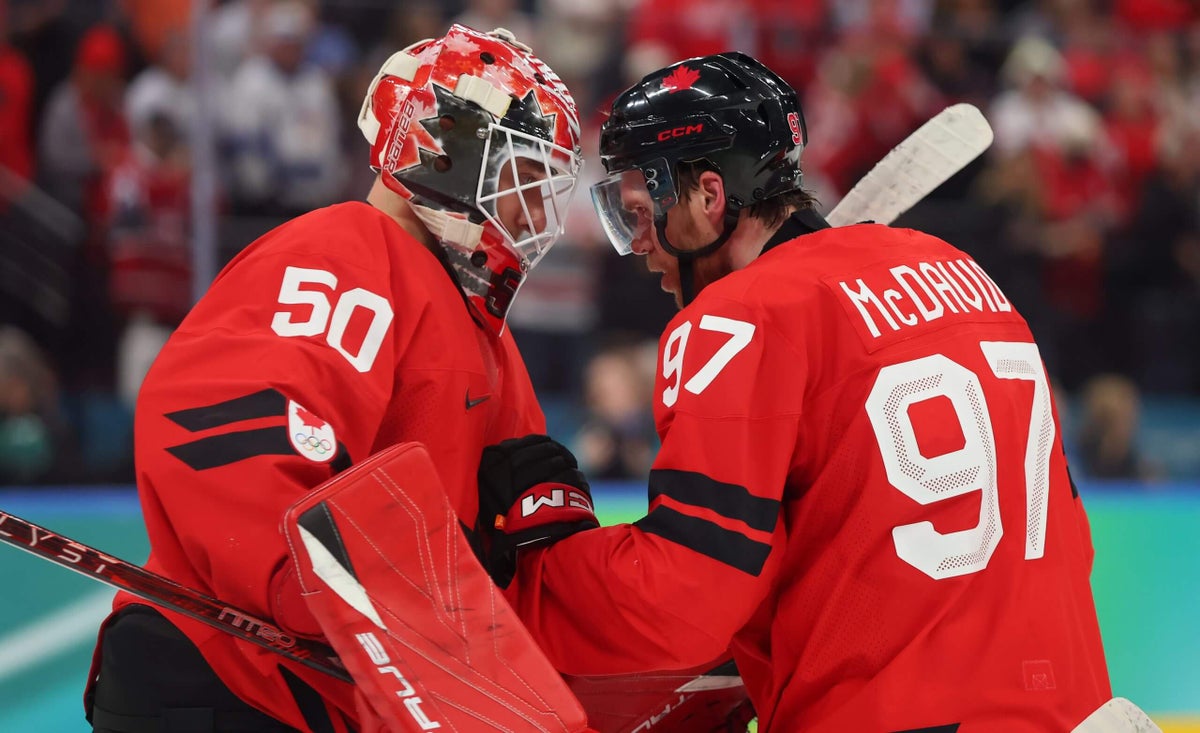
Chris Pronger is a guest columnist for The Athletic during the 2026 Milan Cortina Olympics.
This is it. The heavyweight matchup we’ve been waiting for.
I remember preparing for the gold medal game in Vancouver against the United States in 2010. The 48 hours before puck drop, with the chance to beat the U.S. and win gold on home soil, felt like an eternity.
The thing I remember most leading up to that game is that we’d lost to the United States in the round robin stage of that tournament. And we had to watch them strut around the athletes’ village talking about that game and basically acting as if they’d already won the tournament, and the gold medal.
The funny thing is, you still hear some of the American players from that team talking about it! “Oh, we won the wrong game in 2010.” Yeah, and we won the right game. Sorry that you’re hanging your hat on the wrong one and acting as if it mattered.
Honestly, though, it did matter, but only because it showed us where we needed to be better and gave us a wake-up call.
That’s the thing about adversity: it helps you tighten things up. It reveals your weaknesses. It forces you to problem-solve.
Since the elimination round started, Canada has certainly made it interesting. They needed a late comeback to defeat Czechia. They had to do it again against Finland after falling behind 2-0 on Friday. Those close calls can matter when you arrive in the big moments. You become battle-tested.
Those experiences show the guys in the locker room that you can win those tight games, that you can come back and score big goals. Against Czechia and against Finland, Canada didn’t let up; they kept pushing.
I think the concern is that Canada is relying on a lot of the same guys over and over and over again. Like, you’re playing the s— out of Macklin Celebrini and Connor McDavid. And I get it, it’s a do-or-die game, but seriously? With this collection of talent? On Team Canada? At the Olympics? We need forwards to play over 25 minutes? That’s a lot, especially playing at that pace.
Now, we should keep in mind that Canada was only playing one way for the most part on Friday. The top guys logged a lot of minutes, but it was all with the puck in the neutral zone and offensive zone. Canada wasn’t forced to defend or play physically in their own zone much at all. Finland was just defending, and when they got the puck, they’d just flip it out and change, so they didn’t get caught out on the ice too long.
Then, after the game, there was a lot of complaining about the officials. It’s pretty funny how all of the countries that Canada has beaten in the medal round are just complaining endlessly about the referees after they lose. It’s almost like they think it’s scripted!
You know, nobody told Finland to get up by two goals and then sit back for 35-plus minutes. You can’t play like that and expect to win against a team like Canada, I’m sorry. You’re going to give up chances at some point and potentially take penalties trying to play that way, and at some point, you’re going to get exposed, which they did.
They can complain about the Brad Marchand goalie interference play, but I’ve seen that 10 times now. Marchand got pushed into the goalie, and he knew what was happening. He rolled off Juuse Saros fast.
There’s a huge difference between that and the goalie interference penalty that Charlie McAvoy took against Slovakia. Different area, different spot on the ice, and McAvoy wasn’t pushed into the goalie the way that Marchand was.
Marchand knows how to win; he knows this game. He even takes that extra step back after he gets out of the crease. He knew to take any potential issue out of the equation, knowing how tight the rules are in the IIHF game and how strict that standard is.
He knew they weren’t going to play around, and that’s why he didn’t interfere with the goalie (too much). If Finland actually thought it was interference, they had the opportunity to challenge it.
I don’t think it would’ve mattered if they had, though. Saros had time to get reset; in fact, he made two hockey moves before the goal went in!
Let’s get back to Canada’s depth. You can call them “Canada’s depth players,” but let’s be real, these guys aren’t depth players. They’re all NHL stars! They’re go-to guys for their respective teams.
Now, in one game with everything on the line, they need to act like it, and they need to play like it.
If Canada’s top line can get to the USA early and get on the board first, that’ll give everybody a boost. For Canada to win, though, they’re going to need everybody.
To beat the United States, Canada will need all four lines, all six defenders and maybe even the extra forward and defenseman. They need everyone involved in a meaningful way. It’s not like in years past, where a couple of guys were going to take over. As amazing as Canada’s top line is, that’s just not how this gold medal is going to be won. However, his nickname is McJesus for a reason!
Now, if you’re the U.S., you’re thinking that we’ve been building toward this game. They overcame a potential disaster against Sweden, then threw a beatdown on Slovakia. Their third and fourth lines were playing with a ton of confidence. They had more space to move around, though, which they won’t have on Sunday against Canada.
Last year at the 4 Nations, Team USA, once again, won the wrong game. They look like a team that’s ready to win the right one this time.
I sometimes look at teams in terms of the swagger that they play with, and that used to be Canada going into games. Going into these games, however, it feels to me like it’s the USA that has that swagger. They’re playing like they expect to win.
In my opinion, the U.S. is a very small favorite on Sunday based on how they’ve played throughout the Olympics. They’ve gotten better with each game.
Canada came out hot in the round robin, but you could easily argue in the last couple of games that they haven’t lived up to the expected style with pressure and the way they were attacking opponents with wave after wave of aggressive forechecking from the round robin.
Based on the current trend of the United States getting better every game, while Canada — even if they’re facing adversity and finding a way to overcome it, which is a positive — is fighting it a bit after they came out so hot in the first three games, I think I’d gauge that it’s about a 51 percent to 49 percent in the United States favor going into the gold medal game.
That’s just based on the scoring chance metrics I’ve seen and my eye test. Like, OK, if we say the U.S. has the better blue line, I think you could argue that Canada’s forwards should have the slight edge because of what McDavid and Celebrini are doing.
Then, in net, I’m not sure that Connor Hellebuyck has outplayed Jordan Binnington. I don’t think the edge in the net is that big of a deal.
I thought Binnington made some big saves late in the game against Finland, which is impressive given that he hadn’t seen many shots. It’s hard to stay sharp in goal when you’re not seeing any shots, because the ones you will see will be Grade A chances off of breakdowns.
Then we have to throw in that Binnington has won the big games that Hellebuyck hasn’t in his career. It’s going to take winning a big game to win this gold.
Coming back to Binnington, he understands that to bring back a gold medal for Canada, he has to be on his A-game. He might even have to steal the game.
Can you imagine if he’s able to do that for this team? Everybody, including all of us in the media, are going to have to eat some s— and accept that he was the right choice and he IS the guy.
People were talking about him being the worst goalie in the NHL from an analytics perspective going into this tournament; well, clearly he’s not! He’s finding ways to make the big saves at the key times, and he’s doing it when he’s not seeing a lot of action.
When you think about how he came out of nowhere in 2019 to win the Stanley Cup with St. Louis, then emerged from the abyss to steal the 4 Nations last year and now imagine if he’s able to do it again in Milan? That would be one heck of a legacy for him as a big game goalie.
If Canada is going to win, they need Binnington to lock it down. They need guys that aren’t McDavid, Celebrini and Nathan MacKinnon to step up. And they really need to be tight defensively. They need to gap up and take away time and space from the crafty American forwards. They need to force the American forwards to play in traffic, and they need to lean on guys.
Jack Hughes has been heating up the last few games. Canada’s physical players need to take him out of the game immediately with their presence. You need Tom Wilson, Sam Bennett and Brandon Hagel to be heat-seeking missiles. Not taking penalties or crossing the line, but playing physical. You need Colton Parayko and Travis Sanheim to use their size, not to run around being stupid, but to lean on some guys, grind on them and allow Canada to impose their will a bit.
Injuries are going to be a factor here, too. Will Sidney Crosby play? Will Tage Thompson?
It’s clear that some guys are playing at less than 100 percent. I’ll be interested to see what the damage report is after the tournament on some of these guys. What’s going on with Sam Reinhart, what’s going on with MacKinnon?
There’s one more thing I want to touch on, but we have to remember that we’re not at the end of the road for this tournament. There’s one big game left.
On Friday, when Canada was trailing, you could see everyone start to freak out. People watching back at home are just second-guessing nonstop. “Why isn’t Evan Bouchard there? Why isn’t this guy there? Why isn’t that guy there?”
Can we stop? It doesn’t f—— matter right now!
You even saw it, as that game against Finland went along, Canada’s defense started jumping into the play, and they were creating offense. They did their jobs. They made the difference!
Now that we’ve arrived at the gold medal game, can we worry about the guys that are there?
Once the tournament is over, and one team is coming home with gold and the other with silver, we’ll have plenty of time to talk about who wasn’t there. So let’s stop worrying about that and focus on the guys that are, and whether they’re being utilized in the best possible manner to get their team over the hump and win one more game.
That’s all that remains, one game. The Americans want this. It’s been 46 years since they won gold.
For Canada, it’s just about continuing to find ways to win. I know Canada has won every best-on-best going back to 2010, but at most of these tournaments, it’s not like Canada has been dominating. It’s not as if in Vancouver or at the 4 Nations they were head and shoulders above the United States, or some of the other countries.
The stakes of this one game are huge. Winning a gold medal isn’t like winning the Stanley Cup, especially not for the Canadian players. It’s on par, though. It’s a 1A and 1B situation.
For these players who haven’t had a chance to play on this stage, it’s been 12 years of waiting for an opportunity to win an Olympic gold medal. That time is now, and who knows what the landscape will look like going forward.
The plan is to have a regular run of best-on-best international tournaments, but some of these guys might age out. For a lot of these guys, this might be their lone chance to win gold. You have to take advantage of these sorts of opportunities in hockey and leave it all out there.
It’s just one more game, one more win. That’s all it’s going to take now for gold.