
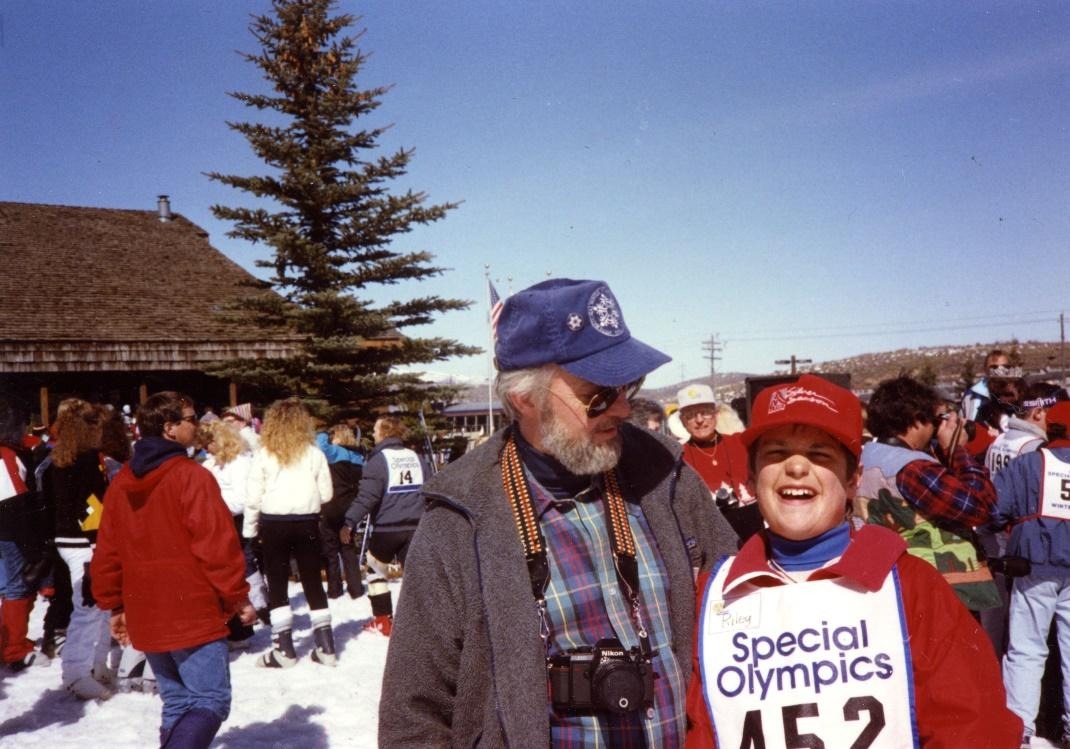
They said Park City was too small to host the Special Olympics. Yet, by the end of the Games, people remarked that it was one of the “most magnificent Games ever staged in the history of the Special Olympics.”
For some, maybe this came as a surprise. For Parkites, it was par for the course.
In June 1962, Eunice Kennedy Shriver began a summer day camp in her home in Maryland for children with intellectual disabilities. The camp took off, and in 1968, the first International Special Olympics Summer Games were held in Chicago. Throughout the 1970s and early 1980s, the Games continued to grow.
By the early 1980s, Park City was in the running to host the third Special Olympic World Winter Games. The city was the No. 1 choice and was selected in December 1982. The next three years were spent raising money and preparing to welcome hundreds of athletes, coaches, families and fans. Park City hosted the Utah Special Olympics twice in the lead-up to the international event.
Park City was abuzz with all things Olympics in March 1985. People walked around town wearing pins and hats and badges. There was pride everywhere you looked, and over 5,000 people gathered at the Park City Golf Course to watch the opening ceremonies. Athletes from all 50 states and 13 countries paraded onto the grounds and past the grandstands, where they were announced by Master of Ceremonies and former Olympian Caitlyn Jenner.
Utah’s delegation wore blue jackets and blue “Ski Utah” hats. For the first time, observers from Korea and the People’s Republic of China joined the event, learning so they could create their own Special Olympics.
Other celebrities joined in the celebrations as well, including Arnold Schwarzenegger, who cheered on the Austrian team. At the end of the ceremony, Utah Special Olympian Shirley Carlos and ski great Billy Kidd lit the Olympic torch. Then, hundreds of balloons were released, and a shower of fireworks colored the daytime sky. The Games were officially on.
Over the next several days, athletes competed in a range of events, including alpine skiing, cross-country skiing, figure skating, ice hockey and speed skating.
They competed at Park City Mountain, the White Pining Touring Center and in Salt Lake City. Behind the scenes, volunteers arranged over 77,000 meals for 800 athletes and 500 coaches, as well as delegations, volunteers, and VIPs.
It was a huge undertaking that many believed Park City couldn’t pull off. Nevertheless, the event went off without major incident. The closing ceremonies of the Games took place at the Salt Palace in Salt Lake City. It was hosted by Phil Donahue with the Mormon Tabernacle Choir performing.
All in all, the third International Special Olympic Winter Games were a resounding success. The athletes and their families had a spectacular time. Many had stated that Park City was too small to host the international event, but with careful planning and enthusiastic Parkites and volunteers, they showed the world how capable Park City was.
Later, the volunteers in charge of the Games in Park City put together a handbook for future games, something that had never been done before. The success of the Special Olympics, plus the World Cup alpine tour in 1984, gave insight into how the region might handle even larger sports events, like, say, the Winter Olympic Games.
Stay tuned for the Park City Museum’s newest exhibit, “Park City Loves A Parade! Our Parades, Processions and Protests from Past to Present.” It includes a bit about the parade of athletes for the 1985 Special Olympics.
Sophie Krupp is a collections assistant at the Park City Museum.
Related Stories