
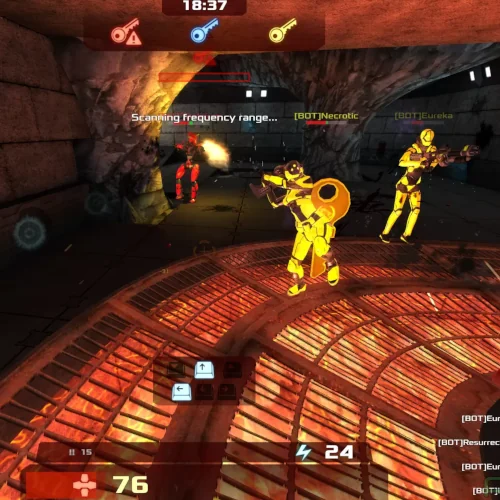
One of the latest exciting developments for the open-source Godot game engine is beginning to lay out support for Vulkan ray-tracing.
For helping to better position Godot with other commercial high-end game engines supporting ray-tracing, the cross-platform Godot engine is pursuing Vulkan ray-tracing support. Godot 4.7 Dev 1 was released today with some of the initial plumbing for ray-tracing.
Godot 4.7 Dev 1 is the first tagged development snapshot toward this next game engine release. Most exciting I find with this new development work is their ongoing work around Vulkan ray-tracing:
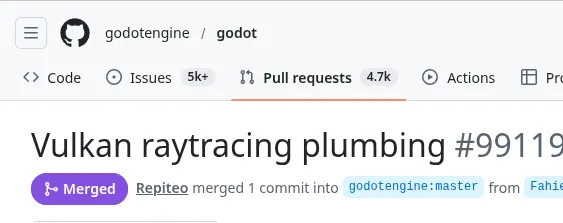
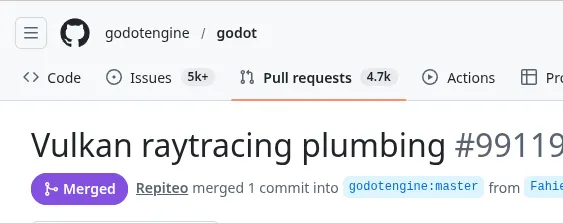
“While Vulkan has had an API available for a few years now to support raytracing, actually implementing that API is much easier said than done. Rendering is already one of the most complex parts of the engine, and adding raytracing on top of that increases that complexity exponentially. With that in mind, it cannot be overstated just how impressive it is that Antonio Caggiano has provided us with the groundwork necessary to make that a reality (GH-99119). He’s graciously provided a demo project to showcase this new functionality via GDScript.”
This pull landed that initial Vulkan ray-tracing work for the Godot rendering device. This repo has the GDScript demo.
It will be interesting to see how quickly the rest of the Vulkan ray-tracing infrastructure for Godot manages to come together. Godot 4.7 Dev 1 also now uses the native file picker on all supported devices/platforms, updates to the newer Vulkan SDK, numerous Godot Editor improvements, Windows HDR output, and more.
Godot 4.7 Dev 1 details can be found on GodotEngine.org.