
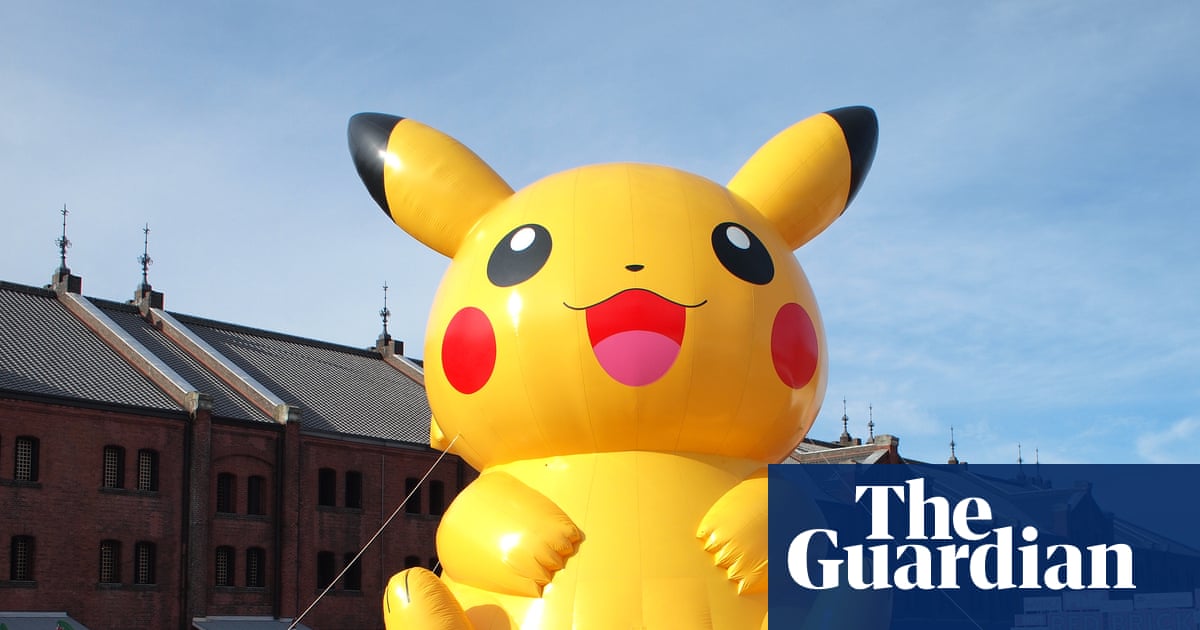
What is the highest-grossing entertainment franchise of all time? You might be tempted to think of Star Wars, or perhaps the Marvel Cinematic Universe. Maybe even Harry Potter? But no: it’s Pokémon – the others don’t come close. The Japanese “pocket monsters”, which star in video games, TV series and tradable playing cards, have made an estimated $115bn since 1996. Is this a sign of the lamentable infantilisation of postmodern society?
Not a bit of it, argues Keza MacDonald, the Guardian’s video games editor, in her winsomely enthusiastic biography of Nintendo, the company that had become an eponym for electronic entertainment long before anyone had heard the words “PlayStation” or “Xbox”. Yes, Pokémon is mostly a children’s pursuit, but a sophisticated one: “Like Harry Potter, the Famous Five and Narnia,” she observes, “it offers a powerful fantasy of self-determination, set in a world almost totally free of adult supervision.” And in its complicated scoring system, “it got millions of kids voluntarily doing a kind of algebra”.
Meanwhile, a lot of adults participated in the 2016 summer craze for Pokémon Go, the phone app that led people to walk around looking for imaginary monsters in real places. Pure escapism, perhaps, for people depressed by the deaths of David Bowie and Prince, not to mention the Brexit referendum. But at least it got people out of the house. When getting people to stay in their house became the law four years later, it was Nintendo’s Animal Crossing: New Horizons, a delightful fantasy of village life, that enabled them to socialise remotely, selling 45m copies in 2020.
Before all that, of course, there was Mario, the bouncy Italian star of the arcade game Donkey Kong (1981) and countless games since. Dressed in what MacDonald unimprovably calls his “unorthodox plumbing uniform”, Mario is central to what may be the most aesthetically consistent long-running entertainment series ever. (The brilliant 2023 entry, Super Mario Bros. Wonder, is a video game that is also a slapstick musical.) His creator, the enigmatic genius Shigeru Miyamoto (now 73 years old), insists that he just thinks of his work as the modest application of common sense, but his colleagues know better, speaking reverently of “Miyamoto magic”.
Miyamoto also designed the hit series The Legend of Zelda, inspired by his boyhood love of exploring the countryside, some instalments of which rank among the greatest video games ever created. In one of those curious reversals of association between art and real life, I find to this day that whenever I hear the cawing of a crow, I think of Hyrule Field, an unprecedentedly vast and realistic open space in the 1998 Zelda game Ocarina of Time. MacDonald interviews the lead programmer of that masterpiece, who says adorably of his responsibility for Epona, the hero’s trusty steed: “I worked hard to make her a good horse.”
MacDonald’s conversations with all the gifted (and often eccentric) creative people who actually make the games are full of such wholesome insights, as are her own superb analyses of favourite games, and of the general vibe of Nintendo: its “toymaker philosophy” is an antidote, she argues, to the increasingly baleful role that technology plays in all our lives. “In an era where our utopian conception of new technologies has soured,” she writes, “where social media algorithms and a mass of online ‘content’ vie to ensnare our attention for profit … a game like Zelda shows us that technology can instead be enriching: it can create a true alternative world behind the screen.”
Nintendo, indeed, has seldom been on the bleeding edge of tech for its own sake. Gunpei Yokoi, the inventor of the handheld Game Boy, described his own design philosophy as “lateral thinking with withered technology”. The company says it has no plans to use generative AI in its games: they would rather focus, Miyamoto says, on “what makes Nintendo special”. And that is its core business of simple joy. As Takashi Tezuka, a producer on Super Mario Bros. Wonder, says to MacDonald: “It’s an action game where you get enjoyment out of discovering how to become better.” In a world over which we have no control, the pleasure of mastery is a rare gift.
Super Nintendo: How One Japanese Company Helped the World Have Fun by Keza MacDonald is published by Guardian Faber (£20). To support the Guardian, buy a copy at guardianbookshop.com. Delivery charges may apply.