
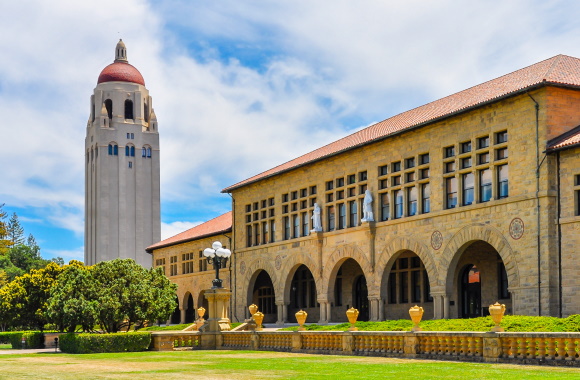
Stanford student says ‘if you’re not gaming it, you’re putting yourself at a disadvantage’
At Stanford University, students are “gaming” the disability and religious accommodations system to get prime dorm rooms, better meals, and extra time on tests, a junior at the California institution wrote Monday at The Times.
Such accommodations are so common and so easy to obtain – nearly 40 percent do — that not requesting one from the elite private university puts students at a disadvantage, student Elsa Johnson wrote.
“… almost no one talks about the system with shame. Rather, we openly discuss, strategise and even joke about it. At a university of savvy optimisers, the feeling is that if you aren’t getting accommodations, you haven’t tried hard enough,” she wrote. “… if you’re not gaming it, you’re putting yourself at a disadvantage.”
Of course, some students do need special accommodations for debilitating disabilities like epilepsy or anaphylactic allergies, but Johnson said others are abusing the system:
And some “disabilities” are just downright silly. Students claim “night terrors”; others say they “get easily distracted” or they “can’t live with others”. I know a guy who was granted a single room because he needs to wear contacts at night. I’ve heard of a girl who got a single because she was gluten intolerant.
Callie, a recent graduate of Stanford, received extra time on tests because she has Asperger’s and ADHD, but she told Johnson that she didn’t really need it.
“When I did use the extra time, I felt guilty, because I probably didn’t deserve the accommodations, given the fact I got into Stanford and could compete at a high academic level,” she told Johnson. “Extra time on tests — some students even get double time — seems unfair to me.”
Many students use accommodations to get better housing, and some better meals, Johnson wrote:
Stanford requires most undergraduates living on campus to purchase a meal plan, which costs $7,944 for the 2025-26 academic year. But students can get exempted if they claim a religious dietary restriction that the college kitchens cannot accommodate.
And so, some students I know claim to be devout members of the Jain faith, which rejects any food that may cause harm to all living creatures — including small insects and root vegetables. The students I know who claim to be Jain (but aren’t) spend their meal money at Whole Foods instead and enjoy freshly made salads and other yummy dishes, while the rest of us are stuck with college meals, like burgers made partly from “mushroom mix”.
And the problem isn’t just at Stanford, she continued, citing statistics from Brown and Harvard universities where at least 20 percent of students have disability accommodations.
Meanwhile, at UC Berkeley, more than half of the disability accommodations given to students are for “psychological/emotional” reasons, The College Fix reported in January.
“Contrast these numbers with America’s community colleges, where only 3 to 4 per cent of students receive disability accommodations,” Johnson wrote. “Bizarrely, the schools that boast the most academically successful students are the ones with the largest number who claim disabilities — disabilities that you’d think would deter academic success.”
A recent study by Alvin Christian at the University of Michigan found a steady rise in accommodations at universities nation-wide.
“… between 2011 and 2024, the share of students approved for accommodations more than doubled from 4% to 10% … and that growth is accompanied by accommodations for mental health diagnoses in college, which quadrupled during this time period,” according to his research, which The Fix reported about last month.
Also, “[m]en and Asian students are half as likely to use accommodations (relative to women and white students, respectively),” according to his research.
Financial class is another distinguisher as “low-income and high-income students are more likely to use [accommodations] compared to their middle-income peers.”
However, a disability rights leader who spoke with The Fix pointed out that there is a lack of research on alleged abuses of disability accommodations in higher education.
MORE: More than half of UC Berkeley disability accommodations are ’emotional’