
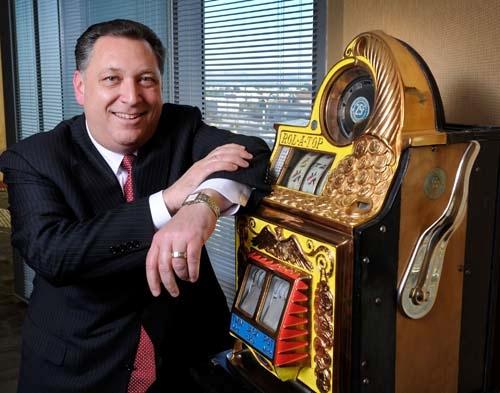
Two of Las Vegas’ leading casino CEOs reminisced about their experiences with some of the city’s greatest gaming executives who helped shape the city.
Bill Hornbuckle, CEO of MGM Resorts International, and Keith Smith, CEO of Boyd Gaming, spoke Friday during a panel discussion at the Vegas Chamber’s annual networking event at Wynn Las Vegas.
Smith, who rarely speaks at such events, since 1990 has worked with Boyd Gaming, founded by Sam Boyd and his son Bill. Smith said he learned from the family that their success came from a strong work ethic and willingness to take risks.

Boyd Gaming was founded in 1975 when it developed the California Hotel and Casino in downtown Las Vegas. The company expanded in 1979 with the opening of Sam’s Town Hotel and Gambling Hall on Boulder Highway; at the time, nothing was around it and it led to development along the Boulder Strip.
“They were willing to put their own money at risk to develop things,” Smith said. “They were innovators.”
Sam Boyd was the first casino to hire female dealers and Smith said the family stressed that the success of casinos was about the people inside the buildings and creating experiences for customers. “They understood that at a very early stage and that’s part of our culture at Boyd Gaming.”

Las Vegas has long been a town of visionary leaders, Smith said. A key to the city’s leadership is buying into changing consumer trends.
For a long time, Las Vegas was one of one when it came to the gambling industry. Then Atlantic City entered the industry in 1978. In the 1990s when gaming expanded to states across the country, people kept talking about Las Vegas’ possible demise, Smith said.
“People asked if Vegas was going to die,” Smith said. “They continue to come, because the community, the town and people invested. They continue to build nicer hotels, better restaurants with celebrity chiefs, and provide entertainment. It’s not just the headline entertainment, but residencies. We have the best retail in the country and now we have sports. A decade ago, the NFL wouldn’t take a Las Vegas ad for the Super Bowl and now they’re here.”
Smith touted Major League Baseball coming to Las Vegas in 2028 and remains hopeful an NBA team will be added in the next couple of years. With tourism down and a narrative that Las Vegas is dying, Smith continued to dismiss those naysayers.
“It happened (with Vegas’ success), because we paid attention to the consumer’s evolution of what they want,” Smith said. “It’s also the size and scale. Nowhere else in the country do they have as many hotels (150,000 rooms). No one can host a CES convention, because they don’t have enough hotel rooms and capacity. That makes Las Vegas unique.”
Hornbuckle got a chance to work with two casino moguls: Kirk Kerkorian and Steve Wynn. He joked that he worked with Wynn for more than a decade, but it seemed like 150 years, sparking laughter from the audience. He served as president of Golden Nugget Laughlin, where he faced his first problem in his new role, union organizing and a picket line. He went to Wynn’s office for advice to handle it.
“This is what you’re going to do,” Wynn said. “You’re going to listen to the employees and listen to your customers. They’ll tell you everything you need to know.”
As he was driving back to Laughlin, Hornbuckle said it was driven into him how to think about the business – it’s about employees and the customers. “He was full of vision and what he did in Las Vegas was unprecedented,” Hornbuckle said of Wynn.
Kerkorian was wired differently than Wynn, who was daily hands-on, Hornbuckle said. Kerkorian was a serene guy, who the first time Hornbuckle met him, was in a buffet line at the MGM Grand. He went over to introduce himself and sought to move him through the line, but Kerkorian wouldn’t do it. When Kerkorian got to the cashier, he pulled out $20 to pay for lunch. “He owned 58% of the company, but that was who he was.”
While Kerkorian wasn’t a day-to-day person like Wynn, he had a vision for the company that everybody understood. He exuded style and glamour. “He had a different vision than Steve, but both were highly impactful,” Hornbuckle said. “Steve had a vision for what he wanted to create. He had a passion as an operator and walked around every day. He was always there and you felt it. His vision was to be what came to be Las Vegas.”
Wynn’s Mirage that opened in 1989 cost $650 million to build, surpassing the $250 million of Caesars Palace. It cost $1 million a day to run, compared to $250,000 to run Caesars, he said.
“It was extremely tight, a complete risk,” Hornbuckle said. “It changed what happened to the company, Las Vegas, and the gaming industry forever.”
Like Smith, Hornbuckle said Las Vegas continues to be well positioned for a bright future. The city didn’t invent restaurants, retail or sports, but it packages them at scale like no other city and provides a thrill when people arrive.
“We didn’t invent the nightclub business,” Hornbuckle said. “We became the nightclub capital. We didn’t invent the convention business, but it continues (to thrive) because of the infrastructure.”
Smith became CEO in 2008 during a difficult time for the company at the start of the Great Recession. Boyd was in the middle of a $5 billion Echelon resort project where Resorts World Las Vegas is located today. The company was less than half the size it is today. The project was fully financed, but because of the deteriorating economy, it was shut down and eventually discontinued, Smith’s first major decision.
“We weren’t going to let one project define who we are as a company,” Smith said. “We’d been in business for 30 years and will be in a lot longer. People said we were nuts. They changed their tune two to three years later. They said it was probably the best decision we ever made and probably saved the company. And here we are today. The company is more than twice the size and more than twice the profitability and the strongest balance sheet in our history and probably the industry. We sold Echelon to Genting. Some part of me wishes we would have moved forward, but I don’t regret the decision.”