
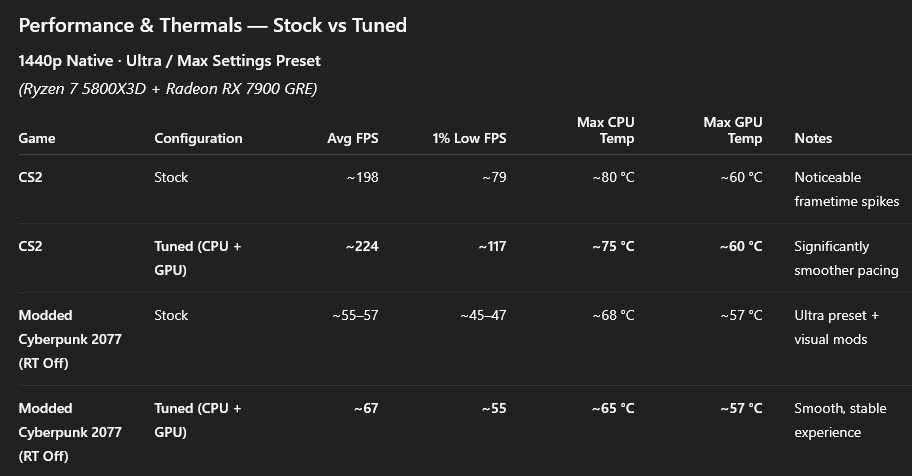
I was getting really annoying stutters, even though my average FPS looked fine, especially in CS2. So I spent some time tweaking things with the help of a few guides and YouTube videos, focusing mostly on frametimes and 1% lows rather than peak FPS. Both games were tested at 1440p with everything cranked to Ultra/max presets, which is obviously a worst-case scenario, but I wanted to stress the system and see how it behaved.
The tuning itself was pretty light and nothing extreme — this isn’t a silicon lottery situation or some crazy overclock. On the CPU (5800X3D), I enabled PBO and Curve Optimiser in BIOS and settled on a −15 all-core offset, leaving clocks otherwise stock since X3D chips don’t really overclock the traditional way. On the GPU (RX 7900 GRE), I used Radeon Adrenalin to max out the power limit, set a 2200–2800 MHz clock range, ran the GPU at around ~1025 mV, and did a small VRAM bump to 2400 MHz. For RAM, I kept things simple and stable with DDR4-3200 and FCLK at 1600 (1:1).
This isn’t about chasing big average FPS numbers — those didn’t move a ton — but the 1% lows improved a lot, especially in CS2, and the game feels way smoother now. That was the main goal, and so far it’s been stable with normal use. For testing, CS2 results were taken using the CS2 FPS Benchmark – Ancient workshop map, and Cyberpunk was tested using the built-in in-game benchmark.
Overall, this was more about fixing stutter and improving consistency than benchmarking flex numbers, and it worked way better than I expected. If you’re running similar hardware and dealing with microstutter, this kind of light tuning is definitely worth looking into.