
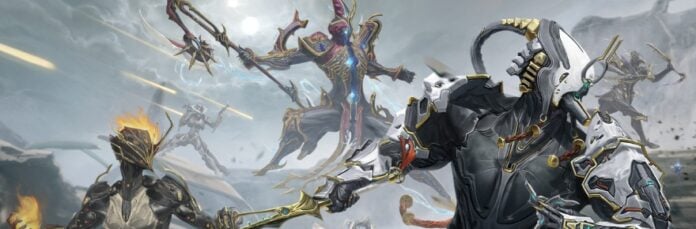
So after spending more time with its most recent update, I am sad to say that Warframe’s latest patch has a number of new abilities that are, lamentably, a group of Win More buttons. This is not great because the Win More button is always a bad thing, but it is good because it allows me to pretty easily write a column about the Win More button, which I haven’t done before! It files under the “useful notes” category, broadly.
I say “broadly” because we don’t tend to talk about Win More buttons very often just because they don’t come up a lot. They’re generally kinda easy to spot in their most obvious form, and they’re not indicative of some deep-rooted sickness in game design so much as they’re just a mistake that every game would be improved without. But I think it’s also a fascinating unintentional cul-de-sac of game design, so let’s talk about the Win More button.
We’ll start by getting abstract. What is a video game? I don’t mean that you need to come up with a deep explanation for the difference between a video game as opposed to a game which merely uses video or whatever; I’m asking what the core difference is between a video game and any other piece of software. And you don’t really need to answer because I’ve already got what’s going to be a workable definition for our purposes: A video game is a series of interesting choices made to solve a problem inherent in the initial state of the game.
That’s not the only possible definition and perhaps not the best one, but it hits close enough to the core to make the point clear. Often the “problem” is that you are at point A and want to be at point B, but there are a large number of things that will kill you and prevent you from reaching point B on the way. You are thus tasked with making numerous choices to efficiently dispatch the things between A and B so you may reach B, or possibly with making interesting choices to avoid the things between the two points. Maybe the problem is you don’t have a Sword of Exceptional Pointiness and wish to rectify that by crafting it. You get the idea.
So how do you make choices? You press buttons.
This is, also, a level of abstraction on top of something you already do instinctively. If you want to move a block in Tetris and rotate it, you don’t think of that process as “press the Right Direction button, then press the Right Direction button, then press the Rotate button” and so forth, but it is an accurate descriptor of what you do. It’s a natural part of video games. You press a button and the game does something. The whole reason that quicktime events became a thing in games was that players complained about big cutscenes in which players had no input, but they loved the cutscenes, so now the cutscene has a button prompt in the middle so you’re pressing a button to do the same thing.
And downstream of that, all of us must eat our sins by ensuring that Heavy Rain exists, but that’s a completely unrelated column.
With all this abstraction, what is a “Win More” button? That should be pretty obvious. It’s a button you press to win more. Not a button you press to win, just to win even more than you were already winning.
Imagine for a moment that you had a triggered ability that said when your attack will kill the target, your damage is increased by 400%. That sounds good until you read the order of operations a little closer. Your target is already going to die from this attack. Increasing your damage by four times is useless in this scenario because it’s still producing the same outcome. You have already won. The button is only useful when you are going to win in order to make you win more.
Our love of big numbers and big effects make winning more feel more appealing because it just feels satisfying. The first time you finish off an opponent that was one hit away from defeat with a combo that goes on longer than the entire rest of the combat to this moment, the more satisfaction you feel. Legends tell of a Killer Instinct combo that is still going to this day.
But it’s only fun once or twice. Then you realize that you’re spending extra time in your life, extra button presses, extra effort, extra everything merely for the right to say that you didn’t just win but you won more. And none of it actually matters because a win is a win. There are a few games that offer mechanics which make winning by a wider margin important, but even those tend to be fairly marginal because why would you just want to win more? You already won!
When you look at it through this lens, not only do you understand the temptation to make these buttons, you understand why they’re generally a bad thing. A “Win More” button is really easy to put into a game without worrying about balance because you know it doesn’t really affect game balance in any sizable fashion, since it’s useful in settings when you’re already doing well. But it’s a bad element of game design because the difference between pushing the button and not pushing the button is functionally nil.
DPS limit breaks in Final Fantasy XIV, for example, are usually a Win More button. Oh, sure, they can clear trash packs faster or take a chunk off of boss health bars… but if you’re able to use them, you’re not having trouble with either of those and they’re likely just being used so they don’t go to waste. Execute-style abilities like the eponymous skill in World of Warcraft can easily fall into a similar space of “oh, deal a lot of damage to something that’s already almost dead,” which is also why WoW has largely retooled Execute to being something triggered by a particular specialty with its own utility.
This doesn’t mean that these are grave sins of game design that produce a terrible experience front to back, either; it just means that when you see these sorts of abilities, you often will find yourself saying “well, that’s unnecessary.” You get space dedicated to buttons that you can press which do nothing but solidify the wins you were already earning. That’s not a venial sin by any means, but it’s not terribly interesting. Wouldn’t you rather just have buttons that make you more likely to win?
But even if very few games explicitly label a “Win More” button as such, understanding the concept teaches you to recognize it. If you have something that looks impressive but is usable only when you’re already doing well, you have a “Win More” button. And that might sound nice on paper, but when you get into the weeds, it doesn’t really add a meaningful choice to your existing lineup.
 Sometimes you know exactly what’s going on with the MMO genre, and sometimes all you have are Vague Patch Notes informing you that something, somewhere, has probably been changed. Senior Reporter Eliot Lefebvre enjoys analyzing these sorts of notes and also vague elements of the genre as a whole. The potency of this analysis may be adjusted under certain circumstances.