
Jim Beam column:Kids have played great games
Published 7:10 am Wednesday, December 24, 2025
Christmas is a time when we often remember the happy days we enjoyed as a youngster. I wondered this year, for example, if the toys I played with are still around.
Thankfully, after doing some research, I found out most of them are. However, I’m not sure today’s youngsters know about them or have enjoyed them as much as I did.
The first one I remembered was Lincoln Logs, named after President Abraham Lincoln. I didn’t realize the Logs were created by John Lloyd Wright, the second child of famed architect Frank Lloyd Wright.
A story by Christopher Klein on history.com said John worked side-by-side with his father. However, their relationship crumbled over money. While out of work, John Lloyd Wright turned his attention to a pint-sized design project in 1916. He created a toy construction set that consisted of notched pieces of wood that children could stack to build log cabins, forts and other rustic buildings.
Lincoln Logs followed the trail blazed by Tinkertoys and Erector Sets, which had been introduced a few years earlier. I also spent many hours playing with both of those toys.
Klein said a century after their creation, low-tech Lincoln Logs continue to be popular in a high-tech world. Over 100 million sets have been sold worldwide, and Lincoln Logs were inducted into the National Toy Hall of Fame in 1999.
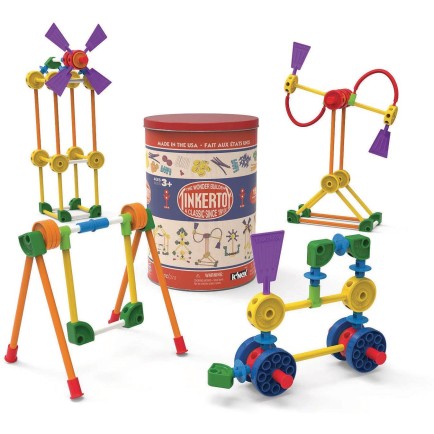
Tinkertoys are classic construction toys that were invented in 1914 by Charles Pajeau, according to museumofplay.org. Pajeau, a stonemason, noticed children playing with pencils and thread spools and created Tinkertoys to formalize their creative play.
The toy features wooden or plastic sticks and spools that snap together to build various models, encouraging imagination and STEAM learning (science, technology, engineering, arts, math).
Sets often include idea instructions but are designed for imaginative free building. Pieces are easy to assemble and disassemble, allowing for continuous play and new designs.
While watching the construction of steel girders to support power lines in 1911, A.C. Gilbert conceived the Erector Set, an educational toy that encouraged kids to create their own miniature buildings. Unfortunately, sales slowed in the 1970s and in 1980, the manufacturer discontinued the line.
The Jacks Game comes complete with 10 silver and gold jacks as well as two red bouncy balls. The aim of the game is to throw the ball in the air, pick up the jacks and catch the ball after it bounces. The first player to get to round 10 is crowned the winner.
Any collection of small objects will work — beans, rocks, stones, and even bones.
Archeologists have found evidence of jacks in ancient Egyptian murals, making it one of the oldest known toys, according to museumofplay.org.
Pick-up sticks is a classic dexterity game where players try to remove sticks from a pile one at a time without disturbing the others. They use either their hands or a special “helper” stick, with points awarded for sticks collected, especially the valuable master stick.
The goal is to score the most points by carefully picking up sticks (different colors have different values) before your turn ends when you accidentally move another stick.
When I told my daughter-in-law I was trying to remember games I played as a kid, she told me she played marbles with boys. I also played marbles but was never too good at it.
A string is used to make a circle. The marbles are scattered within the boundaries of the ring. The goal is to score points by knocking marbles outside of the ring using a shooter marble, which is larger. The youngest player goes first.
One point is scored for each marble knocked out of the ring. The winner knocks the most marbles out of the ring.
The top board games in my young days were 1. Chess, 2. Checkers, and 3. Monopoly, according to fun.com. The most popular board game is Monopoly, which holds the Guinness World Record for being played by the most people.
The point of the game is to buy properties as you work your way around the board and attempt to bankrupt your opponents. More than 275 million copies have been sold since its introduction in 1935.
Writing about these games brings back some great memories. Today’s youngsters would find them enjoyable and most can be found in stores or online.
Merry Christmas to one and all!
Jim Beam, the retired editor of the American Press, has covered people and politics for more than six decades. Contact him at jim.beam.press@gmail.com.