
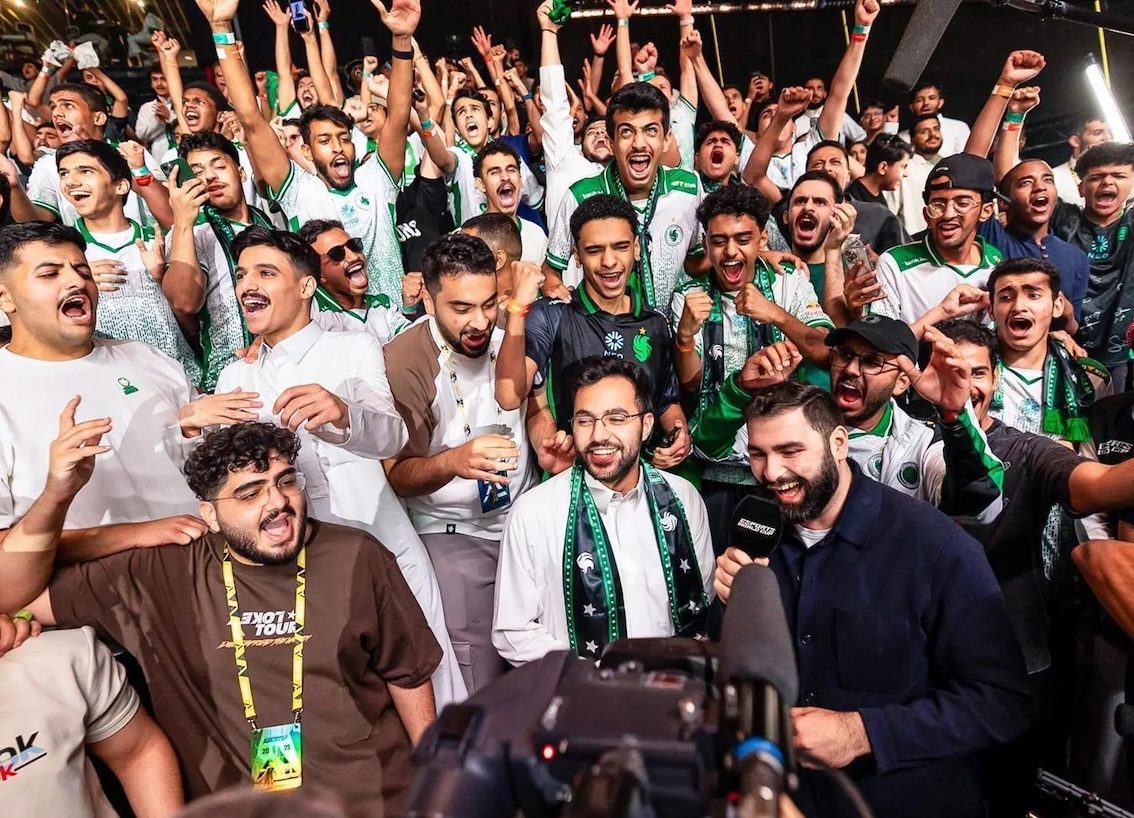
The $7 million cheque Team Falcons collected at the Esports World Cup in August wasn’t just prize money – it was a down payment on the future of competitive gaming.
With 750 million viewers and a single-week peak of nearly 8 million concurrent fans, Saudi Arabia’s second annual tournament has done what seemed improbable years ago: turned the kingdom into an unmissable destination on the esports calendar.
The competition and festival also drew 3 million visitors to Riyadh’s Boulevard City, topping last summer’s 2.6 million. During the event, Riyadh welcomed an estimated 300,000 international tourists, a 7 percent increase compared to the same period in 2024, underscoring the city’s efforts to become a global destination for esports, entertainment and culture.
In August, organisers unveiled the Esports Nations Cup, a biennial tournament that will pit countries, not clubs, against each other starting in November 2026. Riyadh will host the inaugural event before the competition rotates globally, bringing 15 game titles and over 100 qualifying nations into direct competition.
Surprise buyout
Then in September, the kingdom stunned the gaming world by agreeing to acquire Electronic Arts in the largest leveraged buyout in history. EA publishes best-selling franchises including EA FC (formerly Fifa), The Sims and Mass Effect.
The acquisition, orchestrated through Saudi Arabia’s Public Investment Fund, will take EA private. PIF already owned 10 percent of the company; it now becomes the majority shareholder in a deal worth around $56 billion – $36 billion in equity from a consortium and $20 billion in debt financing.
The consortium – PIF, Silver Lake and Jared Kushner’s Affinity Partners – paid a 25 percent premium over market value, pricing shares at $210 each.
PIF has moved aggressively beyond the EA deal. In March, it spent $3.5 billion to acquire Niantic’s gaming division, absorbing Pokémon Go into Scopely Inc, the Monopoly Go maker that PIF subsidiary Savvy Games Group had already bought for $4.9 billion in 2023.
Savvy has also partnered with France’s Ubisoft to integrate content from Saudi Arabia’s Hegra necropolis into the Assassin’s Creed franchise. French President Emmanuel Macron announced the deal during a state visit to Riyadh.
Looking east
Now Savvy is pivoting toward China and, more widely, Asia – the world’s largest and most mature esports markets.
The kingdom has already planted its flag in China. In 2023, Savvy dropped $265 million on VSPO (now Hero Sports), a Chinese esports organiser previously backed by Shanghai’s Tencent, becoming its largest shareholder.
The announcement landed days after Chinese President Xi Jinping visited Saudi Arabia. Tencent – long suspected of state ties despite past plans to list VSPO on US exchanges – now shares the table with Saudi capital.
This frenzied pace of dealmaking indicates Riyadh is racing to lock in first-mover advantages before the global esports market matures. The kingdom is positioning itself to dominate 21st-century esports the way US tech giants dominated social media – by controlling infrastructure, IP and distribution simultaneously.
The programme of acquisitions and events also underscores PIF’s (through SURJ, its sports investment arm) commitment to invest in commercially immature assets with a global footprint.
Untapped opportunity
Esports remains undervalued. The sector is expanding at 21 percent annually, with projections suggesting a $24 billion market by the mid-2030s – meaning today’s investments could multiply several times over.
Event organisation and software investment will contribute to ecosystem development in Saudi Arabia, as the kingdom seeks to diversify its economy away from oil and gas. The government aims for sport to contribute 3 percent to GDP by 2030, which will create jobs and generate inward investment from overseas.
Sealing the value chain
The kingdom is also moving into hardware. China’s Lenovo partnered with this summer’s World Cup, and last year PIF subsidiary Alat signed a $2 billion collaboration deal with the company.
This will accelerate Lenovo’s transformation while enhancing its global presence and diversifying its manufacturing footprint – giving Saudi Arabia access to gaming hardware production and closing another gap in the value chain.
Further reading:
The kingdom’s strategy is straightforward: look east to China and Asia for technological expertise and ready-made markets, while looking west to the US for financing and business acumen.
The appearance of Silver Lake as a co-investor illustrates this westward reach. PIF and the California-based private equity firm are already invested together in assets including Jio, a subsidiary of Reliance, one of India’s biggest companies. Jio brands itself as India’s one-stop gaming destination.
Playing to win
All of this traces back to Crown Prince Mohammed bin Salman’s reported childhood passion for Nintendo’s Super Mario. Saudi Arabia was a vastly different place in the 1990s – conservative and oil-dependent.
Today, esports and gaming are driving the country’s social and economic transformation. This is serious business, and Riyadh is playing to win.
The question for Western gaming companies, policymakers and competitors is no longer whether to take Saudi esports seriously, but whether they’ve already fallen too far behind.
Simon Chadwick is professor of AfroEurasion sport at Emlyon Business School in Lyon and formerly worked at Skema Business School in Paris
Read more from Simon Chadwick