
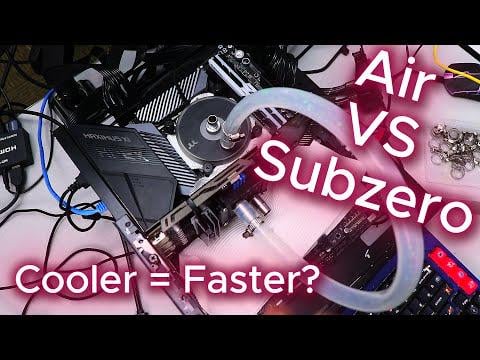
I wanted to see if extreme cooling actually gives a real-world boost once you’ve already maxed out an air overclock, so I ran a straight stock, air, subzero comparison.
Same four games tested at 1440p. 9700k and 3060Ti.
A baseline run at stock just to know where we’re starting from. Circa 1850MHz on the GPU and 4.6GHZ on the CPU
Then I pushed the CPU to 5Ghz and GPU to 1950ish which was as far as they’d go on air without going unstable, then re-ran everything.
Then! I chilled auto coolant to -18C and repeated the tests. CPU to 5.4GHz and GPU to 2100Mhz.
The results were all over the place depending on the game.
Shadow of the Tomb Raider +11 FPS going from stock to air, then +5 more when cold.
Cyberpunk +8 FPS on air, +3 more on ice.
Horizon Zero Dawn +10 FPS on air, +3 more cold.
Red Dead Redemption 2 barely +3 FPS on air, but then suddenly +7 when chilled.
What I learned is that subzero absolutely helps the GPU hold higher sustained clocks under load, obviously. However that doesn’t magically remove CPU bottlenecks or engine limits. If the game’s already capping out somewhere else, the gains are tiny. If it’s hammering the GPU the whole time, the extra thermal headroom makes a much more obvious difference. it also does not equal a dramatic uplift in FPS even if it will boost your TimeSpy score quite a bit.
The card I used turned out to be a total silicon failure as well and was a PITA to tune, so I think a better card would yield better results. I was already deep into it by the time I got to the subzero part so it was already too late.
I did not perform any BIOS hacks or voltage mods because I wanted to show what anyone could do with a bag of ice without any knowledge of performing those mods.
Filmed it all if you want to see the build and charts. https://youtu.be/n4PNXyBsLvk