
Gaming Simulators Market
Overview of the Gaming Simulators Market:
The gaming simulators market is a rapidly expanding segment within the broader gaming industry, characterized by the development and sale of software and hardware designed to replicate real-world experiences in a virtual environment. Gaming simulators encompass a wide range of applications, including flight simulators, racing simulators, and military training simulations, catering to both casual gamers and professional users. The increasing demand for immersive and realistic gaming experiences is driving growth in this market, with advancements in technology such as virtual reality (VR), augmented reality (AR), and high-fidelity graphics enhancing user engagement. As gaming continues to evolve, the simulators market is poised to benefit from innovations that enhance realism and interactivity, making it a key player in the future of entertainment and training.
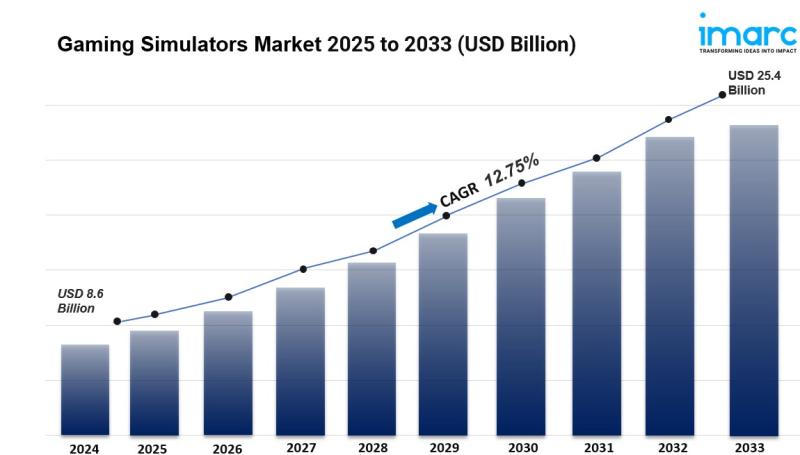
The global gaming simulators market size reached USD 8.6 Billion in 2024. Looking forward, IMARC Group expects the market to reach USD 25.4 Billion by 2033, exhibiting a growth rate (CAGR) of 12.75% during 2025-2033. The surging popularity of esports and competitive gaming, technological advancements in virtual reality (VR) and augmented reality (AR), the pandemic-induced surge in at-home entertainment, rising disposable incomes, innovative partnerships between gaming companies and simulator manufacturers, and the integration of motion-sensing and haptic feedback technologies are factors boosting the market growth.
Buy Now: https://www.imarcgroup.com/checkout?id=3217&method=1670
Key Highlights of the Gaming Simulators Market:
Technological Advancements: The gaming simulators market is significantly influenced by advancements in technology. Innovations in VR and AR are transforming the way gamers interact with simulations, providing more immersive experiences. High-resolution graphics, realistic physics engines, and advanced haptic feedback systems are enhancing the overall realism of simulators, attracting a broader audience.
Diverse Applications: Gaming simulators are not limited to entertainment; they are also utilized in various sectors, including education, military training, and aviation. Flight simulators are widely used for pilot training, while driving simulators are employed for driver education and testing. This diversification is expanding the market beyond traditional gaming, creating new revenue streams and opportunities for growth.
Growing Popularity of eSports: The rise of eSports is contributing to the growth of the gaming simulators market. Competitive gaming events often feature simulation games, attracting a large audience and encouraging the development of high-performance gaming rigs and peripherals. This trend is prompting manufacturers to create specialized simulators that cater to the needs of competitive gamers, further driving market growth.
Increased Investment in Gaming Infrastructure: With the growing demand for gaming simulators, there has been a notable increase in investment in gaming infrastructure. Companies are investing in research and development to create more sophisticated simulators, while gaming centers and arcades are incorporating advanced simulators to attract customers. This investment is expected to enhance the overall gaming experience and expand the market reach.
Consumer Demand for Realism: Modern gamers are increasingly seeking realistic and immersive experiences, leading to a demand for high-quality simulators. This trend is driving manufacturers to focus on developing simulators that offer unparalleled realism, including detailed environments, accurate controls, and lifelike interactions. As consumers become more discerning, the emphasis on quality and authenticity will continue to shape product development.
Rise of Home Gaming Setups: The trend towards home gaming setups is boosting the gaming simulators market. As more consumers invest in home entertainment systems, they are seeking high-quality simulators that can be integrated into their gaming rigs. This shift is leading to increased sales of gaming peripherals, such as steering wheels, flight yokes, and motion platforms, which enhance the simulator experience.
Impact of Social Media and Streaming: The influence of social media and streaming platforms is significant in the gaming simulators market. Gamers often share their experiences through live streams and social media, creating a community around simulator gaming. This visibility helps to promote new products and innovations, attracting more users to the market and encouraging engagement with simulator games.
Global Gaming Simulators Market Trends:
The increasing popularity of simulation-based learning in educational institutions, which use these tools to enhance student engagement and understanding, and the rise in disposable incomes, allowing more consumers to invest in high-quality, immersive gaming experiences at home, strengthening the market growth. In line with this, the integration of multiplayer and social features and the growing adoption of simulators in professional sports training, where athletes use them to improve skills and performance through realistic practice environments, is providing an impetus to the market expansion.
Factors Affecting the Growth of the Gaming Simulators Industry:
Advancements in technology:
The development of high-performance computing, graphics processing units (GPUs), virtual reality (VR), and augmented reality (AR) has revolutionized the capabilities of gaming simulators. Modern simulators leverage these technologies to deliver highly realistic and immersive experiences. Improved hardware, such as motion platforms and haptic feedback devices, enhances the physical realism of simulations by mimicking real-world movements and sensations. Additionally, advancements in software, including sophisticated physics engines and artificial intelligence (AI), enable more complex and interactive environments. These technological innovations enhance the gaming experience and expand the possibilities for simulation applications in various fields, contributing to the market growth.
Increasing demand for immersive gaming experiences:
Gamers are increasingly seeking experiences that go beyond traditional gameplay, desiring a more immersive and engaging environment. Gaming simulators offer a level of immersion that standard gaming setups cannot match, providing users with a sense of presence and realism. VR and AR technologies play a crucial role in creating these immersive experiences by allowing players to interact with the game environment more naturally and intuitively. The rise of esports and competitive gaming has also influenced this demand, as players look for ways to improve their skills and gain a competitive edge through realistic training simulations. Moreover, the COVID-19 pandemic has accelerated the adoption of home entertainment solutions, with gaming simulators becoming a popular choice for individuals seeking engaging activities while adhering to social distancing measures, thus bolstering the market demand.
Expanding the application of simulators beyond entertainment:
Gaming remains the primary use case, thus simulators are increasingly being utilized in training and education across various industries. For example, flight simulators are extensively used in aviation training to provide pilots with realistic and risk-free training environments. Similarly, driving simulators are employed in the automotive industry for driver training, vehicle testing, and research. Medical simulators are used for training healthcare professionals, enabling them to practice procedures and develop skills without risking patient safety. The use of gaming simulators in these professional contexts highlights their versatility, thereby creating a positive outlook for market expansion.
Request for a sample copy of this report: https://www.imarcgroup.com/gaming-simulators-market/requestsample
Gaming Simulators Market Report Segmentation:
By Component:
Hardware
Software
Hardware accounts for the majority of shares due to motion platforms, VR headsets, and haptic feedback devices, which are essential for creating immersive and realistic gaming simulator experiences.
By Game Type:
Shooting
Fighting
Racing
Others
Racing represents the majority of shares due to its popularity and the need for precise and realistic driving experiences.
By End Use:
Residential
Commercial
Residential dominates the market, as the increasing availability and affordability of high-quality gaming simulators have led to widespread adoption in home entertainment setups.
Regional Insights:
North America
United States
Canada
Europe
Germany
France
United Kingdom
Italy
Spain
Others
Asia Pacific
China
Japan
India
South Korea
Australia
Indonesia
Others
Latin America
Brazil
Mexico
Others
Middle East and Africa
North America enjoys the leading position due to its large and affluent gaming population, advanced technology infrastructure, and significant investment in entertainment innovations.
Top Gaming Simulators Market Leaders:
The gaming simulators market research report outlines a detailed analysis of the competitive landscape, offering in-depth profiles of major companies. Some of the key players in the market are:
3D Perception Inc.
CKAS Mechatronics Pty Ltd
Cxc Simulations LLC
D-Box Technologies Inc
Eleetus LLC
GTR Simulators
Hammacher Schlemmer & Company Inc.
Playseats B.V.
RSEAT Ltd.
Sony Interactive Entertainment Inc.
Vesaro
Ask An Analyst: https://www.imarcgroup.com/request?type=report&id=3217&flag=C
If you require any specific information that is not covered currently within the scope of the report, we will provide the same as a part of the customization.
About Us:
IMARC Group is a global management consulting firm that helps the world’s most ambitious changemakers to create a lasting impact. The company provide a comprehensive suite of market entry and expansion services.
IMARC offerings include thorough market assessment, feasibility studies, company incorporation assistance, factory setup support, regulatory approvals and licensing navigation, branding, marketing and sales strategies, competitive landscape and benchmarking analyses, pricing and cost research, and procurement research.
Contact US:
IMARC Group
134 N 4th St. Brooklyn, NY 11249, USA
Email: sales@imarcgroup.com
Tel No:(D) +91 120 433 0800
United States: +1-631-791-1145
This release was published on openPR.