
Future Scope of Gaming Laptop Market
“
The Gaming Laptop Market is experiencing robust growth, driven by the confluence of several factors. The escalating popularity of esports and video game streaming has fueled demand for high-performance portable gaming solutions. Technological advancements, particularly in processing power, graphics cards, display technology, and cooling systems, have enabled the creation of gaming laptops that rival the performance of desktop computers. The increasing availability of high-speed internet and cloud gaming services further enhances the gaming experience on laptops. Moreover, gaming laptops are increasingly used by content creators, programmers, and other professionals who require powerful, mobile computing solutions. The market’s growth also contributes to addressing global challenges by fostering innovation in hardware and software, driving technological advancements, and creating employment opportunities in the gaming and technology sectors. As gaming becomes more mainstream and accessible, the demand for gaming laptops is expected to continue its upward trajectory, positioning the market as a key segment within the broader consumer electronics industry. The ability to enjoy high-fidelity gaming experiences on the go, coupled with the multi-functional capabilities of these devices, solidifies the gaming laptop as a compelling choice for a wide range of users.
Get the full PDF sample copy of the report: (TOC, Tables and figures, and Graphs) https://www.consegicbusinessintelligence.com/request-sample/1561
Market Size:
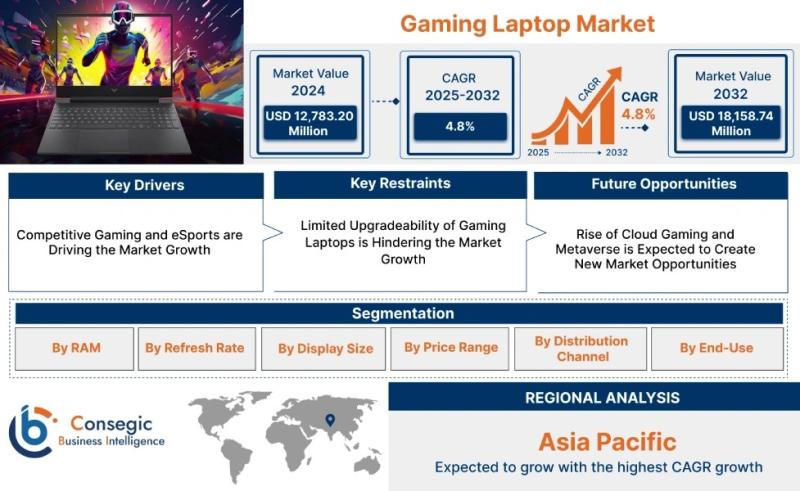
The Gaming Laptop Market size is estimated to reach over USD 18,158.74 Million by 2032 from a value of USD 12,783.20 Million in 2024 and is projected to grow by USD 13,134.23 Million in 2025, growing at a CAGR of 4.8% from 2025 to 2032.
Definition of Market:
The Gaming Laptop Market encompasses the production, distribution, and sale of portable computers specifically designed and optimized for playing video games and running demanding applications. These laptops are characterized by high-performance processors, dedicated graphics cards, high refresh rate displays, advanced cooling systems, and customizable features. Key components of this market include:
* **Gaming Laptops:** The core product, available in various configurations based on specifications, features, and price points.
* **Hardware Components:** Processors (CPUs), Graphics Cards (GPUs), RAM, storage devices (SSDs/HDDs), cooling solutions, displays, keyboards, and audio systems, all optimized for gaming performance.
* **Software and Peripherals:** Gaming software, operating systems, drivers, and peripherals such as gaming mice, keyboards, headsets, and controllers specifically designed to enhance the gaming experience.
* **Services:** Warranty, technical support, and customization services offered by manufacturers and retailers.
Key terms related to the market include:
* **FPS (Frames Per Second):** A measure of the number of frames a graphics card can render per second, directly impacting the smoothness of gameplay.
* **GPU (Graphics Processing Unit):** A specialized electronic circuit designed to rapidly manipulate and alter memory to accelerate the creation of images in a frame buffer intended for output to a display device.
* **CPU (Central Processing Unit):** The primary processing unit of the laptop, responsible for executing instructions and managing overall system performance.
* **Refresh Rate:** The number of times per second that a display updates the image on the screen, measured in Hertz (Hz). Higher refresh rates result in smoother visuals, especially during fast-paced gaming.
* **Thermal Management:** The system of cooling components within the laptop to prevent overheating and maintain optimal performance.
Get Discount On Report @ https://www.consegicbusinessintelligence.com/request-discount/1561
Market Scope and Overview:
The Gaming Laptop Market spans a wide range of technologies, applications, and industries. Key technologies include advanced processors, high-performance graphics cards, high refresh rate displays (120Hz, 144Hz, 240Hz, 360Hz), efficient cooling systems, fast storage solutions (SSDs), and customizable RGB lighting. The market caters to various applications, including esports, content creation, game development, and professional gaming. Industries served include gaming, entertainment, education, and software development. The geographic scope is global, with significant markets in North America, Europe, Asia-Pacific, and Latin America.
The gaming laptop market is a pivotal segment of the global technology landscape. The surge in esports and gaming tournaments has amplified the demand for high-performance, portable gaming solutions. These laptops offer gamers the flexibility to play and compete anywhere, without compromising on graphical fidelity or processing power. Furthermore, the market’s growth impacts related industries such as software development, component manufacturing, and peripherals. As gaming becomes more integrated into mainstream culture, the gaming laptop market will continue to play a crucial role in shaping the future of entertainment and technology. The market also fuels innovation in cooling technologies, display technologies, and battery life, which can have spillover effects into other segments of the laptop market.
Top Key Players in this Market
Lenovo Group Limited (China) Razer Inc. (United States) Dell Technologies Inc. (United States) Micro-Star International Co., Ltd. (MSI) (Taiwan) Origin PC Corporation (United States) Eluktronics, Inc. (United States) Acer Inc. (Taiwan) HP Inc. (United States) ASUSTeK Computer Inc. (Asus) (Taiwan) Alienware Corporation (United States) GIGA-BYTE Technology Co., Ltd. (Taiwan)
Market Segmentation:
The Gaming Laptop Market is segmented by RAM (8GB, 16GB, 32GB, Other), refresh rate (60Hz, 120Hz, 144Hz, 240Hz, 360Hz), display size (Up to 14-inch, Between 14-inch to 18-inch, Above 18-inch), price range (Budget Range, Mid-Range, Premium), distribution channel (Online Retail stores, Authorized Resellers and Distributors, Custom PC builders, Enterprises), and end use (Professional Gamers, Content Creators, Programmers, Others). Each segment contributes to market growth by catering to specific consumer needs and preferences. For example, professional gamers often require high refresh rates and powerful hardware, while content creators may prioritize larger displays and ample storage.
Market Drivers:
Key drivers for growth in the Gaming Laptop Market include:
* **Technological Advancements:** Continuous innovation in processors, graphics cards, display technology, and cooling systems.
* **Growing Popularity of Esports:** Increasing participation in and viewership of esports tournaments.
* **Demand from Content Creators:** The need for high-performance, portable workstations for video editing, graphic design, and streaming.
* **Increasing Disposable Income:** Rising purchasing power, particularly in emerging economies.
* **Enhanced Gaming Experiences:** Advancements in game graphics and immersive gameplay.
* **Online Availability**: Accessibility to wide variety of selections and options online.
Market Key Trends:
Significant trends in the Gaming Laptop Market include:
* **Adoption of High Refresh Rate Displays:** Increased demand for 144Hz, 240Hz, and 360Hz displays for smoother gaming experiences.
* **Use of Advanced Cooling Systems:** Implementation of liquid cooling and vapor chamber technologies to manage heat dissipation.
* **Integration of AI and Machine Learning:** Application of AI to optimize performance and enhance gaming experiences.
* **Rise of Cloud Gaming Services:** Growth in cloud gaming platforms allowing gamers to stream high-end games on less powerful hardware.
* **Increasing Focus on Portability:** Development of slimmer and lighter gaming laptops without compromising performance.
* **Customization Options**: Gamers are having more freedom to customize.
Market Opportunities:
Growth prospects in the Gaming Laptop Market include:
* **Expansion into Emerging Markets:** Targeting untapped markets in Asia-Pacific, Latin America, and Africa.
* **Development of Niche Products:** Creating specialized gaming laptops for specific game genres or user segments.
* **Integration of Virtual and Augmented Reality:** Incorporating VR/AR capabilities into gaming laptops.
* **Partnerships with Game Developers:** Collaborating with game studios to optimize gaming laptops for specific titles.
* **Innovations:** Developing high quality cooling options, and better processor.
Market Restraints:
Challenges and barriers in the Gaming Laptop Market include:
* **High Initial Costs:** The relatively high price of gaming laptops compared to desktop computers.
* **Limited Battery Life:** The challenge of providing adequate battery life for extended gaming sessions.
* **Thermal Management Issues:** Overheating problems that can affect performance and longevity.
* **Component Shortages:** Supply chain disruptions that can lead to component scarcity and price increases.
* **Competition from Gaming Desktops:** The continued popularity of gaming desktops, which offer better performance at a lower price point.
Market Challenges:
The Gaming Laptop Market, while exhibiting strong growth, faces several significant challenges that could impact its future trajectory. One of the primary challenges is managing the delicate balance between performance, portability, and battery life. Gaming laptops are expected to deliver desktop-level performance in a compact form factor, which requires advanced cooling solutions and power management techniques. However, achieving this balance often leads to compromises. For instance, high-performance components generate significant heat, necessitating bulky cooling systems that can reduce portability and increase weight. Similarly, maximizing battery life while running demanding games remains a persistent challenge, often limiting the duration of unplugged gaming sessions.
Another challenge is the rapid pace of technological advancement. New processors, graphics cards, and display technologies are constantly being introduced, requiring manufacturers to continually update their product lines to stay competitive. This necessitates significant investment in research and development, as well as efficient supply chain management to ensure timely access to the latest components. The cost of these advanced components also contributes to the high price of gaming laptops, potentially limiting their accessibility to a broader consumer base. Furthermore, component shortages and supply chain disruptions can exacerbate these challenges, leading to production delays and price increases.
Thermal management also remains a critical concern. Overheating can lead to performance throttling, reduced component lifespan, and even system instability. Manufacturers must employ sophisticated cooling solutions, such as vapor chambers, liquid cooling, and advanced fan designs, to effectively dissipate heat. However, these solutions can add to the cost and complexity of the laptop. Software optimization and power management techniques are also essential for mitigating thermal issues and maximizing performance. Finally, competition from other gaming platforms, such as consoles and cloud gaming services, poses a challenge to the Gaming Laptop Market. Consoles offer a more affordable entry point into gaming, while cloud gaming services allow gamers to stream high-end games on less powerful hardware. To remain competitive, gaming laptop manufacturers must continue to innovate and differentiate their products through superior performance, unique features, and enhanced user experiences.
Market Regional Analysis:
The Gaming Laptop Market exhibits distinct regional dynamics influenced by factors such as economic conditions, gaming culture, and technological infrastructure. North America and Europe are mature markets with high adoption rates of gaming laptops, driven by strong gaming communities and advanced technological infrastructure. Asia-Pacific is the fastest-growing region, fueled by increasing disposable income, the popularity of esports, and a large gaming population. Countries like China, India, and South Korea are key growth markets in this region. Latin America and the Middle East & Africa represent emerging markets with significant growth potential, driven by increasing internet penetration and rising interest in gaming. Each region presents unique opportunities and challenges for gaming laptop manufacturers, requiring tailored marketing strategies and product offerings. The presence of local players and distributors also impacts market dynamics in different regions.
Frequently Asked Questions:
* **What is the projected growth of the Gaming Laptop Market?**
The Gaming Laptop Market is projected to grow at a CAGR of 4.8% from 2025 to 2032.
* **What are the key trends in the Gaming Laptop Market?**
Key trends include the adoption of high refresh rate displays, the use of advanced cooling systems, and the integration of AI and machine learning.
* **What are the most popular Market types?**
Most popular types include those with high refresh rates, advanced cooling solutions, and portability.
“
Contact Us:
Consegic Business intelligence Pvt Ltd
Baner Road, Baner, Pune, Maharashtra – 411045
(US) (505) 715-4344
info@consegicbusinessintelligence.com
sales@consegicbusinessintelligence.com
Web – https://www.consegicbusinessintelligence.com/
About Us:
Consegic Business Intelligence is a data measurement and analytics service provider that gives the most exhaustive and reliable analysis available of global consumers and markets. Our research and competitive landscape allow organizations to record competing evolutions and apply strategies accordingly to set up a rewarding benchmark in the market. We are an intellectual team of experts working together with the winning inspirations to create and validate actionable insights that ensure business growth and profitable outcomes.
We provide an exact data interpretation and sources to help clients around the world understand current market scenarios and how to best act on these learnings. Our team provides on-the-ground data analysis, Portfolio Expansion, Quantitative and qualitative analysis, Telephone Surveys, Online Surveys, and Ethnographic studies. Moreover, our research reports provide market entry plans, market feasibility and opportunities, economic models, analysis, and an advanced plan of action with consulting solutions. Our consumerization gives all-inclusive end-to-end customer insights for agile, smarter, and better decisions to help business expansion.
Connect with us on:
LinkedIn – https://www.linkedin.com/company/consegic-business-intelligence/
YouTube – https://www.youtube.com/@ConsegicBusinessIntelligence22
Facebook – https://www.facebook.com/profile.php?id=61575657487319
X – https://x.com/Consegic_BI
Instagram – https://www.instagram.com/cbi._insights/
This release was published on openPR.