
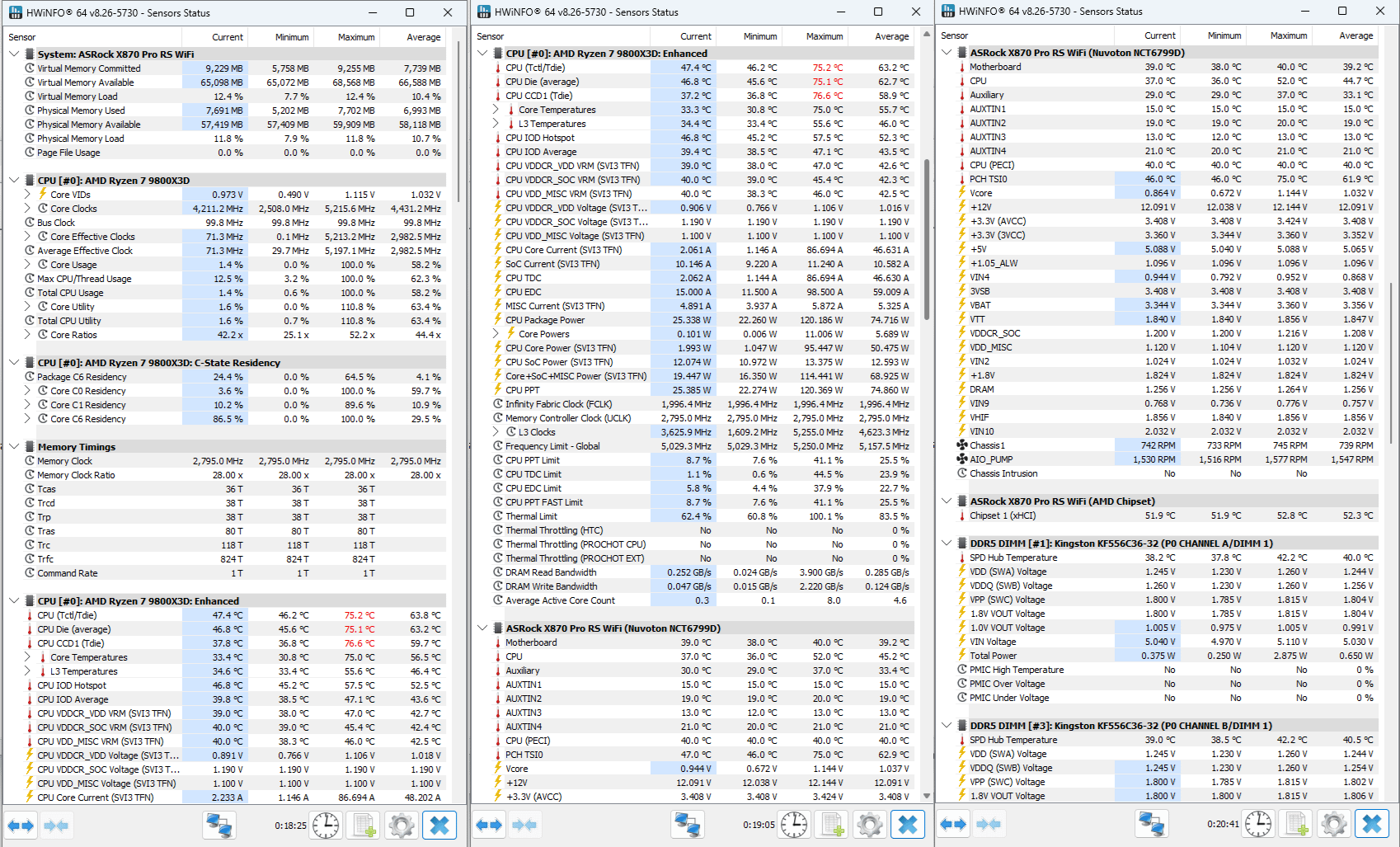
In light of the recent news about ASRock motherboard failures and CPUs dying, I decided to change the default settings. I used the 75°C Tjmax -30 curve option and the XMP 5600 settings for my RAM, just to be safe. So far, I have run two Cinebench R23 multicore tests (22793 and 22765) and everything looks good; there has been no BSOD.
My questions are: should I try pushing for the -40 curve, or should I keep it as it is? Do my voltages look good enough to not fry my CPU?
6 Comments
Imgur for bigger (and maybe better) pic: [https://imgur.com/a/tm2xcf9](https://imgur.com/a/tm2xcf9)
Why would you lock it at 75 degrees? It’s designed to try to get to 95 because it runs most efficient at that temp. You can read about it here : [Ryzen 7000 Series Processors: Let’s Talk About Pow… – AMD Community](https://community.amd.com/t5/gaming/ryzen-7000-series-processors-let-s-talk-about-power-temperature/ba-p/554629)
OP you’re playing with fire running that processor in that motherboard. Asrock still to this day does not know why their motherboards are cooking AMD CPUs to death. They claimed that the 3.25 BIOS fixes it, but it does not. You’re just grasping at straws trying to mitigate it at this point. It’s likely a voltage issue, not a temperature issue, and it probably relates to a specific part of the processor that you can’t tinker with at all, similar to what killed all those Intel chips not that long ago. The sad part of it, too, is that Intel still to this day has not been able to fix that issue. So I am concerned that these X3D chips may perhaps be permanently borked.
At the very least don’t run that chip in an Asrock motherboard right now. It’s just asking for trouble IMO.
As for your voltage curve, so long as it is 100% stable at -30 and you have tested it, yes, you might as well try for -40, and heck even go for -50 if it’s fully stable at -40.
Side Note:
I would be willing to bet my left but -40 will crash in the stability test in Aida64.
I can run TestMen5, Prime95, OCCT, etc. all day without issues but Aida64 will cause my system to crumble.
Just so you know..CB R23 isn’t stability test.
Use core cycler to verify your – CO