
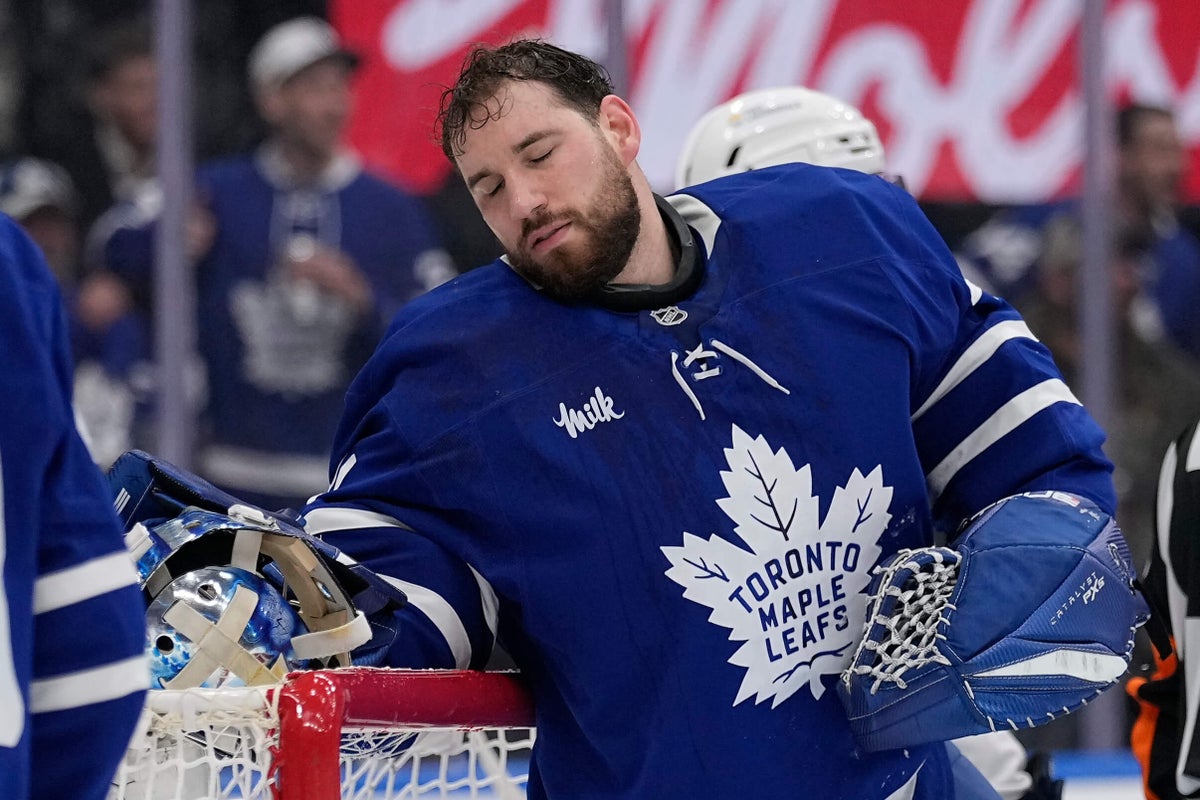
The process for pulling an NHL player from a game due to a potential concussion is complex.
The league introduced concussion spotters during the 2015-16 season as part of its initial concussion protocols, but over time, the way those spotters interact with events on the ice has evolved.
While it was initially on team employees to flag and pull players from games, the NHL later introduced neutral spotters at the league offices in New York and in arenas around the league.
The centralized league spotters are certified athletic trainers or therapists with hockey experience. They’re based remotely at the Department of Player Safety offices and mandated to look out for signs of concussion in games, such as players lying motionless on the ice, displaying coordination or balance problems, giving blank or vacant looks, getting up slowly or clutching their head.
It’s up to those remote officials — and not the in-arena spotters, who are not necessarily athletic trainers or therapists — to determine whether a player needs to be removed immediately for concussion testing or if it’s a discretionary call to be made by the team’s medical staff.
The concussion spotters’ impact has already been felt several times throughout the NHL playoffs, including when Toronto Maple Leafs veteran John Tavares was removed from overtime in Game 4 of the first round against the Ottawa Senators after taking an elbow to the head.
Three games later, Leafs goaltender Anthony Stolarz was hit in the head multiple times — once by a shot that knocked his goalie mask off and then by a controversial forearm to the head — and spotters did not remove him from Game 1 of the second round against the Florida Panthers.
It wasn’t until Stolarz went to the bench to vomit midway through the second period that he was removed from Monday’s game, after which he was placed on a stretcher and taken to a Toronto hospital.
The sequence of events alarmed those who work in the field of concussions and head injuries in professional sports.
The fact Stolarz wasn’t removed from the game earlier revealed gaps in the way the NHL handles potential concussions, according to Chris Nowinski, a behavioral neuroscientist who co-founded the Concussion Legacy Foundation after dealing with head injuries as a professional athlete.
“I saw the elbow to the head and learned he was not removed, which was disappointing,” Nowinski said on Wednesday. “That’s very concerning with two potential concussions, neither of which he was removed for, and might help explain why we saw a player vomiting (during a game) for the first time in a long time.”
Nowinski explained there were signs Stolarz may have had a concussion after the first blow to the head, like when the goalie shook his head after his mask was knocked off by a shot. Nowinski has done considerable research in this area and calls these events a “Spontaneous Headshake after a Kinematic Event.” According to one study he was part of, SHAAKE has a positive predictive value of 72 percent for the diagnosis of concussion across all sports.
Nowinski does not believe, however, that this is one of the signs NHL concussion spotters are identifying during games.
As for why Stolarz wasn’t pulled from the game after being hit in the head a second time, despite the fact he went down to the ice and held his head, the play was not ruled a mandatory pull from the league’s central spotter like the Tavares incident. It’s possible spotters missed the hit or simply deemed the contact and Stolarz’s response not severe enough to warrant a mandatory pull.
When that happens, the quiet-room decision becomes a discretionary pull, which means it is up to the team to decide whether the player comes out for further testing and examination.
Stolarz did go to the bench and consult with Leafs head athletic therapist Paul Ayotte during a commercial break after the second blow to his head, but he then returned to the crease and played another two minutes before eventually leaving the game after he was sick.
His replacement in goal, Joseph Woll, was not given a warmup when he entered play at the midway point of the game, something permitted only when league spotters pull a goaltender.
A Leafs spokesman confirmed Wednesday that Stolarz was not pulled by a concussion spotter during the game. NHL deputy commissioner Bill Daly, however, said the league did a review of the process in this case and said it “has not indicated any variations or misapplications of our concussion protocol.”
But Nowinski said having players and team personnel involved in deciding whether or not players are OK to play can be problematic, as there’s a conflict of interest, especially during high-stakes games in the playoffs.
“That probably creates a slower hook for pulling people out,” Nowinski said. “Because if you pull somebody out who’s healthy and it affects the game outcome, you could lose your job.
“I think 100 percent he should have been pulled. If this is a non-NHL game, athletes would be pulled. But we’re just dealing with the realities of professional sports and the money that’s on the line and people’s jobs.”
Nowinski explained that it was not possible to diagnose the severity of Stolarz’s injury based on watching on television or the additional available details. However, the fact that Stolarz had vomited and was placed on a stretcher and taken to the hospital after leaving the game indicated the seriousness of what he was potentially dealing with.
Nowinski said vomiting repeatedly can be a sign of a potential brain bleed, which may have been why the team would have quickly escalated his treatment.
Stolarz was back with the team behind the scenes on Tuesday, but he is not playing for the Leafs in Game 2 on Wednesday night. His status for the remainder of the series is unknown, as the team has released no details about his injury or treatment.
“He’s fine. He’s recovering,” Leafs coach Craig Berube said.
While Nowinski has been frustrated by the NHL’s approach to concussion-related issues for years, he is encouraged that new NHLPA executive director Marty Walsh is forming a chronic traumatic encephalopathy advisory committee to educate players about CTE and its potential link to concussions in hockey.
Nowinski believes it is now on NHL players to educate themselves about the risks of injuries to their brains and the importance of having comprehensive concussion protocols that are closely followed. He argues the NHL needs to adopt more transparent, publicized “no-go” symptoms of a concussion, like the NFL has, for determining when players will be removed from games.
“I don’t think we should expect any improved leadership from the NHL,” Nowinski said. “They are not going to be leaders on this. This is on the players at this point. I don’t think the players are educated on the consequences of what these head impacts are going to do to them long-term. I doubt very many are aware that 19 of the first 20 NHL players that we have studied have had CTE.
“And I don’t think they understand how bad CTE can be and how much it can affect them. So there is a lack of respect for the brains of their opponents and an appreciation of their (own) brains. And I think people are still willing to try to take out a good player for the other team and take that suspension, and that’s not a culture that good players should want to play in. And so I would encourage them to take learning about CTE very seriously this summer and come and start taking steps to create a safer game. Because right now, if they get CTE, we can’t fix them.”
(Photo of Anthony Stolarz: John E. Sokolowski / Imagn Images)