
Disclaimer: This is not a leak or a rumour. Everything is guesstimation based on publicly available info. I've tried making the data as accurate as possible.
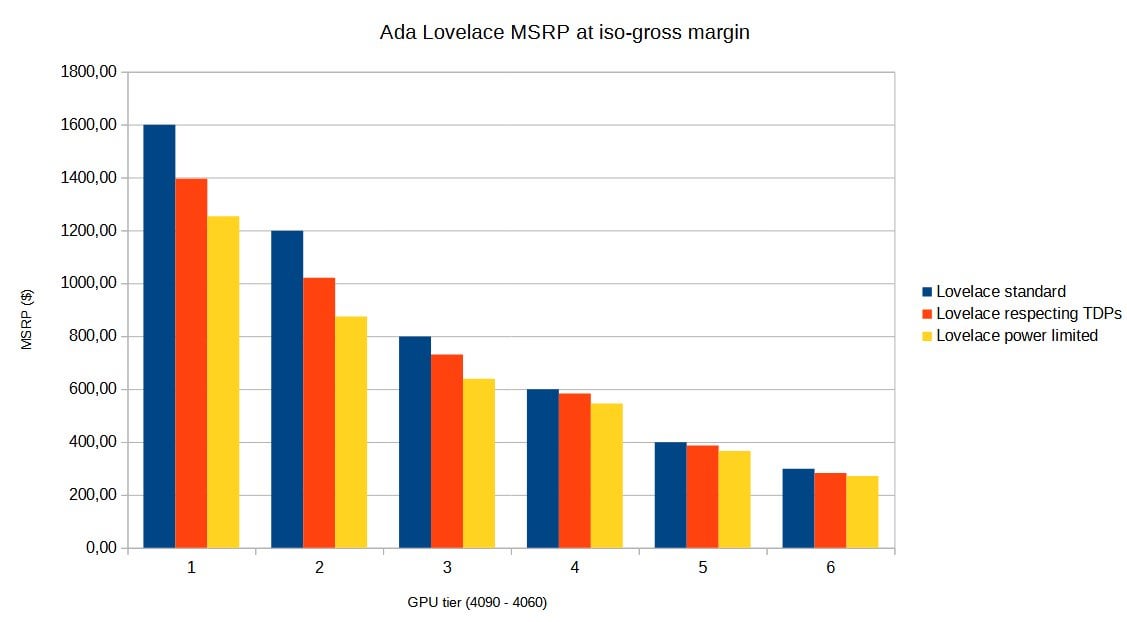
TL;DR: Prices for RTX 4000 series could have been these at TDPs or power limited all without a single dent in Nvidia's bottom line (gross margin), see bar charts at #1:
| GPU | $ at TDP (same perf) | $ at Pwr lim (~5-7% less perf) |
|---|---|---|
| RTX 4090 ($1599) | $1395 (450W) | $1254 (315W) |
| RTX 4080 ($1199) | $1021 (320W) | $874 (220W) |
| RTX 4070 TI ($799) | $731 (285W) | $639 (200W) |
| RTX 4060-4070 ($299-599) | 5% lower $ (9-17% lower TDP) | 8-9% lower $ (10-25% lower TDP) |
Text: Imagine how much better and less of a headache Lovelace could have been if Nvidia had just power limited it and not released a overblown TDP (+600W) specs to AIBs like ASUS resulting in a RTX 4090 the size of a PS5, and in general much larger graphics cards.
There would have been no new PSU issue with a 16pin PCIe connector of 300W easily adapted to 2 x PCIe 8pin. PC cases could be reused and there would be no overheating room woes (not everyone has AC) or problems with electricity bill (electricity is expensive in Europe where I live).
Compared to previous generations RTX 4000 series graphics cards are very expensive to produce (see #2). In addition it doesn't make Nvidia a higher profit (gross margin) than previous generations (again #2), and unfortunately we know Nvidia is always passing extra cost onto the consumer.
This once again underscores just how bad overbuilding (+600W cooler) and not power limiting a power hungry (450W instead of ~315W) graphics card is: The consumer always ends up footing the bill.
Sources:
- Pricing bar charts here: https://imgur.com/a/IOdPggT
- 2012-2023 gross margin on Nvidia graphics cards: https://imgur.com/a/InCpqnM
- Data for #1+2: https://docs.google.com/spreadsheets/d/1YFkHCFroGLIQ-QcZLtcLeLeYNnuNFHICqg_r2BsNQdY
Edit – Clearing up any confusion: The info is NOT fact but guesstimation based on the best info I could find online, which took days to compile.
Also I'm not a Nvidia apologist or anything like that. I'm simply stating that the production cost (BOM) underlying newer generations of graphics cards is not working in the consumers favor. This is due to increased costs associated with power draw and more complex and expensive GPU chips.
Nvidia like any other company laser focused on their bottom line and will only very reluctantly reduce their gross margin (profit without overhead (R&D, drivers, sales and support etc..)). Ampere (2000 series) and Lovelace (4000 series) already had lower gross margins on average than previous generations at launch. I couldn't really believe it at first, but it's true and is a result of this increased production cost. That doesn't mean it's a low gross margin it's still quite high, but Nvidia doesn't think so and in the end that's really all that matters. Without a GPU price war you'll not see Nvidia lowering their gross margin by a ton. Effectively the BOM cost acts as a floor that Nvidia wants to keep a large distance too, and if it goes up by a lot prices will almost always go up as well.
Also like people have said Nvidia could technically sell their gaming GPUs at cost or a loss (like consoles), but they'll never do that and if they did then AMD will completely withdrew from the GPU gaming market to focus on making their AI datacenter competitor.
18 Comments
They care about selling datacenter cards, not gaming GPU, the gaming market is a bonus
Technically they could’ve given the cards away for free and barely made a dent in their profits…
Believe me they make their margins healthily even in the gaming segment. A 4060 uses a Ad107 die, that’s so small it can normally be found in 50 class GPUs. Production cost of the chip and pcb (labor and research included) is probably 75-100$ per 4060. they sell it for 150-200$ to an AIB, they add a 50$ cooler and another 20-30$ margin. Then the card gets bought for 250-300$ by the retailer who adds another 20-60$ per card and bam you get the gpu. Of course the pricing is highly speculative and TSMC wafer pricing is kept secret for a reason but a 100mm2 die costs about 20$, then 8gb vram ~12-16$ and the rest costs are packaging (~10$) and the engineering (?)
Shocking
Why would it be cheaper for Nvidia to release these cards at a lower TDP? It’s still the same silicon?
I don‘t get what you’re trying to say?
Why would they make it cheaper if they don’t have to
They price based on what people will pay, not on what would maintain their margin.
If people will pay more, they price more.
Much cheaper -> even less sense in buying AMD cards -> more monopoly
You are massively overestimating the cost of the cooler and board.
The massive cooler on the 3090ti only cost them [$150 to make](https://www.techpowerup.com/268278/nvidias-next-gen-reference-cooler-costs-usd-150-by-itself-to-feature-in-three-skus).
By far the most expensive part of the board, excluding core and RAM, is the power stages in the VRM. However, they are still only [$5 a piece](https://www.monolithicpower.com/en/mp86957.html?), probably less for Nvidia.
Nvidia is not in the business of selling gaming GPUs anymore. Some gamers get Nvidia gpus because they are good for gaming.
Wait do you mean late stage capitalism results in corporate greed? Gee willikurs!
You dont cost in r+d
OP thinks that undervolting and smaller cooler would save $150 in 4080 production costs. Insanity
We should be glad that they are even selling gaming GPUs now.
I’m sure someone in the company put out an idea to completely stop gaming production and focus that silicon to data center GPUs. In theory, every consumer GPU they are selling right now is a net loss for them, no matter how costly it is. If they made those into AI GPUs, they stand to make 20x + profits.
But they probably committed too many resources by this point for 50series already so it’s a small price to pay to stay ahead of any competition in the gaming sector , even if they charge crazy prices for the chips.
IMO there is a good chance they will be delaying the next to next generation aka 60series cards by couple of years for sure. Nvidia has this internal work culture of not slacking off, from what I hear. So they will continue to work on 60 series. But I see no reason for them to rush it or even do it at normal pace.
This is such nonsense
The data provided here is incomplete and doesn’t prove anything
You need to take those meds the shrink gave you.
Alright so there’s this thing called business where every company prices things as high as possible while people still pay it.
Prices stay lower with more competition; this goes from Electronics, Baby clothes, Candy bars. Doesn’t matter what field every company prices things at a point where consumers will still pay it albeit it at the maximum of what they’re willing to pay.
If you need the most dramatic rendition of this check out Car Dealerships and their ridiculous markups over the years. You’re not paying for what it’s worth; rather what you’re willing to pay.