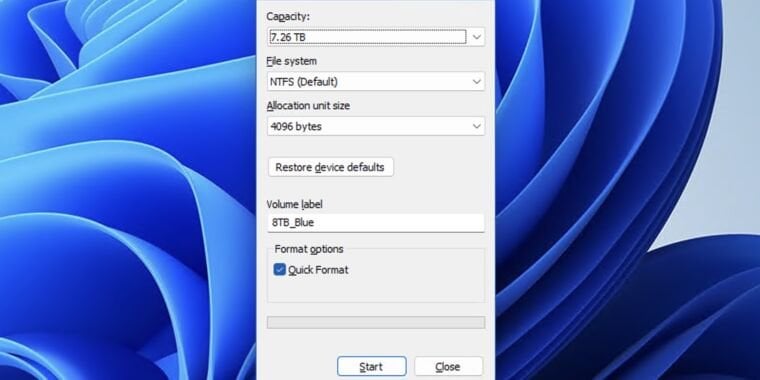
The 32GB limit can allegedly be pinned on former Microsoft programmer Dave Plummer, who occasionally shares stories about his time working on Windows in the 1990s and early 2000s. Plummer says that he wrote the file format dialog, intending it as a “temporary” solution, and arbitrarily chose 32GB as a size limit for disks, likely because it seemed big enough at the time (Windows NT 4.0 required a whopping 110MB of disk space).
There aren’t a ton of reasons to actually use a FAT32 disk in 2024, and it’s been replaced by other filesystems for just about everything. As a filesystem for your main OS drive, it was replaced by NTFS decades ago; as a widely compatible filesystem for external drives that can be read from and written to by many operating systems, you’d probably want to use exFAT instead. FAT32 still has a 4GB limit on the size of individual files.
But if you’re formatting a disk to use with an old version of Windows, or with some older device that can only work with FAT32 disks, this tweak could make Windows a tiny bit more useful for you.
BetterPySoonTm
If Microsoft keeps this up Windows 11 will be pretty damn good by the time Windows 12 is dropped on our heads with the weight of 18,446,744,073,709,551,615 bits
SaltedCoffee9065
FAT32 itself is ancient
SignalButterscotch73
But why?? Who needs more than 32GB of fat32? It’s an almost completely irrelevant file system now.

4 Comments
From the article:
The 32GB limit can allegedly be pinned on former Microsoft programmer Dave Plummer, who occasionally shares stories about his time working on Windows in the 1990s and early 2000s. Plummer says that he wrote the file format dialog, intending it as a “temporary” solution, and arbitrarily chose 32GB as a size limit for disks, likely because it seemed big enough at the time (Windows NT 4.0 required a whopping 110MB of disk space).
There aren’t a ton of reasons to actually use a FAT32 disk in 2024, and it’s been replaced by other filesystems for just about everything. As a filesystem for your main OS drive, it was replaced by NTFS decades ago; as a widely compatible filesystem for external drives that can be read from and written to by many operating systems, you’d probably want to use exFAT instead. FAT32 still has a 4GB limit on the size of individual files.
But if you’re formatting a disk to use with an old version of Windows, or with some older device that can only work with FAT32 disks, this tweak could make Windows a tiny bit more useful for you.
If Microsoft keeps this up Windows 11 will be pretty damn good by the time Windows 12 is dropped on our heads with the weight of 18,446,744,073,709,551,615 bits
FAT32 itself is ancient
But why?? Who needs more than 32GB of fat32? It’s an almost completely irrelevant file system now.