
To preface, there is pretty much zero reason to do the mods I did on a GTX 650 Ti. The card is irrelevant in the modern GPU landscape, and it's not worth many (b)points on HWBot. But I saw it has a controller capable of voltage control over I2C and I just could not resist.
So here we go:
On the front I added the breakaway header pins on the top left where the VRM test point is (GND, SCL, SDA) for the ASP1212 (CHL8318) VRM controller. I added some bulk output filter capacitors to the immediate output side of the Vcore and Vmem power rails (blue caps). I harvested these caps from a dead GPU – polymer caps rated for 2.5 V and 820 uF. I added a 470 uF SMD SP-cap to the Vcore output in the empty spot. Lastly, I populated empty MLCC pads with capacitors also harvested from dead GPUs. Simple voltmod to the FB pin of the APW7165 Vmem controller using a 20K potentiometer to give a good range of voltage control. I also added some heatsinks, but these were completely useless.
I added some liquid electrical tape around the core, originally intending to put this under dry ice. But after I checked the scores on HWBot, I realized I could do pretty well with just a voltmod and water cooling. I kept the LET on anyway because it makes it look cooler and gives the impression this is more extreme than it really is.
On the back, things are more interesting. All the capacitors were harvested from dead GPUs. The back is mostly bulk capacitance on the output filter, and also directly behind the core/mem. I found that after adding the bulk capacitance on the memory helped stabilize memory clocks, reducing random crashes and letting me run right up until the roll over limit (~1.82 V for this Hynix AFR; ran at 1.78 V). Backside Vcore capacitance I think helped, but I don't have an O-scope and didn't test thoroughly enough to know what it did, if anything, but I'll pretend it was absolutely essential to please myself. The same thing is true for the input filtering, but I did this because I've seen some reports it helps and had I the caps laying around. Input caps are 16 V 270 uF capacitors. Bulk input filter caps are 2.5 V 820 uF and the caps behind the core are 6.3 V 560 uF caps and one 2.5 V 820 uF. Bulk memory caps were also 6.3 V 560 uF.
Lastly, here is the setup. Kind of janky because I am moving and most of my original setup, like the desk, is either sold or packed. But I had that itch and couldn't help myself and had to bench something. Just a Freezemod block and some watercooling parts I got for dirt cheap. A fan directly over the Vcore VRM to help it stay cool since the ICs don't have any cooling from factory.
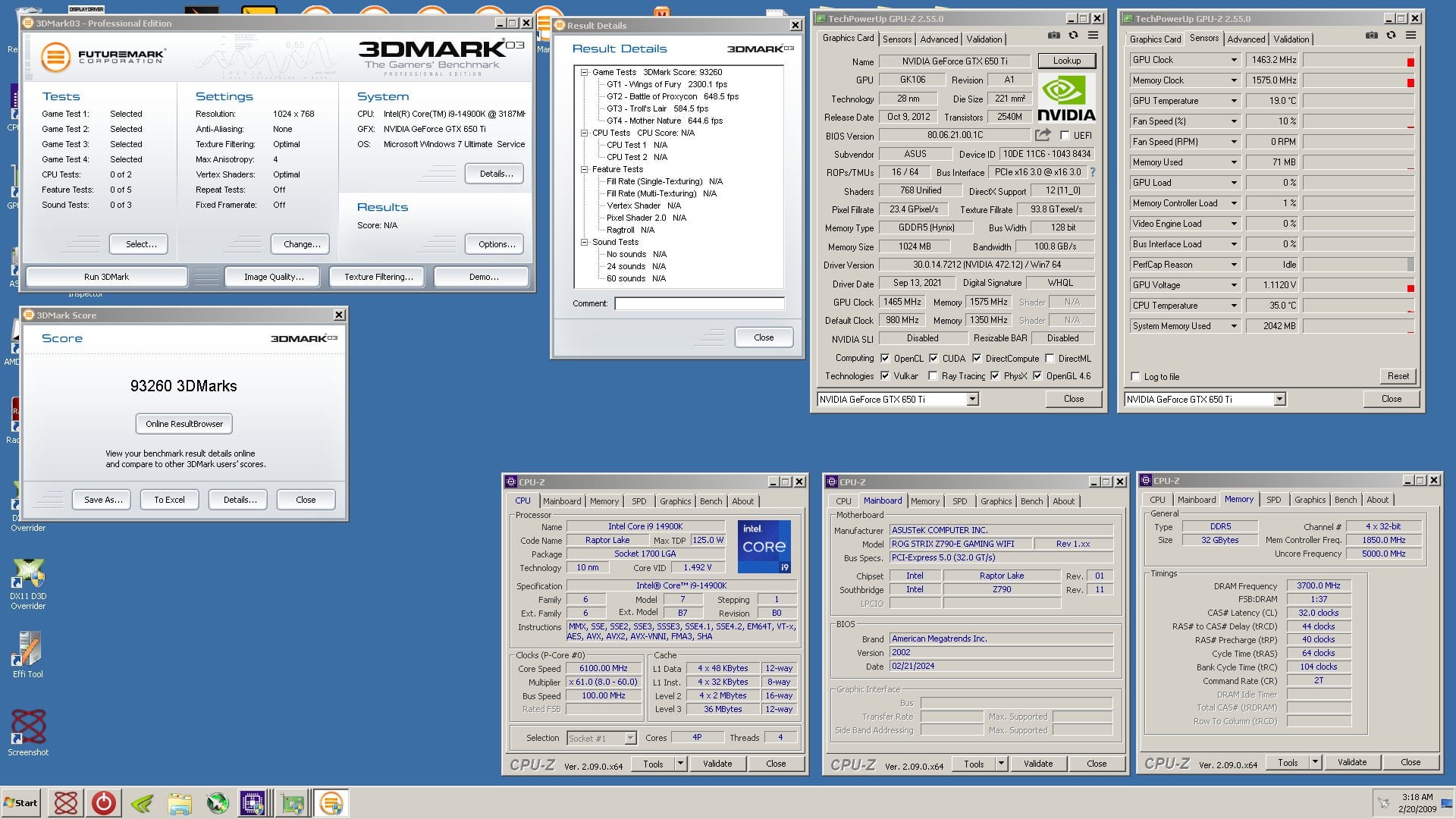
The card ran well, and got it bench-stable at 1463.2 MHz (at 1.45 V load) on the core max, and 1575 MHz (at 1.78 V idle measured) on the memory max. Not all benches could do this. Max power draw to just the core reported by the ASP1212 telemetry was 153.1 W, not bad for a 110 W stock TDP. VRM temperature peaked at 55 C at the 150 W power draw. I'm not sure what the core temperature got to since I only cared if it was stable, but at idle it was 18 C in my room with the AC on after the sun had set, so quite cool.
As for scores, here's where the asterisk comes in. A lot of older 3D benchmarks can be somewhat cheesed by modern CPUs. A 14900K used to bench some stock cards can crush scores from faster GPUs with older CPUs. At the same time however, some of the benchmarks I ran are less prone to CPU intervention, and thus the combination of scores I got, plus the high bench-stable clocks make the title not totally inaccurate. Anyway, here are the scores.
3DMark03 – 3DMark05 – 3DMark06 – 3DMark Vantage Performance – 3DMark11 Performance – 3DMark Fire Strike – Unigen Heaven Xtreme