
I’ve been doing a spot of overclocking on my 3080ti FE (+214/+1000!), and I’ve realised something that has me a bit disappointed with GPUs and energy waste generally.
One game I frequently play is WoW, which is obviously an incredibly easy game to run. Standing in Ironforge, my card can leisurely hit ~370fps, but I have it capped to 240 as that’s the refresh rate of my monitor. What I’m saying applies for any game with a capped framerate, though.
With an unrestricted voltage/frequency, the card will attempt to run as high of a voltage/frequency as it can before hitting the power limit. This means that with a capped game and a core load of only ~30%, the card will whack up the voltage as high as it can muster. This means it hits (or gets close to) the power limit of 400W drawing only 240fps, and since the cores aren’t being utilised well a lot of that power is wasted.
If I cap the voltage/frequency right down at 750mv, then I still get 240fps, Core Load goes up to 90%, and power consumption is down at 217W. This is a massive efficiency gain for zero downside, and is obviously the way to go.
Running an uncapped load with full core utilisation, the GPU seems to generally start being power limited at 868mv/1920MHz. Clearly this seems to be a sensible place to cap the voltage/frequency, as any additional voltage will power limit on a heavy load and waste power on a lighter load. However, this is still nowhere near the most efficient place for WoW, as it still results in only ~66% core utilisation and a power draw of ~317W, over 100W higher than limiting it at 750mv.
If the framerate is low enough (say locked 60,) then the card seems to go into a full on energy saving mode, and massively lowers the clocks down below 1000mhz. It also lowers the power draw right down to 109W. It seems to go into this low power mode at around 105fps, and when it does it substantially reduces the power draw. This whole time it stays at around 30% core load, so clearly there’s *some* sort of system where it keeps the core load at least 30 by dropping the voltage/frequency.
Obviously this is the core concept behind efficiency undervolting, restricting voltages when not Core Load limited so as to not burn unnecessary power and to better utilise the core. However, messing around with this honestly has me dissapointed with how Nvidia GPUs set their core voltages and frequencies.
Is there a reason why voltage/frequency is entirely dependent on power limit, and not also dependent on core load? Having the voltage/frequency modulate to keep high core utilisation (especially for capped/cpu locked games) seems like it would give a *massive* efficiency bonus with quite literally zero performance impact.
Failing that, is there a way to set per-game overclock profiles? I’m not bothered about pulling 400w if the power is being used to make the game run smoother, but for games like wow that I’d be frame capping anyway those extra 50w limiting to 750mw instead of 868mw are quite literally just a waste of energy and money.
Thanks!
—–
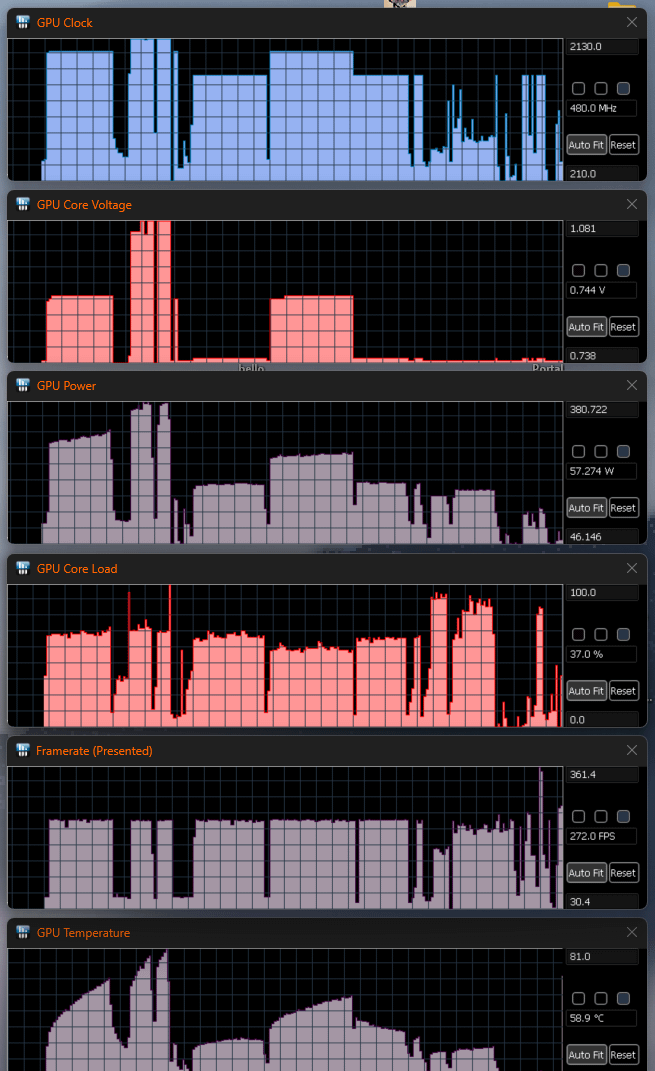
EDIT: This isn’t super clear, but [here’s a graph of what I mean.](https://cdn.discordapp.com/attachments/340633160893333505/1190929925973217340/image.png)
Looking at the chunks from left to right;
– First is a modest cap of 900mv, pulling ~300w
– Second is totally uncapped, where it pulls 1.081v and 380w.
– Third is heavily capped at 750mv, pulling around 170w.
– Fourth is the same as the first, not sure why it pulls slightly less power.
– Fifth is same as the third.
– After this I started moving the power limit slider around to see how it would affect framerate and core load, and was able to get a nice 170w limit while introducing only a slight instability of 220-240fps.
You can see from this data that I could probably get away with around 1000mhz for a stable 240fps, but obviously to do that it would require a custom overclock exclusively for that game. Honestly I was shocked just how much variance there was in power draw for the exact same framerate, and it’s really disappointing to know 100w is just being burned due to not having per game overclock profiles or a voltage/frequency that reacts to keep core load high.