
2026 COMMONWEALTH GAMES
“Should auld acquaintance be forgot
And never brought to mind
Should auld acquaintance be forgot
And auld lang syne”
A proper send-off, for what has been a great week of competition. While the Games themselves have been trimmed and scaled down, swimming has still stood paramount, and we certainly have been rewarded. History has been made in and out of the pool over the past five days. Numerous records have been rewritten, tears have been shed, and some touching moments have been experienced. New Zealand’s delegation performing a Haka after Lewis Clareburt‘s win, Jersey’s Filip Nowacki winning Jersey’s first-ever medal in swimming, and Archie Goodburn making the final of the 50 breaststroke in the face of such unimaginable life events are just a few. However, the bells have not yet struck midnight, and there is still plenty of swimming left to be witnessed, and the final session sure kicks off with some fireworks.
The men’s 100 backstroke sees Pieter Coetze as the top seed. The South African and reigning World Champion is entered with a seed of 52.20, nearly a full second clear of the field, but that is not his fastest result of the meet, as after the semifinals, Coetze leading off his nation’s mixed medley relay produced a result of 51.98, which not only lowered his season best time, but also was recorded as a new Games Record. Rewriting Games Records is not new for him, having done so once in the 200 back, thrice in the 50 back, and now twice in the 100 back. While the gold is all but wrapped up, the battle behind is shaping up to be fierce. Half a second separates 2nd through 5th, with England’s Oliver Morgan leading the pack ahead of Coetze’s teammate Ruard van Renen.
The women’s 200 breaststroke is also looking to be a tight race, with less than two seconds the distance between 1st and 6th. Expecting to hear thunderous support when she walks out, top-seeded Angharad Evans looks to be the heavy favorite. She was 2:26.48 this morning, but with a season best of 2:19.70, the Scotswoman should be able to distance herself from the 2nd seed Tara Kinder and the dangerous South African pair of Aimee Canny and Kaylene Corbett.
Duncan Scott failed to advance to the final of the 200 free, finishing 10th this morning; his result really shows the depth of the event across the Commonwealth nations. England advanced two swimmers, with James Guy‘s 1:45.69 slotting in as the top seed and with Tom Dean‘s 1:47.46 earning the last spot in the final. Guy may be England’s best chance at a gold medal in the meet, as so far outside of the para-events (where the English have been performing phenomenally, having earned four golds already), they have been held winless. It won’t be easy for Guy, as the Australians have a formidable trio of swimmers comprised of Sam Short, Harrison Turner and Kai Taylor. Matt Richards, long a relay-teammate of Guy and Dean, and Jack McMillan, the newest edition to Britain’s dominance in the 4×200 free relay, lurk as the 4th and 5th seeds.
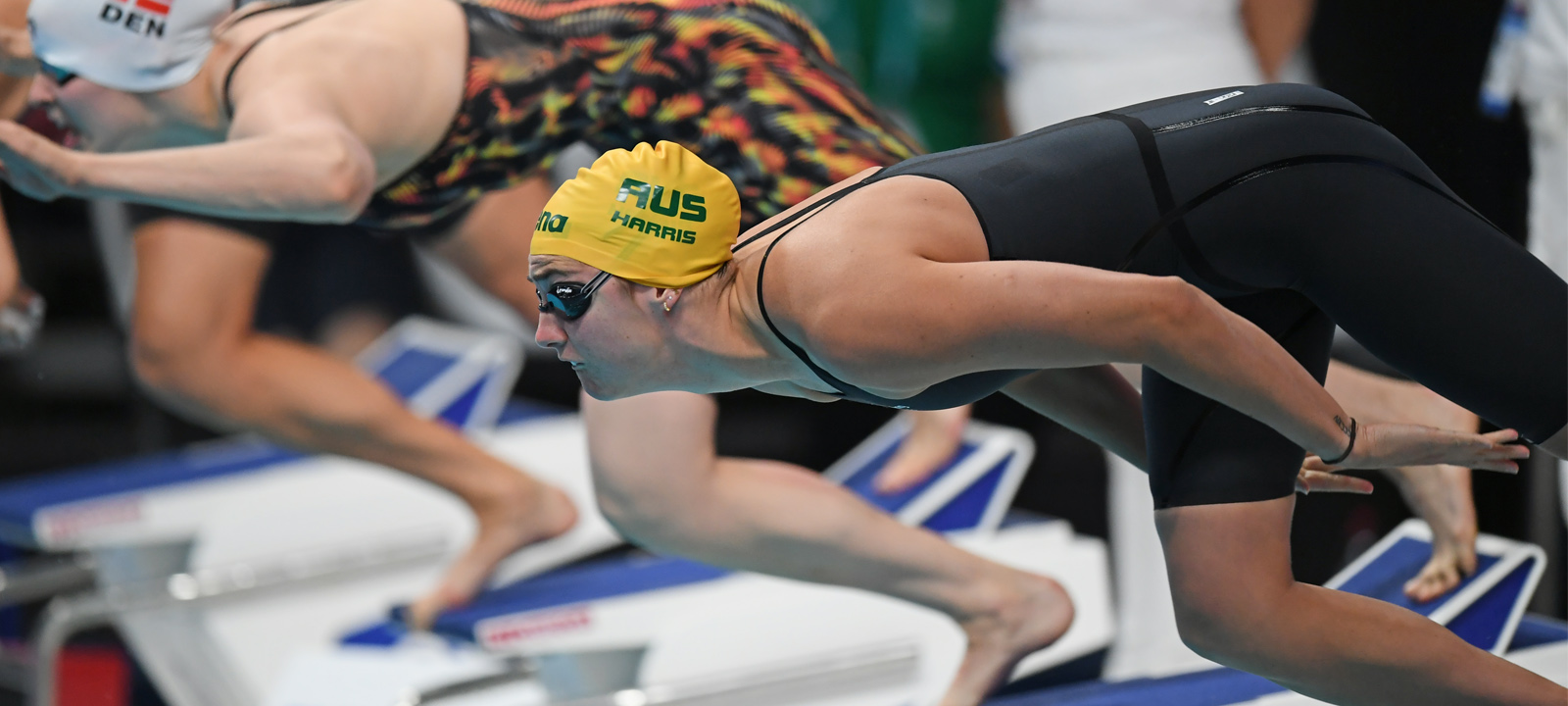
The fastest two events of the evening are unsurprisingly awash with Australians as they lead the field in the women’s 50 free and men’s 50 fly. Meg Harris sits comfortably atop the 50 free, with a .24 second lead on her compatriot Shanya Jack. Harris, the defending World Champion in this event, is looking for her 5th gold medal in this event, adding to her 100 free title and three relay victories. Jack, the bronze medalist in the 100 free, is seeking to end her career on the podium, having stated that this competition would be her last. It’s not a fait accompli for an Australian sweep as the 3rd Australian Alex Perkins is just .05 ahead of South Africa’s Caitlin de Lange, with the pair entering with seeds of 24.77 and 24.82 respectively.
Like in the previous event, the men’s 50 fly will likely see two Australians atop the podium, but it is much more uncertain as to whom will climb to the top spot, as both Kyle Chalmers and Ben Armbruster produced identical times in the semifinals, tying at 22.82. The pair were both .01 off the Games Record last night and sit comfortably ahead of their teammate Cam McEvoy (23.41) and Canada’s Josh Liendo (23.46). The pair will be battling for the bronze, but won’t be alone in that quest as just .11 separates McEvoy, seeded 3rd, from Abduljabar Adama, the 8th seed. Adama had to swim the event twice last night, tying for 8th at 23.55. In the swim-off, he produced a new Nigerian record of 23.32 to earn the last spot in the final.
A tight battle is expected in the final of the women’s 100 free S9. As is often the case, the Australians have dominated the freestyle events, and this event is no exception as Lakeisha Patterson, Emily Beecroft and Belando Nicholson earned the top three seeds for this evening’s final. The trio will have to contend with more than just the other five competitors, however, as the Glaswegian crowd will be sure to be behind 4th seed Toni Shaw, as the Scot was just .08 off the presumptive bronze medal spot this morning.
Christian Sadie appears to have the men’s 50 Free S7 wrapped up, having set the Commonwealth Games record this morning, hitting the wall in 28.45. .99 ahead of Singapore’s Toh Wei Soong, Sadie will be on the hunt to lower his record once again, but with only seven swimmers in the field, his competitors may have held something in reserve this morning.
The women’s 200 fly may be the most hotly anticipated event by the host nation as the Scots have set themselves up for a pitched battle against the Australians. The Aussies arrived in Glasgow as the favorites in nearly every event. Still, Ciara Schlosshan will hope that either she or her compatriot Keanna MacInnes can deny the trio of Lizzy Dekkers, Brittany Castelluzzo and Jessica Cole a spot on the podium. Schlosshan posted the fastest time this morning, going 2:08.47, but holds a very small lead as Dekkers and MacInnes joined her under 2:09, with 2:08.64 and 2:08.99 prelim results.
The last individual event of the meet is also the longest event on the men’s side, as the 1500 takes center stage. Samuel Short of Australia has multiple chances to make history, as not only is he looking to attempt the distance triple (400/800/1500), but with a win in the 200 freestyle, where he is the 2nd seed, he could also be the first swimmer to win four individual golds at the same since Mitch Larkin did so in 2018. He is seeded just .62 ahead of Northern Ireland’s Daniel Wiffen, but the 2024 Olympic bronze medalist has been far from his best form and finished outside of the medals in the 800. Looking to, like in the 800, sweep the podium, Matt Galea and Benjamin Goedemans represent Australia’s other two entrants, with the pair being the only other swimmers with seeds under 15:00.
Australia leads both the women’s and men’s fields in the medley relays. This morning the Australian women posted a result of 4:01.14 but expect them to be much quicker as they exchange three legs, bringing in the likes of Iona Anderson, Alex Perkins and Meg Harris, the respective winners of their individual 100s. Scotland had a strong swim this morning to take the 2nd seed, have fully swapped out their roster, and hope that the strong pair of Angharad Evans and Keanna MacInnes can keep the hosts ahead of the English and the South Africans.
In the men’s race, the Australians are making a full wholesale swap and call upon 100 breaststroke champion Sam Williamson and 100 free champion Flynn Southam to ensure a victory against the English, who were 2nd this morning, and against the South Africans. The 3rd seeds are using Chad le Clos on the fly leg, where if he medals, he will become the most decorated athlete in any sport, male or female, at the Commonwealth Games. It won’t be easy, as they sit less than a second ahead of the Canadians, who bring in 100 fly champion and Games Record holder Josh Liendo.
Men’s 100 Back – Final
Top 8
Pieter Coetze (South Africa) – 51.77 ***NEW COMMONWEALTH, GAMES, AFRICAN RECORDS***
Oliver Morgan (England) – 52.66
Ruard van Renen (South Africa) – 53.31
Jack Skerry (England) – 53.43
Henry Allan (Australia) – 53.51
Matthew Ward (Scotland) – 53.62
Cameron Brooker (England) – 53.73
Jamie Ferguson (Scotland) – 55.88
Out like a bat, Pieter Coetze nearly erased the four-year-old world record of 51.60 set by Thomas Ceccon, finishing just .17 off the mark. The South African, who got the better of the Italian last summer in Singapore, opened in 24.68 and had a near bodylength over the field at 50 turn. Coetze, who had already reset the Games record twice this week, charged home to take the win with a last split of 27.09.
His new mark of 51.77 not only stands as a new Games record, but it erases his own national, African and Commonwealth record, with the swim clocking in as the 2nd fastest performance of all time. The result breaks his tie with Ryan Murphy as the 4th fastest performer and leapfrogs Russia’s Kliment Kolesnikov, who now slides down to 3rd. Also of note, the swim is his 4th performance under the 52.00 mark, a feat which ties him with both Ceccon and Murphy with four.
Oliver Morgan of England, the 2nd seed entering the final, was 25.23, well back of Coetze’s 24.68 but clear of both Ruard van Renen and Jack Skeery, who turned in an equal 25.58. Morgan, closing in 27.43 hit the wall in 52.66 to earn his 3rd individual silver medal of the week, having finished runner-up to Coetze in all of the backstroke events.
The battle for the bronze was won by van Renen, as the South African kicked things into gear on the last 50, using a 27.73 to break the tie with Skerry, who closed in 27.85, to finish .12 off the podium. For van Renen, who trains with the University of Georgia, the time stands as a new personal best, taking .10 off his former best, which he set last night.
Women’s 200 Breast – Final
Top 8
Angharad Evans (Scotland) – 2:23.79
Kaylene Corbett (South Africa) – 2:24.46
Ellie McCartney (Northern Ireland) – 2:24.73
Ella Ramsay (Australia) – 2:24.89
Aimee Canny (South Africa) – 2:25.05
Tara Kinder (Australia) – 2:26.95
Sophie Angus (Canada) – 2:28.95
Rebecca Meder (South Africa) – 2:30.25
It was a little off her season best and British record of 2:19.70, which she set this past April, but the Scot got the crowd ignited as she took the win in the women’s 200 breaststroke, adding another gold to her 100 breaststroke win. Evans trailed at the 50, as she hit the wall in 32.49, but only by the smallest of margins as the Australian pair of Ella Ramsay and Tara Kinder made it to the first wall in an equal 32.48.
From there, however, Evans established why she is one of the world’s best with her 2nd split of 35.64, the lone sub-36 split in the field, giving the Scotswoman firm control of the race as she hit the halfway wall in 1:08.13. Closing in 36.57 and 39.09, Evans hit the wall in 2:23.79.
It was a tight battle for the silver and bronze as when the dust settled, little more than half a second separated 2nd through 5th. South Africa’s Kaylene Corbett, 3rd at the 100 (1:09.04), made the most of her experience, having won the bronze medal in Singapore, as well as making several Olympic finals, to move up one spot. Splitting 36.68 on the 3rd 50, Corbett tried to run down Evans, but came up short, taking the silver in 2:24.46.
Fifth at the 100, turning in 1:09.56 and 6th at the 150, Northern Ireland’s Ellie McCartney smashed the last 50, producing the fastest last 50 of 37.84 (lone sub-38) to move up three spots to earn the bronze with a time of 2:24.73.
Men’s 200 Free – Final
World Record: 1:42.00 – Paul Biedermann, Germany (2009)
Commonwealth Record: 1:44.06 – Ian Thorpe, Australia (2001)
Games Record: 1:44.71 – Ian Thorpe, Australia (2002)
2022 Commonwealth Champion– Duncan Scott (SCO), 1:45.02
Top 8
Kai Taylor (Australia) – 1:45.22
James Guy (England) / Matt Richards (Wales) – 1:45.72
Harrison Turner (Australia) – 1:45.93
Sam Short (Australia) – 1:45.94
Jack McMillan (Northern Ireland) – 1:46.29
Lewis Clareburt (New Zealand) – 1:46.40
Thomas Dean (England) – 1:46.86
The top end of the pool seemed to dominate the event as lane 2’s Jack McMillian and lane 1’s Kai Taylor got things going with a very quick opening 100. Out it 23.93, Taylor led McMillian by over half a second, and only continued to build upon that lead as his 26.09, 2nd 50 was also the fastest split of the field.
Taylor made the halfway turn in 50.02, and was under .10 under the supersuited World Record of Paul Biederman. With a lead of over a second on McMillian and a full second and a half on the rest of the field, Taylor looked to be more in a battle with the inevitable piano than with the rest of the field. The musical instrument started to make an appearance on the 3rd length as his 27.19 split gave ground to the chasing McMillian (26.76). Taylor’s 28.01 last 50 was the 2nd slowest closing split, but his early lead was enough to hold off the piano enough as Taylor took the win from lane 1, with a time of 1:45.22.
McMillian, 2nd at the 150 wall, felt the piano more, though, as his 28.46 dragged him from the presumptive silver down to 6th place, as James Guy, Matt Richard, Harrison Turner and Sam Short all passed him in the last 50 meters. Guy, 4th at the 150, produced a 26.82 to move up two spots to earn the silver medal in a time of 1:45.72, tying with Matt Richards‘s 26.70, which brought him into a dead tie and co-2nd place with his British relay teammate.
Taylor’s time slices .08 off his month-old former personal best and jumps him up into a tie with Lukas Martens as the 8th fastest performer this season.
Women’s 50 Free – Final
Top 8
Meg Harris (Australia) – 24.23
Alex Perkins (Australia) – 24.53
Shayna Jack (Australia) – 24.57
Theodora Taylor (Wales) – 24.80
Caitlin de Lange (South Africa) – 24.98
Jessica Thompson (South Africa) – 25.06
Chelsey Edwards (New Zealand)/Darcy Revitt (England) – 25.17
The Australians added yet another sweep of the podium as the trio of Meg Harris, Alex Perkins and Shayna Jack posted the fastest three times of the morning. Jack looked to have the better start of the trio and kept her head down through the halfway mark, but Harris and Perkins wound themselves up for a strong finish and passed Jack in the last 15 meters to just get ahead of her.
Harris’s time of 24.23 is a little off her season best of 24.08 from last month’s trials, but this is Harris’s 5th gold medal of the meet, so fatigue may be a factor. Perkins, who has also had a busy week, collecting four gold medals, adds a silver to her luggage, with her 25.53 standing as a new personal best and the 18th fastest time in the world this season. For Jack, her time of 23.57, is .20 off her season best, but the Australian’s bronze medal caps off an incredible career that saw her win two Olympic gold medals and five World Championships golds.
Men’s 50 Fly – Final
Top 8
Kyle Chalmers (Australia)/Ben Armbruster (Australia) – 22.73 ***NEW GAMES AND OCEANIAN RECORD***
Cameron McEvoy (Australia) – 22.92
Joshua Liendo (Canada) – 23.30
Abduljabar Adama (Nigeria) – 23.42
Jacob Peters (England) – 23.46
Calvyn Justus (South Africa) – 23.53
Dean Fearn (Scotland) – 23.56
After a tie in the semifinals, we wondered how Ben Armbruster and Kyle Chalmers would be separated in the final, as their 22.82 results each warranted the pair the right to lane 4 tonight. Chalmers, the elder and more experienced of the two, was awarded the middle lane, but it was all for naught as the pair remained inseparable, with each tying once again for the gold medal in a time of 22.73.
Australia’s Cam McEvoy looked to have the best start (.57 reaction time), but quickly gave way to Armbruster, who looked to be edging in front of his compatriots at the halfway mark. The long arms of Chalmers started to pull the eight-time Commonwealth champion level with Armbruster. At the wall it appeared to be Chalmers in first, but a strong last stroke and finish by Armbruster had him hit the wall exactly at the same time as Chalmers. The pair’s time 22.73 took a .08 chunk out of the Games record set by Ben Proud four years ago. Their winning time also equals the Oceanian record set by fellow Aussie, Matt Targett back in 2009. The trio now rank tied for 15th on the all-time performers list.
McEvoy, who led in the opening few meters, took the bronze medal in 22.92, equalling his personal best from last month and making yet another sweep of the podium for the medal table leaders, Australia.
Women’s 100 Free S9 – Final
Top 8:
Lakeisha Patterson S9 (Australia) – 1:02.99
Emily Beecroft S9 (Australia) – 1:03.56
Toni Shaw S9 (Scotland) – 1:04.71
Victoria Belando Nicholson S9 (Australia) – 1:04.73
Brooklyn Hale S9 (England) – 1:06.52
Evie Lambert S9 (England) – 1:07.07
Meghan Willis S9 (Wales) – 1:07.94
Husnah Kukundakwe S8 (Uganda) – 1:13.36
Men’s 50 Free S7 – Final
World Record (S6): 28.57 – Qing Xu (CHN), 2012
Games Record (S6): 30.75 – Matthew Haanappel (AUS), 2018
World Record (S7): 26.38 – Andrii Trusov (UKR), 2024
Games Record (S7): 28.45 – Christian Sadie (RSA), 2026
Top 8:
Christian Sadie S7 (South Africa) – 28.06
Toh Wei Soong S7 (Singapore) – 29.36
Bruce Dee S6 (England) – 31.33
Suyash Narayan Jadhav S7 (India) – 31.63
Chaitanya Vishwas Kulkarni S6 (India) – 33.17
M.N.S. Zulkafli S5 (Malaysia) – 34.62
Sebastian Massabie S5 (Canada) – 35.26
Women’s 200 Fly – Final
Top 8
Men’s 1500 Free – Fastest Heat
World Record: 14:30.67 – Bobby Finke, USA (2024)
Commonwealth Record: 14:34.07 – Dan Wiffen, Northern Ireland (2024)
Games Record: 14:41.66 – Kieran Perkins, Australia (1994)
2022 Commonwealth Champion– Sam Short (AUS), 14:48. Women’s 4×100 Medley Relay – Final
World Record: 3:49.34 – USA (Smith, Douglass, Walsh, Huske), 2025
Commonwealth Record: 3:51.60 – Australia (McKeown, Hodges, McKeon, Campbell), 2021
Games Record: 3:54.36 – Australia (Seebohm, Bohl, McKeon, B. Campbell), 2018
2022 Champion: Australia (McKeown, Hodge, McKeon, O’Callaghan) – 3:54.44
Top 8
Men’s 4×100 Medley Relay – Final
World Record: 3:26.76 – USA (Murphy, Andrew, Dressel, Apple), 2021
Commonwealth Record: 3:28.64 – Australia (Delaney, Rickard, Lauterstein, Targett), 2009
Games Record: 3:31.04 – Australia (Larkin, Packard, Irvine, Chalmers), 2018
2022 Champion: England (Williams, Wilby, Guy, Dean) – 3:31.80
Top 8: