
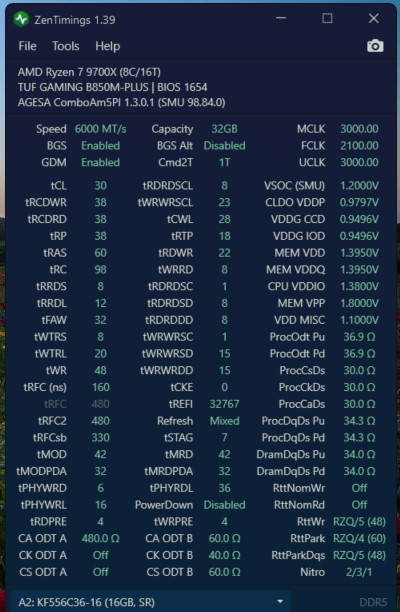
Update to the yesterday's post:
My 5600Mhz CL36 Hynix M-die kit ran flawlessy on Intel platform for 3 years. I was able to run them at 6400Mhz CL30 with zero issues. After switching to AM5, there has been nothing but issues.
Long story short, everytime I find a stable overclock, it becomes unstable over time. It might take 1 day or 2 weeks until I start encountering weird crashes. Those settings in ZenTimings screenshot were stable for 4 hours of Karhu and 3 hours of VT3. I booted the PC several times between runs and also forced it through memory trainings. It looked good.
Just one hours ago I decided to do the final forced memory training to ensure stability. It absolutely ruined stability. Without changing anything, Karhu now gave error after 7 seconds and the whole PC was extremely unstable! Nothing changed when I rebooted the PC but after I forced it through another memory training, stability returned. ZenTimings values are always identical between memory trainings.
Why on earth does memory training occasionally ruin stability?
What I have now tried:
- Different Vsoc values
- Default secondary and tertiary timings
- FCLK 2000Mhz
- Reseating RAM and CPU
- Updated bios (identical issues with two very different AGESA versions)
- Adjusting ProcODT, VDDP and VDDG
- Trying Normal mode instead of Mixed
- Disabled all PBO and CO settings
- Disabled memory context restore
My thoughts:
- I doubt it is a faulty RAM DIMM since they can work flawlessy for hours of heavy testing before memory training ruins stability
- I also doubt it is a bad IMC since adjusting Vsoc does nothing and stress tests usually run for hours
- Memory training changes some value that isn't visible in ZenTimings but it completely ruins stability. I have now proved this.
Any ideas? RAM is very expensive and I don't want to try another kit. Not sure if something is wrong with my Asus bios. I was also thinking of switching to a 3D CPU that doesn't care about slow EXPO profile. But what if I get similar issues on another CPU?