
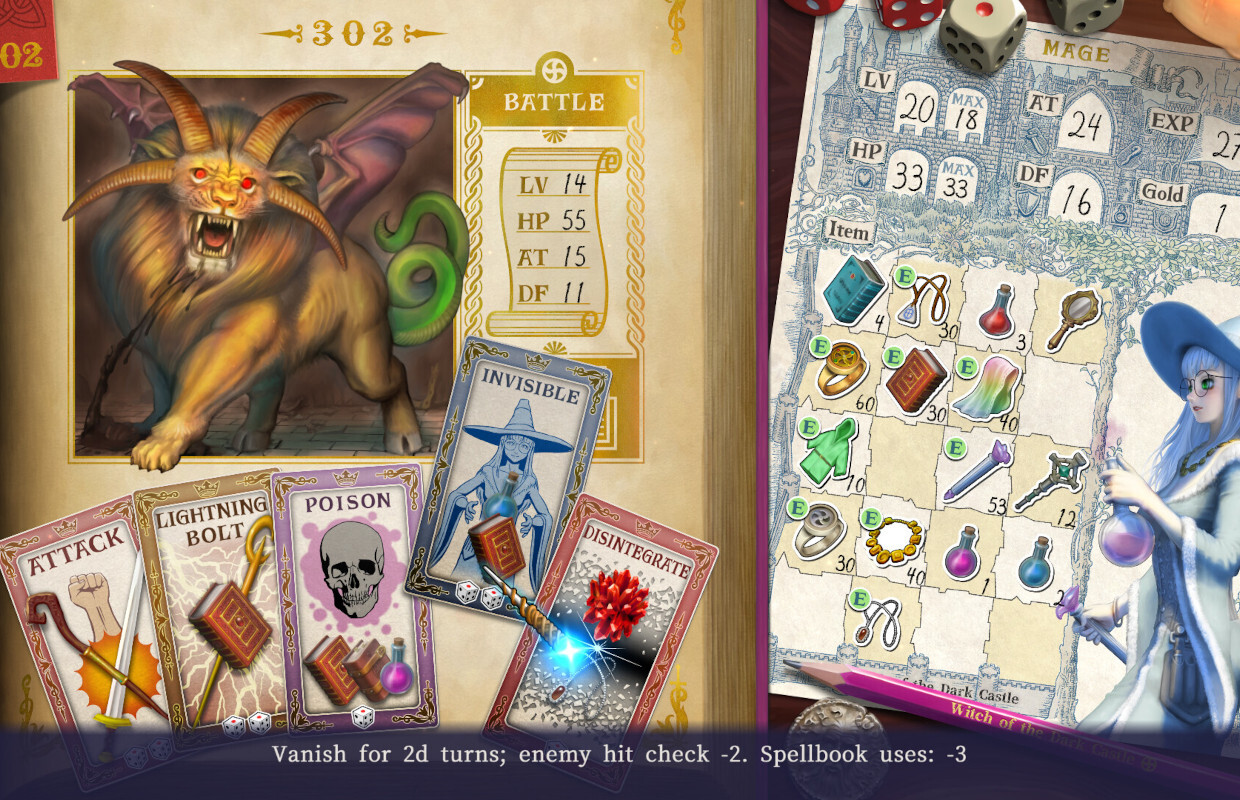
There’s an undeniable charm to Veritas Tales: Witch of the Dark Castle, and it’s not hard to pinpoint what exudes it. Borrowing from the history of classic RPGs, Capcom and Vanillaware veteran Yoshio Nishimura crafts a story that borrows just as much from the RPG storybooks of old as games like Wizardry, Radical Dreamers, and more.
Advertisement. Keep scrolling for more
In a similar vein to Voice of Cards, everything about the game is a constant reminder of the physical inspirations it clads itself in. The entire story takes place in a book, with your inventory and stats ever present with a character sheet displayed on the desk next to the magical tome the story is told from. Dice, coins, pencil and eraser all serve as the constant reminder of the boundary between the story you’ve inserted yourself into.
Speaking of the art, I find myself unable to say anything of real merit other than acknowledging that, yes, you can very clearly tell that Nishimura had spent over a decade working at Vanillaware. The game’s art is gorgeous, even if it doesn’t quite reach the same level of polish. As for the soundtrack, I come away with a similar evaluation.
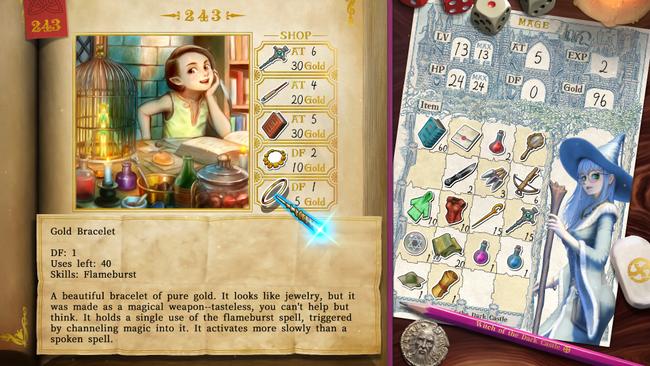
On the opposite end of the spectrum, the gameplay itself is very simple; at the start of the game you choose to play as either a Warrior or a Mage. While both adhere to the same fundamentals of gameplay – rolling dice to determine whether you or an enemy’s attack connects, with the difference between the winner’s attack stat and the loser’s defense determining the damage dealt – the choice informs the other options at your disposal, both within and without combat.
While as a Warrior you might focus more on your basic attack, as a Mage you’re far more likely to utilize spells that bypass the initiative rolls entirely as far as you can help it. The same goes for exploration; at core points of the story, you’ll be let loose to explore the castle town, or the titular castle itself. Depending on your actions not only will you receive coin, equipment and experience – but more importantly you’ll receive information that could aid you later.
Veritas Tales is an RPG that expects you to replay it. Not just in the sense that it fully expects you to savescum, either – dying will usually offer the option to rewind time to right before your fatal encounter, and you can save the game at any time to easily reload upon an undesirable result – but also in how the game pretty explicitly draws inspiration from the original Resident Evil 2.
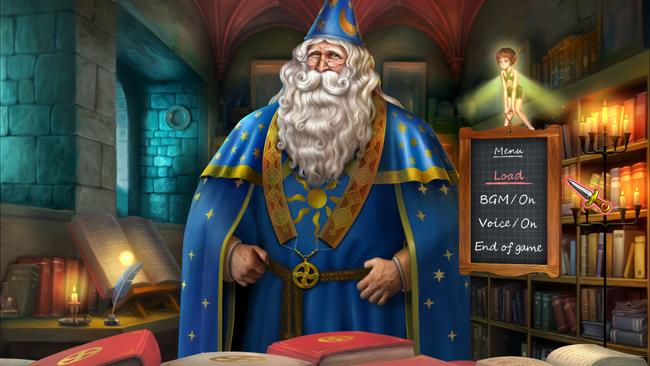
Upon finishing a playthrough as one of the two characters available, you’re instantly transported back into the swing of things with the other you hadn’t chosen. Much like how your actions in your first playthrough of Resident Evil 2 would have an impact on your playthrough in the second, the same remains true here – certain gear or items you picked up as your first character will be missing the second time through. To that end, inventory management and keeping track of the “uses” left for your gear is a major part of the gameplay loop.
Advertisement. Keep scrolling for more
The fact that Veritas Tales has “zapping” isn’t something the game exactly hides, either; you’re told explicitly you won’t be able to choose to swap to the other character until after you’ve finished your first playthrough, and choices which could impact them are clearly telegraphed. On the second playthrough, you’re even given a new UI element on your character sheet to showcase feats you’ve accomplished which can have a major impact on the progression of the story.
If I had one complaint about how this works out, is that while you can generally intuit “what” could be tied to these feats, the game doesn’t always cleanly spell it out for you. Truthfully, I don’t know if I actually reached the “True Ending” for my playthrough, and while an average run for both halves also bares resemblance to a classic Resident Evil, without any sort of proper indication that there’s more left for me to explore I’m left unsure about whether more playthroughs are in the cards for me.
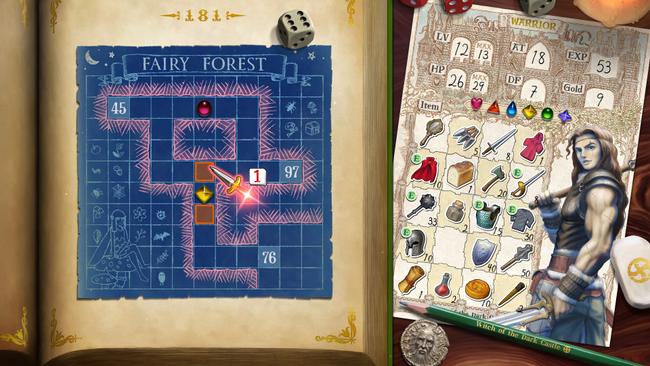
The story itself, while basic, is pretty good. The setpieces when the disconnect between the world of the book and the world of the study where you’re reading it become blurred are fascinating; and if anything, I wish the game had hidden a few more of those moments in the second playthrough. As things stand, it acts as a memory check for what you’d learned in the first half, and the overall scope of the playthrough is shaved down. In some ways I appreciate this – there’s no need for things to overstay their welcome, but I can’t help but appreciate moments like the stopwatch when they appeared.
I’d be kidding myself if I called that anything but a nitpick, though; Veritas Tales: Witch of the Dark Castle truly feels like a singular RPG, even as it wears its myriad inspirations on its sleeves. Digitalis Publishing’s debut project is an instant classic.
9
Versions tested: PC
Disclaimer: A copy of this game was provided to RPG Site by the publisher.