
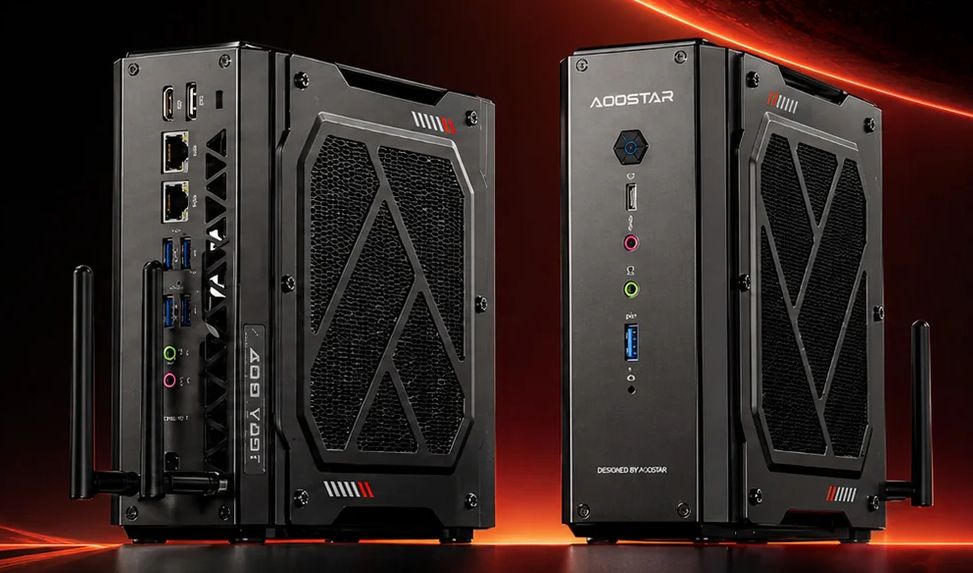
The AOOSTAR GODY is a small desktop computer with the specs of a decent gaming laptop (from a few years ago). Inside its 200 x 193 x 80mm (7.9″ x 7.6″ x 3.1″) chassis, the computer houses a 55-watt AMD Ryzen 9 7940HX, 16-core, 32-thread Dragon Range processor and an AMD RX 7600 XT discrete GPU.
If the design looks familiar, that’s because this new model is an updated version of the AOOSTAR GODX we wrote about a few years ago, and the GODZ model that launched later with an updated processor. The new version should bring a big boost in graphics performance, while an $849 price tag also helps position the AOOSTAR GODY as a competitor for Valve’s Steam Machine, which starts at $1049. It’s not exactly an apples to apples comparison though.
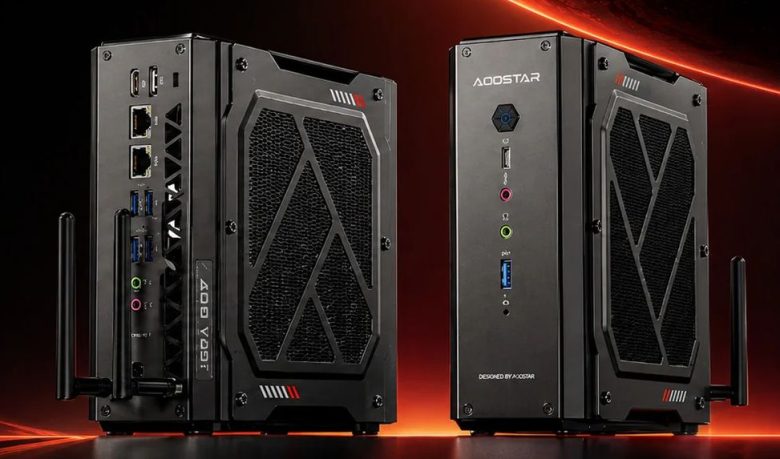
On the one hand, the GODY has a lower starting price and should deliver better graphics performance: both computers have GPUs that are based on the same basic graphics architecture, but the Steam Machine has a custom GPU with 28 GPU compute units, while the Radeon RX 7600 XT has 32 computer units, and support for higher frequencies.
According to benchmarks published by Gamers Nexus, a system with the RX 7600 XT GPU performs around 15 to 36 percent faster, at least in some situations.
But on the other hand, while the AOOSTAR GODY is small by desktop PC standards, it’s still larger than a Steam Machine. And its $849 starting price is for a barebones model that doesn’t include memory or storage. You do get a Windows license, so you don’t have to pay extra for that if and when you decide to install Microsoft’s operating system after equipping the system with an SSD. But if you don’t already have memory and storage lying around, you’re going to end up spending at least as much on the GODY as you would on a Steam Machine, which comes with 16GB of DDR5 memory and at least a 512GB SSD.
That said, I can’t really blame AOOSTAR for positioning the GODY as a Steam Machine alternative.
Valve’s Steam Deck has been one of the most popular handheld gaming PCs for years thanks to its unique combination of design, performance, software, and price. But the company’s first desktop is off to a bumpier start. Launching during a global RAM and storage crisis, the Steam Machine costs about 30 percent more than Valve had originally planned.
And while the Steam Deck came to dominate a relative niche field of handhelds that play PC games, the Steam Machine is competing in the much more robust desktop space, where many users have pointed out that you could build your own gaming PC with higher-performance hardware at lower prices.
The benefits to picking Valve’s mini PC is that it’s small, quiet, and designed to ship with the Linux-based Steam OS that’s been a key part of the Steam Deck’s success, offering a console-like gaming experience, while still offering a full-fledged desktop operating system when you need it.
While the GODY is a little larger than the 152 x 156 x 162mm (6″ x 6.1″ x 6.4″) Steam Machine, it does have a few advantages, at least on paper. In addition to the higher performance GPU, it has faster networking (WiFi vs WiFi 6E and two 2.5 GbE LAN ports vs one Gigabit Ethernet port), and two M.2 slots for PCIE 5.0 x4 storage (vs one on the Steam Machine.
AOOSTAR’s gaming PC also has a pretty robust set of ports that includes two USB Type-C ports (one is data-only, one supports video output), multiple USB 3.2 Gen 2 Type-A and USB 3.2 Gen 1 Type-A ports, HDMI and DisplayPort, mic and headphone/speaker outputs, and a DC power input.
via AndroidPC.es