

Become a member of GB MAX to gain exclusive access to the industry and to the most influential global B2B leadership community in the business of gaming, entertainment, and tech. Join now and also get a VIP ticket to GamesBeat Next (Nov 2-3, SF).
Tripo AI, a global artificial intelligence company building AI 3D foundation models and world models, said it raised a new round of $150 million in funding.
The new funding comes just a month after the company said it completed funding rounds that raised $200 million in total. As you can tell from the numbers here, it’s still a frothy time for AI fundings, including some that have to do with gaming.
The aim for the generative AI technology for use in gamers is to lower the barrier to entry for artists in creative work, not replacement, the company’s chief scientist, Yanpei Cao, told me a month ago in an interview. I also did a written interview with him that you can see below for this funding, and he reiterated the pledge to work with artists.
At GDC, CEO Simon Song showed me the company’s 3D generation models and vibe coding tools, with results showing in seconds. As befits a company with a lot of people in China, they weren’t that concerned about whether the AI would replace human game developers.
The latest investors in the Series A3 financing come from the automotive, automotive, gaming, internet, and technology sectors. Automotive backers included Geely Capital among other strategic investors. Gaming companies 4399 Network, Tanwan, and Giant Network also took part, alongside strategic investors Fosun Capital and Orinno Capital.
 World model from Tripo AI. Source: Tripo AI
Financial investors CoStone Capital, Addor Capital, T-Capital, and Muhua Tech Ventures joined as well. Existing shareholders INCE Capital and Genesis Capital further increased their investments, underscoring their continued confidence in Tripo AI’s strategic direction and long-term growth prospects. The breadth of the investor base reflects growing cross-sector recognition of Tripo AI’s leadership in 3D foundation models and world model technologies. These technologies are expected to play an increasingly important role in intelligent manufacturing, interactive entertainment, internet applications, and embodied intelligence.
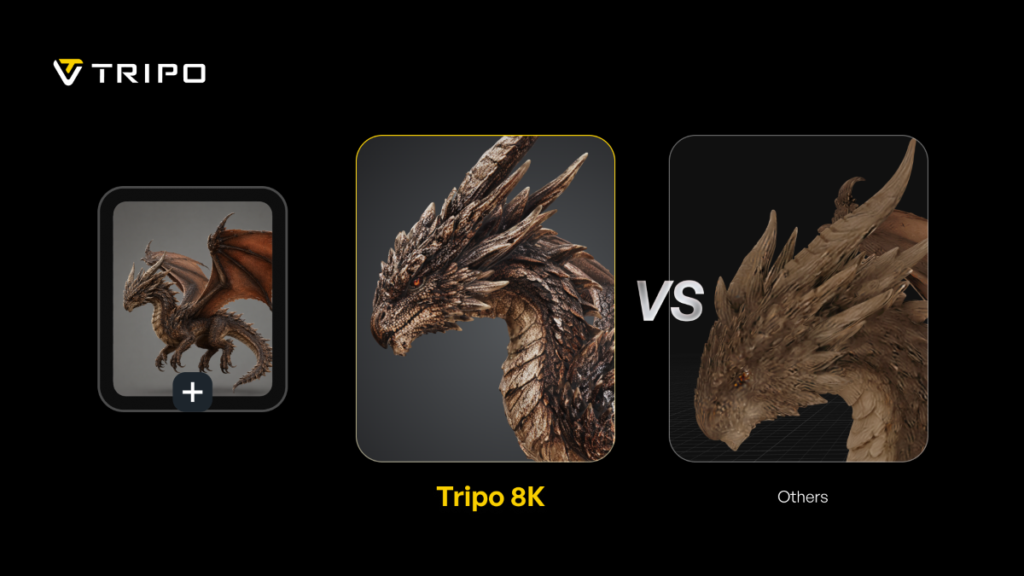
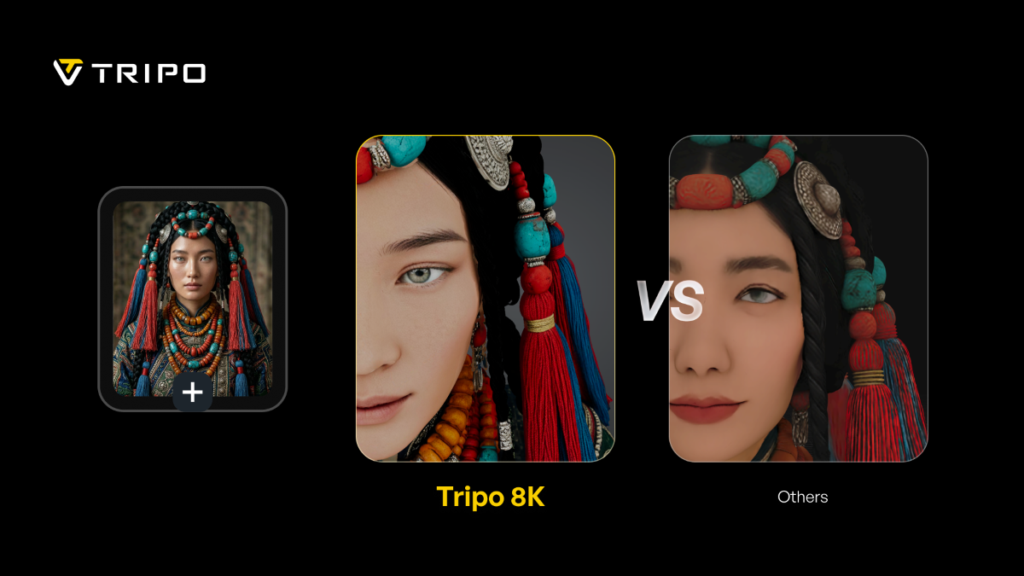
Over the past six months, Tripo AI has released a series of advanced 3D foundation models, including Tripo H3.1 and Tripo P1.0, while introducing major algorithmic breakthroughs such as 8KTexture Generation and Segmentation V2. In independent blind evaluations and community voting, Tripo AI has consistently ranked among the world’s top AI 3D models. The company also introduced Project Eden, its world model research preview, pioneering native architecture that decouples underlying state simulation from visual rendering and establishing a new paradigm for world model development.Following the completion of this round, Tripo AI will further increase investment in 3D foundation models and world models, with a focus on core algorithm development, data infrastructure, and the recruitment of top global talent.
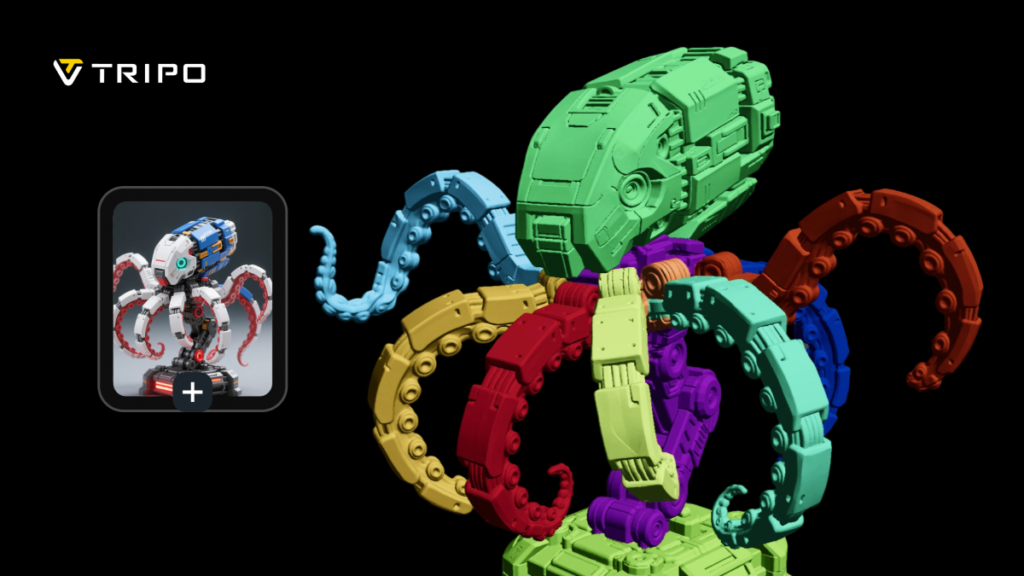 Segmentation view from Tripo AI. Source: Tripo AI
The company will also accelerate its global commercialization and strengthen its industry ecosystem, reinforcing its technology and product leadership while delivering more powerful AI solutions to creators and enterprise customers worldwide.
Tripo AI said is advancing AI toward true spatial understanding, physical simulation, and real-world production.
Written Q&A with chief scientist Yanpei Cao
 Yanpei Cao is chief scientist of Tripo AI.
What was the most convincing demo or tech that you showed investors that helped
them decide to invest in this big round?
To be completely frank, investors in 2026 are well past being dazzled by a rotating video of a
3D object. What ultimately convinced them wasn’t a single “magic demo,” but rather the
hard proof that we have crossed the threshold from experimental AI to industrial-grade
production, alongside a sound roadmap for the future.
We demonstrated this across two parallel tracks:
First, on the 3D Generation side, we proved that AI 3D is no longer a visual toy; it is an active
pipeline multiplier. We showed them the combined power of our native architectures: Tripo
H3.1 for extreme geometric fidelity, P1.0 for structured, engine-ready topology, and our
latest capabilities like Segmentation V2 (native semantic part-understanding) and 8K
Textures.
But more importantly, we showed them exactly how this tech is being used in the wild right
now, backed by strong month-over-month revenue growth. For example:
 World model from Tripo AI. Source: Tripo AI
In Professional Gaming: While I can’t name specific IPs for confidentiality reasons, we
demonstrated how major mobile and AAA RPG studios are already integrating Tripo into
their level-design workflows. Instead of outsourcing background props and waiting weeks,
their technical artists use our pipeline to generate assets with clean edge flows and 8K
textures, dropping them straight into game engine with zero manual retopology.
In the Automotive Sector: We showed how automotive design teams are utilizing
Segmentation V2. They can generate a highly detailed vehicle concept and natively isolate specific components (like headlights or chassis parts) for rapid prototyping and aerodynamic simulation environments, completely bypassing early-stage CAD bottlenecks.
In the UGC and Creator Ecosystem: We highlighted stories from grassroots creators. During a recent ‘Vibe Jam’ event, we saw solo indie developers and hobbyists use Tripo to populate entire playable game levels in a single weekend. They used our AI to instantly generate everything from mechanical props to environment structures, turning what used to require an entire art department into a seamless, solo creative process.
Second, on the World Model side, we showed them the underlying framework of Project
Eden, where the underlying structured physical state is completely separated from the visual rendering.
This specific architectural choice resonated deeply, not just in the boardroom, but among
top-tier researchers globally. When you decouple the state from the rendering, you natively solve object permanence, spatial consistency, and multi-agent concurrency. People looked at it and realized this isn’t just an engine for next-generation interactive entertainment. We are building the exact logically consistent, physics-bound simulation environments required to train robotics and Embodied AI (EAI). They saw the foundational architecture applied to real scenarios, and they believed in that future.
What will you do with the money?
 World model from Tripo AI. Source: Tripo AI
The continuous rounds give us the computational firepower and runway to aggressively
accelerate our R&D, but we are allocating it with extreme precision across three main pillars:
Scaling our 3D Foundation Models and World Models. We are pushing our native 3D
architectures to their absolute limits. For our 3D generation models (the H and P series), we are scaling our parameter counts and proprietary data curation pipelines to handle unprecedented geometric complexity. The goal is to consistently deliver assets
with flawless, production-ready topology that require zero human cleanup.
For our World Model, a massive portion of our R&D is dedicated to solving ‘State Transitions.’ We are investing heavily in multimodal training (combining 2D Video with native 3D data) so our models can learn ‘latent general actions’, essentially teaching the AI how physical structures should bend, break, and collide. This compute will allow us to move from generating static environments to simulating concurrent, multi-agent interactions in real time.
User Experience and Workflow Integration. Great models are useless if they don’t fit into how people actually work. For our enterprise clients and professional developers, we are using this funding to build deeper, more robust API infrastructure and native plugins. We want Tripo to act as an invisible, seamless utility embedded directly within traditional DCCs (like Maya and Blender) and game engines (like Unreal and Unity), completely removing the friction of asset transfer.
For independent creators and UGC platforms, we are investing in the interactive runtime experience. We are building the interface layer where a user can simply use natural language to instantly instantiate and orchestrate a playable, physics-based environment, lowering the barrier to game creation to near zero.
Real-World Applications and Functional AI. Finally, we are expanding our R&D beyond
just visual assets into functional assets to unlock new industrial use cases. We are actively researching native kinematics and physical parameter generation. This means an AI-generated car won’t just look like a car; its wheels will be topologically separated with defined rotational axes.
By generating assets that natively understand their own physical structure and function, we are actively expanding our footprint beyond interactive entertainment. This is the exact technological leap required to provide the highly physically accurate simulation environments needed for Embodied AI, robotics training, and advanced industrial design.
How many employees do you have?
 World model comparison from Tripo AI. Source: Tripo AI
We currently have several hundred team members including full-time employees and research interns. Given the pace at which we’re scaling, any specific number would likely be outdated within weeks.
Where are most of the investors from?
Rather than looking at our cap table through the lens of geography, we look at it through the
lens of strategic ecosystem alignment. Our backers are a combination of top-tier financial
institutions and major strategic investors spanning the automotive, gaming, entertainment,
and broader technology sectors.
To give you an idea, our strategic investors include Geely Capital on the automotive and industrial side, major gaming companies like 4399, Tanwan, and Giant Network, as well as
the strategic investment arm of a leading internet conglomerate.
When you have automotive, gaming, internet, and heavy industrial capital all converging on the exact same company, it sends a definitive message to the market. It signals that native AI 3D and World Models are no longer being viewed as a niche vertical tool just for making video game props. They are being universally recognized as horizontal infrastructure: the foundational spatial computing engine required to power everything from next-generation UGC gaming platforms to autonomous driving simulations and Embodied AI.
Who uses Tripo? How will this help with game development?
If you look at our user base today, it spans the entire spectrum of interactive 3D and digital content creation. We are being heavily utilized by professional AAA game studios, indie developers, AR/VR teams, and animation houses. But because our AI understands native 3D
geometry and doesn’t just generate visual illusions, we also have massive adoption in heavy
industries like automotive design, architectural pre-visualization, and 3D printing, where physical accuracy is mandatory.
When it comes to game development specifically, Tripo is fundamentally rewiring the production pipeline.
In a traditional workflow, every single character, background building, and environmental
prop has to be modeled, retopologized, UV-unwrapped, and textured by hand. It is an incredibly expensive, time-consuming bottleneck. What Tripo does is collapse that entire
process. Using our native architectures (like P1.0 and H3.1) developers can use text or
images to instantly generate high-fidelity meshes.
But here is the critical difference: we aren’t just generating a “concept.” Because we solve
for strict geometric details and logical edge flows, we are outputting pipeline-ready assets.
And they export natively in industry-standard formats like FBX, OBJ, and GLB, complete with
semantic structures, PBR textures, and skeletal rigging.
This means a technical artist can drop our generated assets directly into mainstream DCC
tools like Blender or Maya for immediate editing, or pull them straight into Unreal Engine
and Unity for gameplay integration, with zero manual cleanup required.
Ultimately, this changes how games are built. We are moving from a paradigm where assetsare pre-fabricated in isolated silos, to a workflow where creators can summon assets on demand during the level-design process. It elevates AI from being just a “cost-reduction tool” into the foundational engine for a real-time, UGC world-building ecosystem.
Do you compete with General Intuition? How can you beat them?
 World model from Tripo AI. Source: Tripo AI
The short answer is no, we don’t compete with them. In fact, if you look at the broader AI ecosystem, we are highly complementary. We are solving two different halves of the same
equation.
To understand the difference, you have to look at the end goals.
General Intuition is fundamentally focused on Action Models and Policy Learning. They are
using a clever dataset: hundreds of millions of hours of 2D gameplay video paired with explicit button presses, to train an AI agent to understand causality and take actions. For them, their world model (which generates environments frame-by-frame from video) is not their final product; it is just an internal gym used to train their agentic models. They want to build the brain that navigates the world.
Tripo, on the other hand, is not an embodied AI or agent company. We have zero intention
of building the “brain.” We are building the universe it operates in.
Our technical focus is entirely on architecting the foundational physical simulator. As we discussed earlier, generating an environment frame-by-frame from 2D video is essentially an
optical simulator. While it can learn basic visual correlations like shadows or walls, it lacks a
true state. If you want to train an agent to precisely grasp a complex mechanical part, or if
you want to support hundreds of agents interacting concurrently in the exact same room, a
pixel-based video simulator will hit a hard mathematical ceiling regarding object permanence and compute costs.
This is where Tripo’s decoupled architecture comes in. Because our World Model is built on
a persistent, structured state rather than guessing pixels frame-by-frame, we provide an environment with absolute physical boundaries, native multi-agent concurrency, and long-
horizon consistency.
So, rather than framing other world model companies as direct competitors, we view them
as vital parts of the ecosystem. In the future, companies building advanced AI agents (like
General Intuition) will inevitably need structural, highly diverse, and persistent simulation
environments to train their models beyond what 2D video can offer. Tripo is building the exact foundational infrastructure to provide that environment.
How do you feel about the resistance from gamers and game developers to generative
AI?
 World model from Tripo AI. Source: Tripo AI
We consistently view AI as a tool to augment the capabilities of creators, rather than a tool
to replace them. The value of AI lies in helping teams reduce highly repetitive production cycles, allowing artists and developers to dedicate more time to pure creativity. From the perspective of industry evolution, technological progress typically reshapes job structures rather than simply eliminating roles. For example, as tools have evolved within the gaming industry, new roles have emerged:—such as Tools Engineers and, more recently, AI Tools Artists.
I believe AI will bring about a similar transformation. In the future, we will see more roles centered around AI workflow design, data management, and creative control. Of course, we also attach great importance to issues such as data usage, copyright, and creator rights.
Establishing a transparent and responsible technological ecosystem is vital; this requires the joint participation and standardization efforts of regulatory bodies, content creators, and industry organizations.
Overall, I do not believe AI will diminish the importance of human creativity. On the contrary, it will lower the barrier to entry, allowing more people to participate in the creation of 3D content and interactive worlds. The true value lies in how we combine technology with creativity, rather than allowing one to replace the other.
The new capital will be used to expand Tripo AI’s AI 3D and world model research teams, accelerate core algorithm development, strengthen data and infrastructure systems, and broaden the company’s global product and ecosystem presence.
Alongside the financing, Tripo AI introduced Project Eden, a world model research initiative designed to support persistent, reusable, and multiplayer interactive environments. Project Eden represents Tripo AI’s next step toward enabling creators, developers, and researchers to create, modify, and enter interactive worlds that can persist over time.