
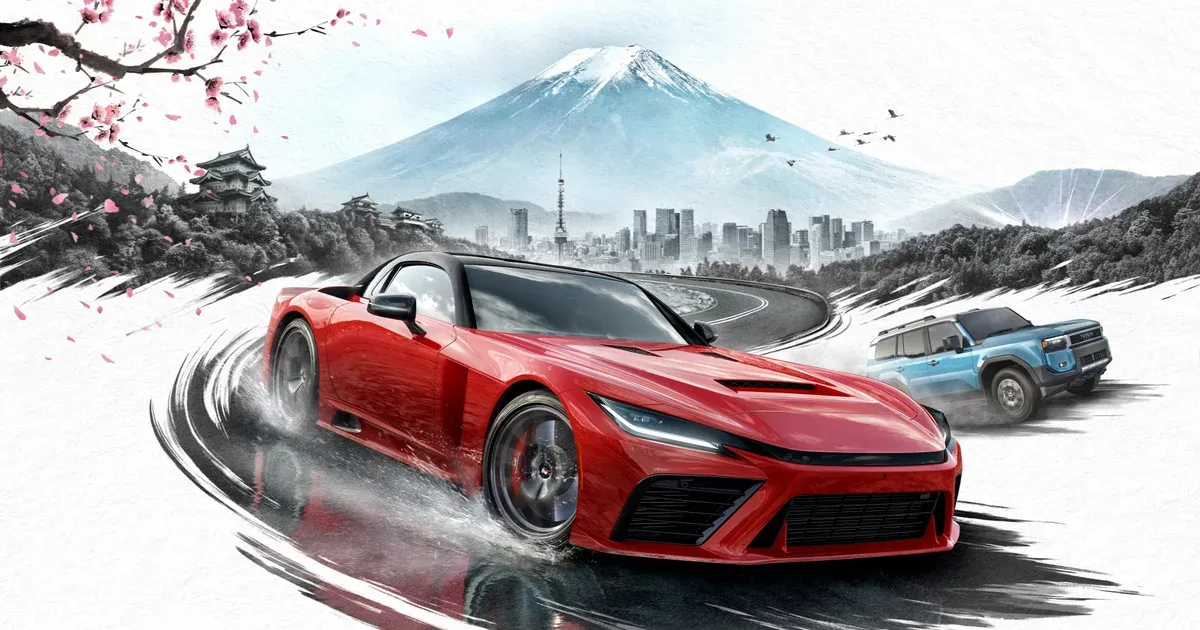
The fastest way to go sideways in Japan
Drifting sits at the heart of Forza Horizon 6. The game is set in Japan, the birthplace of touge culture, and Playground Games leaned hard into that. There’s an entire Drift Club story arc, dedicated drift zones scattered across the map, and a skill point system that rewards you for holding the longest, smoothest slides possible. Getting good at it takes the right car, the right settings, and an understanding of what actually makes a rear end break loose. This guide covers all three.

Drift zones reward long slides
What makes a good drift car in Forza Horizon 6?
The short answer: rear-wheel drive and a front-mounted engine. That combination naturally wants to kick the rear tires out under hard throttle, which is exactly what you need. AWD cars fight you at every step, and FWD is essentially a non-starter for serious drifting.
Beyond drivetrain layout, you want a car with enough torque to keep the rear wheels spinning through a corner without so much power that you immediately spin out. The sweet spot is roughly 800 to 1,000Nm of torque once upgraded. You can check engine placement and drivetrain type in the bottom-left corner of any car’s Autoshow listing before you buy.
Formula Drift cars are the exception to the build-from-scratch rule. These are purpose-built for sideways driving and arrive from the Autoshow already configured for drifting. They are, however, harder to find at budget prices.
info
Before spending credits on a dedicated drift build, search the “Find Tuning Setups” menu at any Horizon Festival site and filter by the “Drift” keyword. The community has already optimized setups for most popular RWD cars, and applying one takes seconds.
Best drift cars in Forza Horizon 6
Here are the top picks across different price ranges and classes, based on testing across multiple drift zones.
1994 Mazda MX-5 Miata (15,000 credits)
The cheapest genuinely good drift car on this list. The MX-5 is already lightweight and RWD from the factory, so upgrades go a long way. The Drift Club story missions even call it out directly: “the MX-5 loves to be sideways.” Any MX-5 or RX model works well, but the 1994 Miata is the most consistent across different drift zone types.
1985 Toyota Sprinter Trueno GT Apex (30,000 credits)
The most iconic drift car in the game for anyone who grew up watching Initial D. Katsuhiro Ueo won the 2002 D1 title in this car, beating more powerful machines through sheer precision. Community-made liveries already exist to recreate the famous black-and-white paint scheme. At 30,000 credits, it’s the best value for a dedicated drift project.

The AE86 is a drift icon
1989 Nissan Silvia K’s (40,000 credits)
This is the starter car you get during the prologue, which means you might already own it. The Silvia K’s starts underpowered, but it has a thriving aftermarket upgrade path that turns it into a proper sideways machine. Lightweight coupe, RWD, and a chassis that’s been an icon of the real-world drifting scene for decades.
2015 Lexus RC F (35,000 credits)
This one surprises people. The RC F looks like a grand tourer, not a drift car. But its high horsepower and torque figures, combined with RWD, make it a beast once tuned correctly. At 35,000 credits it sits at a price point where you can still afford meaningful upgrades.
Toyota GR Supra (45,000 credits)
More power than the MX-5 and a step up in aggression. Once you’re comfortable with the basics and want to push into faster, longer slides, the GR Supra rewards more confident throttle inputs. The extra power means more room to play with angle mid-corner.
Ford Mustang Dark Horse (59,000 credits)
American muscle cars are notoriously difficult to keep pointed straight, which makes them perfect for drifting. The Mustang Dark Horse is louder and angrier than anything on the JDM side of this list, and the sound when you pull a clean drift is genuinely satisfying. The Ford Mustang GT works as a cheaper alternative if the Dark Horse is out of budget.
1997 Nissan #777 240SX Formula Drift (150,000 credits)
The premium option. Formula Drift cars arrive drift-ready from the Autoshow, meaning you can skip straight to tuning rather than building from stock. The #777 240SX is the best of the Formula Drift lineup for most drift zones, though all Formula Drift cars are worth considering if you can afford them. At 150,000 credits it’s the most expensive car on this list by a significant margin.
info
Honorable mentions include any Nissan Skyline model, the Toyota GR86, the Mazda RX-8 R3, the DeBerti Toyota Tacoma TRD, and the Lotus Evija Forza Edition. The Lotus Evija is exceptional on tarmac but struggles on dirt drift zones. For off-road drifting, heavier cars like the Tacoma tend to be more stable.
Community tunes save hours of setup
How to drift in Forza Horizon 6
Having the right car gets you halfway there. The other half is technique and settings.
What settings do you need to turn off?
Before attempting anything, open your difficulty settings and disable four things:
Traction Control (this kills any slide attempt immediately)Stability Control (prevents you from holding extreme angles)Anti-Lock Braking (optional for beginners, but disabling it gives more aggressive weight transfer on braking)Assisted Steering (fights against the inputs you need for drifting)
Leaving any of these on is the single most common reason new players can’t get a drift going. The game’s default assists are designed to keep you on the road and pointing forward. Drifting requires the opposite.
Manual shifting: is it required?
Yes, practically speaking. Automatic transmission makes drifting significantly harder because you lose control over your RPMs. You rarely want to be above third gear, fourth at an absolute push, during a drift. Manual with Clutch unlocks the clutch kick technique, which is the most useful tool for low-power cars on slow corners.
What tires should you use?
Here’s the counterintuitive part: dedicated drift tires are not the best option for most builds. They have slightly more grip than ideal. Drag tires and snow tires have the lowest grip on asphalt, which means the rear end breaks loose more easily and you can maintain a slide with less effort. Test both on your specific car and see which produces more consistent results.
The standard handbrake drift
This is the baseline technique. Approach a corner at speed, apply the footbrake with the left trigger while turning into the corner. The weight shifts forward, the rear loses traction, and you enter oversteer. Once the back steps out, tap the e-brake to lock the rear wheels and extend the slide. Pulling the e-brake without the footbrake first is technically an E-drift rather than a proper weight-transfer drift, but it works fine for building confidence.
The clutch kick
Switch to Manual with Clutch in your settings. Enter a corner with your foot completely off the throttle, then simultaneously slam the accelerator and quickly press and release the clutch button. The sudden jolt of power to the rear wheels breaks traction instantly. This is the go-to technique for lower-power cars on tight, slow corners where you need an artificial burst of momentum to initiate a slide.
warning
Never attempt to drift during a competitive circuit race. Sliding burns forward momentum. Clean racing lines with maximum grip will always produce a faster lap time. Save the handbrake for drift zones and free roam.
Feathering the throttle
The most common mistake after initiating a drift is burying the throttle and immediately spinning out. Once the rear is loose, the throttle becomes a fine control input. Small pulses of gas keep the momentum going through the corner. If the car gets twitchy, ease off completely to let the rear settle, then get back on the throttle to continue the slide if the angle allows it.
Steering angle adjustments mid-drift
Shallow corners need counter-steering (turning slightly opposite to your initial direction) to keep the car sideways without changing direction too much. Tighter corners need you to steer in the same direction as your initial turn, and a tap of the e-brake can sharpen the angle further if that isn’t enough. Some corners need both methods in sequence.
The drift tuning baseline
Once you’re past the community tune phase and want to build your own setup, here’s a reliable starting point for any RWD build.
On engine swaps, resist the temptation to install the most powerful V12 available. Drifting needs a balance between horsepower and torque. Aim for roughly equal foot-pounds of torque and overall horsepower figures. Once the engine is sorted, add a dedicated 4-speed drift transmission, wider rear tires, and a rear spoiler. The rear spoiler and wider tires add just enough grip to stop full spins under heavy throttle mid-corner.
Where to practice
The Drift Club story arc, found near the Daikoku Parking Area on the island southeast of Tokyo City, is the best structured practice environment in the game. Six chapters with Jordan, each progressively harder, with three-star scoring that’s more forgiving than the open-world drift zones. Start here before touching the drift zones on the main map.
For open practice, the three drag strips (Irokawa Quarter Mile, Ito Half Mile, and Festival Kilometer) offer wide, empty tarmac with no traffic. The Kawazu Nanadaru Loop Bridge in the southwest corner of the map is a personal favorite for learning how to chain drifts through a long sweeping section.
To maximize points in drift zones, focus on long continuous slides rather than short repeated ones. The point multiplier climbs faster the longer you hold a drift and the higher your speed during it. On straight sections between corners, gentle left-right steering inputs keep your multiplier alive while you wait for the next bend.
info
On dirt drift zones, heavier cars outperform nimble sports cars. The Lotus Evija is a disaster on loose surfaces. The DeBerti Toyota Tacoma TRD handles off-road drifting far better because its weight naturally stabilizes the slide.
Ready to build your garage?
Drifting is one discipline. If you want to see how these cars stack up against the full roster, the complete Forza Horizon 6 car list and unlock guide covers all 550+ vehicles, top picks by discipline, and the cars worth chasing first. For the other end of the speed spectrum, the fastest cars in Forza Horizon 6 ranks the top-speed monsters from the 304 mph Hennessey Venom F5 downward. There’s also a full Forza Horizon 6 guides collection covering barn finds, starter car choices, and everything else you need to get the most out of Japan’s roads.