
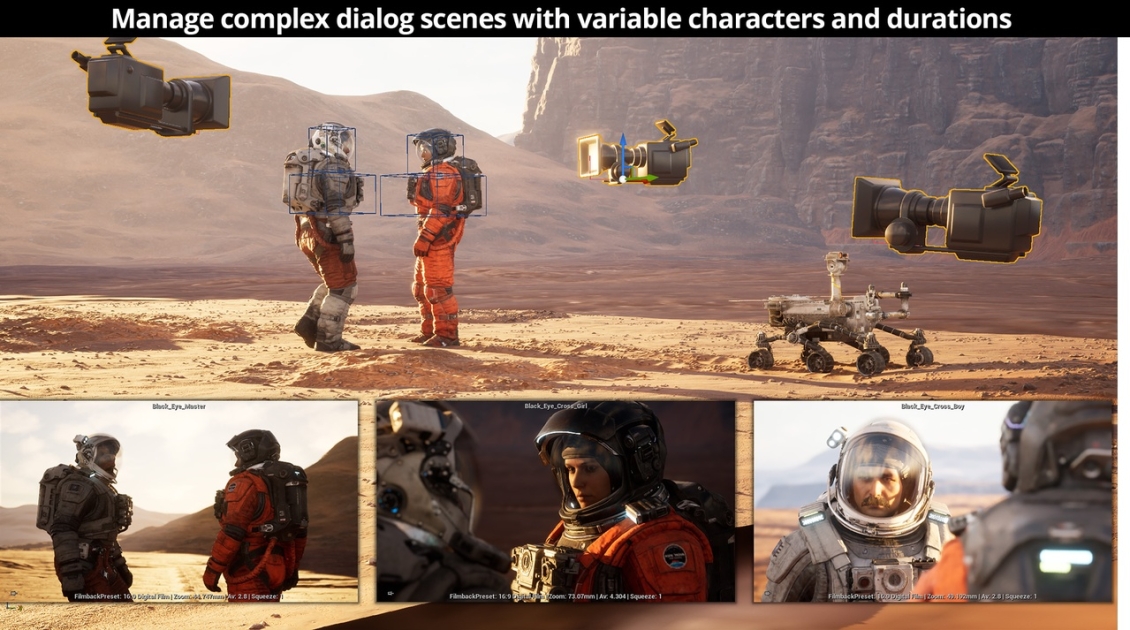
What problems in modern game production made you feel there was still a need for a new solution like Black Eye 2.0?
Adam Myhill, Co-Founder of Black Eye Technologies: The camera is the lens through which every design, animation, environment, and performance is experienced, yet they’re often horribly underserved parts of a project.
The problem is that camera work often falls into two difficult buckets. On the cinematic side, shots can be fragile because they are hand-authored around very specific animation, timing, layout, or character scale setups. Change any of those things, and shots break. Fully keyframed cameras can make blocking experimentation difficult and slow, and they force a certain order of operations. Camera work goes here in the pipeline.
On the gameplay side, camera systems usually start clean but then slowly become a pile of exceptions: special cases for combat, vehicles, interiors, bosses, dialogue, traversal, multiplayer, scripted moments, and so on. That huge, fragile ball-of-code camera, which can severely limit iteration time and is often a bug factory.
Black Eye 2.0 came from the belief that cameras should be more directable, more adaptive, and much faster to work with. You should be able to describe the shot you want, tune the behaviour, and keep iterating as the game changes. In real life, cameras have operators who look through the lens, and they follow the action. Something changes, and the cameras figure it out. We wanted to bring that real-life philosophy to CG. You think in behaviors and framing, not nodes and numbers.