
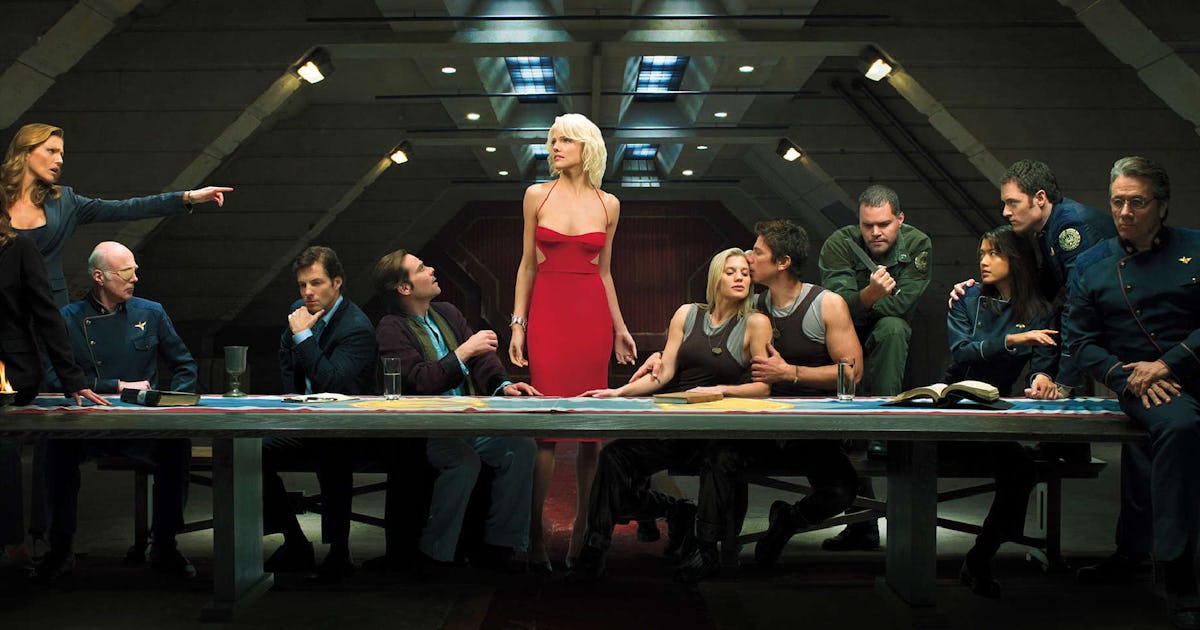
When people talk about the Golden Age of Television that followed in the wake of David Chase’s groundbreaking series The Sopranos, you’re likely to hear a few usual suspects touted as examples: Mad Men, Lost, Breaking Bad, etc. But there’s one show that deserves to be in the conversation just as much, even though its genre exterior might not fit with the grounded prestige of its contemporaries: 2003’s Battlestar Galactica. A reimagining of the short-lived, mostly forgotten 1978 series of the same name, the Battlestar revival was a monumental critical success that almost immediately overtook the cultural presence of its predecessor with just a two-part miniseries and four seasons.
With its complex, character-driven storytelling and nuanced approach to grand ideas like conflict and survival, Battlestar Galactica arguably paved the way for our contemporary era of smart sci-fi on television, continuing in the thought-provoking tradition of shows like Star Trek and going on to inspire works like The Expanse and For All Mankind. The show was so popular that it received a spin-off and broke out into other media, most notably video games – up until recently, the last release in the franchise was 2017’s Battlestar Galactica: Deadlock. Now, after almost a full decade, fans have gotten the chance to return to that universe, courtesy of Battlestar Galactica: Scattered Hopes, a brand new roguelite strategy game developed by Alt Shift. Those same devs (creative director Julien Cotret, lead game designer Simon Swinscoe, and lead narrative designer Martin Ringot) recently sat down with Inverse to talk about what it was like bringing the struggle between humanity and the Cylons to PC.
What was your first exposure to Battlestar Galactica prior to working on the game?
Julien Cotret: I first saw the show when it aired in 2003, 2004. And it was a revelation for me because it was the golden age of TV and it was one of the first sci-fi TV shows with a more complex narrative and character arcs. And it was drama-focused, which was quite different from everything we had before on sci-fi. So it was very interesting for me, and it has impacted a lot about how we approach video game design in the 20 years after the show.
Simon Swinscoe: We were working on another game before his game started. And just one year before the project started, I watched the whole show. And one year after, well, they said, “Oh, we’re going to work on Battlestar Galactica.” And I was like, “Oh, well, that’s great, because it was very good.”
Martin Ringot: I missed the show when it aired back then in 2004. And actually I was tasked to binge-watch the show when I was hired for the job. And so I have today’s perspective on the show and I was struck on how actual the problems are. Every issue you want, every interpersonal problem, all the drama can be translated in today’s situation. And well, that’s how you see how good a show can be and can remain over the years.
If you could boil it down to one element, what’s the thing that defines BSG in comparison to the sci-fi that came before and after it?
Cotret: I think it’s definitely the drama and the focus on characters. I think it’s partly due to the fact that it was a TV show and they had the time to build on it, and it came at the right time. In the early 2000s, it was the right time for a show with more leeway to go into deeper narratives. I saw Ronald D. Moore, the showrunner, had a lot of experience before doing that show and it was his intention to push the genre forward and do something that wasn’t done before because he worked on Star Trek. I love Star Trek too, but it’s less focused on the sci-fi and the lore and more focused on the characters.
Ringot: I think the characters are fascinating because they are very deep, very complex, and you can love to hate Gaius Baltar, for example. He’s a despicable character and yet you want to see how he gets away from everything he does during the show. You cannot plainly hate one character. There is not a villain. Every character has their own purpose and their own motivations and it’s something you see in later shows, but this one was very early in doing such a great job at this.
One of the touchstones that made Battlestar Galactica so acclaimed during its run was the nuanced and complex approach to characters, both heroes and villains.
SyFy
Were there any particular episodes from the show that served as a guiding light during the development process?
Cotret: Yeah, obviously the 33 episode, which is the one setting the tone of the show and make it so great and that resonate with people because it’s the one that has a lot of tension. It’s also a perfect setup for roguelite because they’re constantly pressured by the Cylons and they catch up, but they escape at the last second and they do it again and again.
Ringot: And there was also the Dirty Hands episode where there is a refinery ship that goes on strike and it raises the question of how everyone had a position into the fleet and how the fleet works as a microsociety that keeps existing despite the apocalypse that it’s all around them. And I think with the Election episode, I think it’s important because you can see that there is a society still living into this fleet and it struck me and it led me to build the system with the factions and stuff.
What made you feel like the heavy strategic roguelite approach was the best way to tackle Battlestar?
Cotret: I think it came naturally because, like I said, the main inspiration part was the 33 episode and all of it. We have the constant struggle for resources, but we don’t have the time for it, and we have the battles, we have to temporize and to slow down the Cylons before they jump. So the whole structure was mostly in that episode. And we knew that, to make it true to the show, we had to have another phase, like the resource management phase when you have to prioritize, and you have to know that every decision will make someone unhappy and have some consequences down the road.
Swinscoe: What was interesting is, like Julian said, the asymmetric battle where there’s a lot of Cylons, there’s not a lot of human squadrons and you still have to have this feeling that you win without destroying the enemy. So you win by fleeing. That was an interesting thing to do. And I think we made it because people are always happy when they survive, just surviving, not just destroying the fleet.
Knowing when to retreat from battle to tend to your fleet is both a key part of a successful run and a key part of how Alt Shift replicated the desperation of the show.
Microsoft Windows
What was it like crafting an experience that’s difficult but not too difficult while also evoking that survivalist, desperate underdog feeling of BSG?
Ringot: It was quite hard. It was first a game design challenge to find the right balance. And I think the game designers never stopped balancing the game and finding the right balance for the players not to feel lost or not to feel too powerful. And I think it works well because, well, currently I can’t beat the game, but-
Swinscoe: But I can, so it’s okay.
Ringot: He can, so we are on the right balance, I think. And we used narrative to explain that and to make that clear and to focus on every part of the narrative that is about survival, about people being desperate.
Swinscoe: The balancing was a lot of work for the designers and we had to work with Martin as well because we have the combat and the fleet management and both of these parts intertwined together and they have an effect on each other. But it’s a roguelite, it has to be difficult by definition. It’s okay to die. When you die, it’s not for nothing. You did something, you unlock new stuff and things. And even during the run after each combat, sometimes you lose some shapes or things like that, but you have a blessing system, which is kind of a reward after each combat. So losing something doesn’t feel like it’s a total failure and it’s impossible to get back.
What was the balance like between paying homage to the 2004 series in a way that will make fans happy while also doing a distinct spin on the BSG timeline?
Cotret: Well, one of the most important goals we had when starting to work on the game was to make a good roguelite. And to do so, we tried to find the right balance of being clear with the canon, but then we wanted to be free to explore everything we wanted to do and to make the design and the gameplay as interesting and fun as possible.
And it meant that we discussed fleets, and all the stories that haven’t been told in the show, and most of them end up in death because they were caught by the Cylons and they didn’t make it, but it was still stories worth telling in a game. So that was the framework we tried to have: to have a lot of freedom, while still being true to the show and to ourselves too, because we are fans of both the game and the IP.
Battlestar Galactica: Scattered Hopes is now available on PC.Learn Something New Every Day