
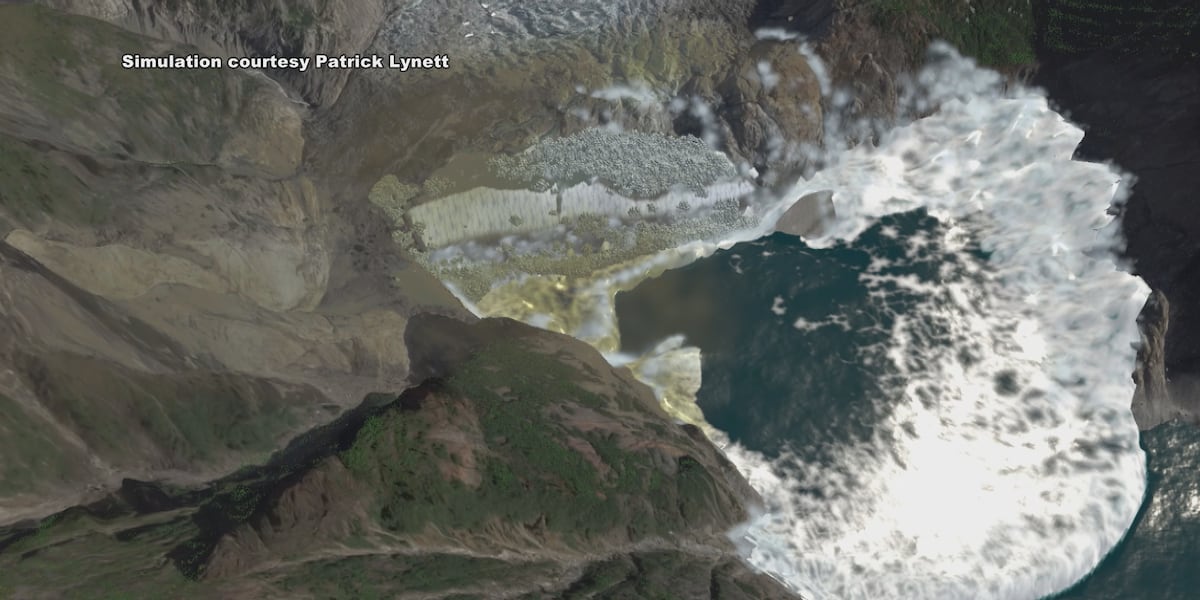
ANCHORAGE, Alaska (KTUU) – An engineering professor outside of Alaska has created a simulation and video game that can help people understand the scale of August 2025’s Tracy Arm landslide and tsunami in Southeast Alaska in real-time.
The massive landslide fell from the fjord wall in Tracy Arm in the early morning hours of August 10, 2025. It created an approximately 328-foot tsunami wave that pushed water about 1,578 feet up the fjord wall, according to a new research article.
The nearly 1,600-foot run-up rivals the size of the world’s tallest tsunami, which was in Lituya Bay, Alaska in 1958.
There have been no reports of injuries even though some people who were many miles away from the landslide reported seeing waves from the tsunami, but a scientist detailed his experience seeing the destruction just days after it happened.
Patrick Lynett, a USC civil engineering professor, said when it comes to natural disasters, training people how to react is important, and one way to do that is through digital work like the simulation and video game he created that depicts what happened.
“It’s really hard to convey the scale of these events. But maybe if we could create digitally, so that you can imagine you there during the event, you’ll have some idea of the tremendous scale of the landslide,” Lynett said.
Part of that simulation allows the person playing the video game to try to outride the tsunami on a jet ski.
“It is state-of-the-art physics,” he said of the simulation. “You can interact with the scene. You can fly through it. One of the ways you can interact with it is to hop on a jet ski and ride around on the water right in front of the landslide.”
But there’s a caveat.
“The particularly compelling part of that is the jet ski can only go 70 miles an hour, which for a jet ski is quite fast. But the wave is so big, and it moves so quickly that even though the jet ski is moving at 70 miles an hour, the wave is moving at close to 100 and it overtakes the jet ski. There’s no way to escape the wave if you’re on the water,” Lynett said.
He said the game is mostly a simulation, but there are also “Easter egg components.”
“You can explore the scene and there are markers throughout the scene which tell you a little bit about Tracy Arm, which tell you information about the landslide, Sawyer Glacier, the tsunami itself. So, it’s meant to be an experience of the tsunami, but at the same time, teach you about the environment and the event,” he said.
To make something like this, he said he first needed the physics of the event itself to model the landslide and the wave it generated. That information came from a paper nearly 20 people from the science community co-authored, including Lynett.
“You can’t do that with AI. You can’t do that with graphic artistry. You have to do that with modeling them the way we did when we create tsunami inundation zones. It’s the same models that we use. It’s engineering level. It’s design level physics,” he said.
From there, he said graphics artistry is needed. And then all of the scene components can be brought together to make the game playable.
Lynett visited Tracy Arm about two months after the landslide and tsunami.
“It is still very hard for me to believe how high the landslide was. So, the top of the landslide was 3,000 plus feet above the water. The wave itself went 1,500 feet up the mountainside. I saw these things, and it’s hard for me to believe that it happened,” he said. “So, for me, that is the most incredible aspect of this, the level of energy that was imparted onto the water. And it’s the hope that the video game experiences and the animations that we created helped to feel the size of that tsunami.”
He has made similar simulations for things like tsunami evacuation training, but he said he has not done something like this for a tsunami.
“The Tracy Arm event was so incredibly large that conveying its scale with the types of graphics or the types of stories that we usually use doesn’t work. It’s not sufficient,” he said.
The only way to get the true feel of the scale is to be standing on the shoreline having the nearly 400-foot wall of water coming at you, he said.
“You don’t have intuition of what that looks like. The only way to provide that picture is to create it digitally and let people imagine that they were there,” he said.
“We don’t want to wait until the disaster happens to try to save people’s lives. So, if we can allow people to understand what these events are like, what would happen if you were near it, maybe they react better. Maybe they behave better. Maybe they prepare a little bit differently when they go into these places so that the event does not turn into a disaster,” he said.
The game is not yet available to the public, but he is working on making it available on Steam for free, he said.
See a spelling or grammar error? Report it to web@ktuu.com
Copyright 2026 KTUU. All rights reserved.